
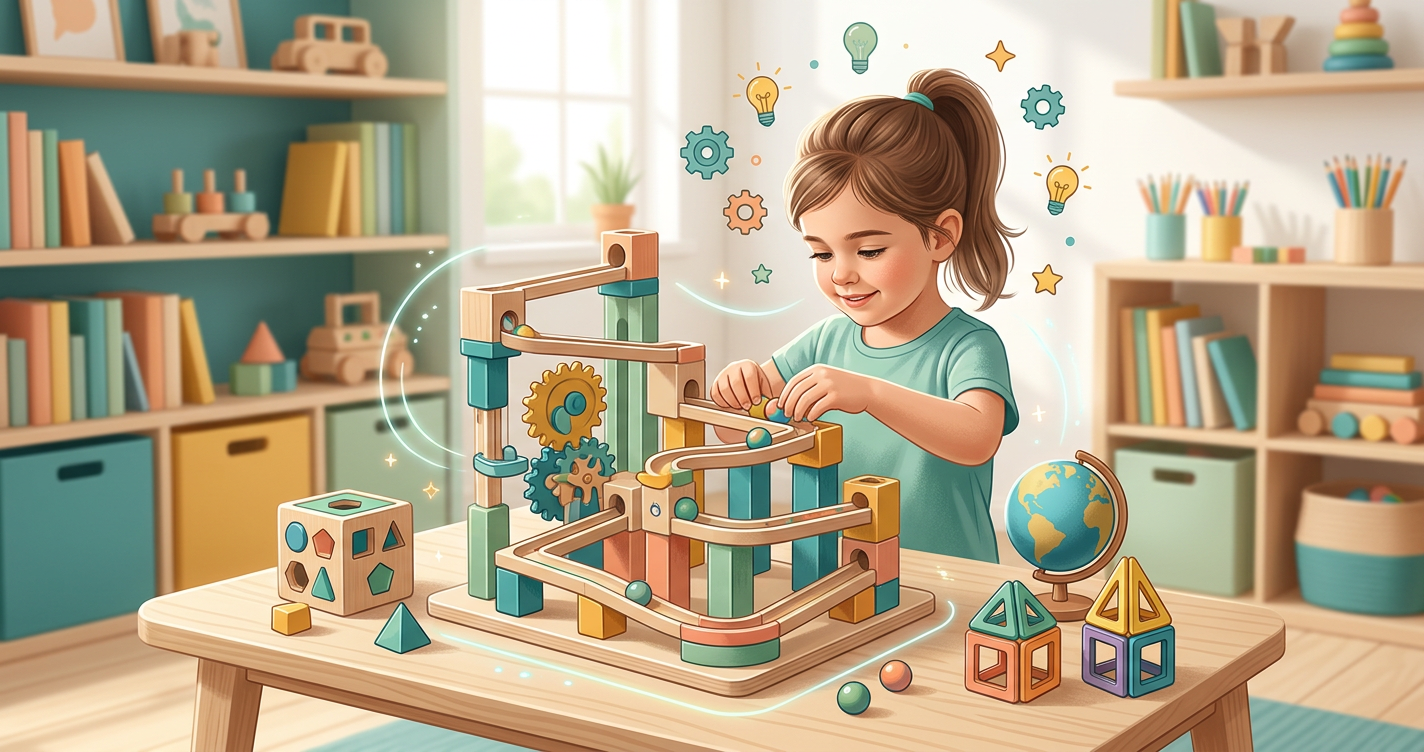
Unlocking Genius: How Educational Toys Fuel Cognitive Development in Children
Every parent marvels at the incredible speed with which children learn and grow. From their first word to their first wobbly steps, each milestone is a testament to the astonishing power of a developing mind. But what if we told you that one of the most potent tools for nurturing this development isn't a textbook or a rigid lesson plan, but something far more enchanting: play? And within the realm of play, educational toys stand out as powerful allies, silently shaping the architects of tomorrow. This isn't just about fun and games; it's about laying crucial foundations for cognitive development that will benefit your child for a lifetime.
In this comprehensive guide, we'll dive deep into the fascinating science behind play, explore what truly defines an “educational toy,” and reveal how these seemingly simple objects become catalysts for problem-solving, creativity, language acquisition, and essential STEM skills. Get ready to discover how you can empower your child's brain development, one playful moment at a time! this excellent toy product
Beyond Fun and Games: The Science of Play
For centuries, play was often dismissed as a mere pastime, a way for children to burn off energy. However, modern neuroscience and child psychology have unequivocally demonstrated that play is anything but trivial. It is, in fact, the brain's preferred method of learning, hardwired into our very DNA. When children play, their brains are buzzing with activity, forming new neural connections at an astonishing rate.
Research shows that engaging in various forms of play stimulates different parts of the brain, enhancing everything from memory and attention to emotional regulation and social skills. Think of it as a workout for the mind. During imaginative play, children practice problem-solving, negotiate roles, and develop empathy. With constructive play, they learn about cause and effect, spatial reasoning, and persistence. This isn't just theoretical; studies using neuroimaging reveal increased brain activity in areas associated with executive functions – planning, decision-making, and self-control – during playful activities. Play provides a safe, low-stakes environment for children to experiment, fail, and try again, building resilience and a love for learning that extends far beyond the playroom.
What Exactly Are "Educational Toys"?
The term "educational toy" can sometimes conjure images of dull, didactic objects designed solely for rote memorization. However, the modern understanding is far richer and more nuanced. An educational toy isn't just something that teaches the alphabet or numbers; it's any toy that stimulates a child's natural curiosity, encourages exploration, and supports specific developmental milestones. The best educational toys are often those that are open-ended, allowing for multiple ways to play and learn, rather than dictating a single correct outcome.
They are tools that invite children to experiment, discover, and think critically. This broad definition means that a simple set of wooden blocks can be just as educational as a complex coding robot, depending on how it engages a child's mind. Examples span a wide range: puzzles that challenge logical thinking, building sets that foster engineering skills, art supplies that unleash creativity, role-play items that develop social-emotional intelligence, and science kits that introduce basic scientific principles. The key is engagement and the opportunity for growth, not just instruction.
Fueling Cognitive Growth: How Educational Toys Make a Difference
Educational toys are not just passive objects; they are active participants in a child's cognitive journey. Here’s how they specifically contribute to crucial areas of brain development:
Problem-Solving and Critical Thinking
From the simplest shape sorter to intricate jigsaw puzzles and strategy games, educational toys are masters at cultivating problem-solving skills. Children learn to identify a challenge, strategize potential solutions, and then test them out through trial and error. This iterative process builds logical reasoning and persistence. Building blocks, for instance, aren't just for stacking; they teach balance, stability, and spatial awareness as children figure out how to construct a tower that won't topple.
Language and Communication Skills
Toys like puppets, dollhouses, storytelling cards, and alphabet puzzles are fantastic for fostering language development. They encourage children to create narratives, expand their vocabulary, and practice expressing themselves. When children engage in imaginative play with these toys, they often narrate their actions, take on different voices, and interact with others, all of which are crucial for developing strong communication skills and understanding social cues.
Spatial Reasoning and Motor Skills
Construction toys, interlocking gears, modeling clay, and even simple drawing tools significantly enhance both fine and gross motor skills, which are intimately linked to cognitive processing. Manipulating small pieces improves dexterity and hand-eye coordination. Understanding how different parts fit together to create a whole object develops spatial reasoning – the ability to think about objects in three dimensions. These skills are foundational not only for physical tasks but also for abstract thinking and mathematical concepts.
Creativity and Imagination
Open-ended toys such as art supplies, dramatic play costumes, and simple natural materials like sand or water are unparalleled for sparking creativity. They provide a blank canvas for children to invent worlds, characters, and stories, allowing their imaginations to soar. This type of play encourages divergent thinking – the ability to come up with multiple solutions to a problem – which is a hallmark of innovative thinkers. It also helps children process emotions and develop empathy as they step into different roles.
STEM Foundations (Science, Technology, Engineering, Math)
Many educational toys are specifically designed to introduce STEM concepts in an accessible and engaging way. Science kits explore basic physics and chemistry, coding robots teach foundational programming logic, and building sets exemplify engineering principles. Toys that involve counting, sorting, measuring, or pattern recognition lay early mathematical foundations. By making these complex subjects tangible and fun, educational toys demystify STEM fields and ignite a lifelong interest in discovery and innovation.
Choosing the Right Educational Toys: A Parent's Guide
With a vast array of educational toys available, selecting the right ones can feel overwhelming. Here are some friendly, evidence-based tips to guide your choices:
- Age-Appropriateness: Always consider your child's developmental stage. A toy too simple will bore them; one too complex will frustrate them. Look for toys that offer a gentle challenge.
- Open-Ended Potential: Prioritize toys that can be used in multiple ways, encouraging creativity and sustained interest. Blocks, art supplies, and simple dolls often fit this bill perfectly.
- Durability and Safety: Choose well-made toys from non-toxic materials that can withstand enthusiastic play and meet safety standards.
- Align with Child's Interests: If your child loves dinosaurs, find educational toys with a dinosaur theme. Engagement is paramount for effective learning.
- Quality Over Quantity: A few well-chosen, versatile educational toys are far more beneficial than a room full of single-function gadgets.
Maximizing the Learning Potential: Beyond the Toy Itself
While educational toys are fantastic tools, their true power is unleashed when coupled with thoughtful interaction. Remember, the toy is a prop; the learning happens through engagement and exploration.
- Play With Them: Join your child in their play. Ask open-ended questions ("What do you think will happen if...?"), offer suggestions, and model problem-solving. This interaction enriches the experience and strengthens your bond.
- Create a Supportive Environment: Provide a designated play space that is safe, accessible, and free from excessive clutter. Rotate toys to keep things fresh and exciting.
- Allow for Exploration and "Failure": Resist the urge to constantly correct or show your child the "right" way. Let them experiment, make mistakes, and discover solutions independently. This builds resilience and self-confidence.
- Observe and Extend Play: Pay attention to how your child is playing. What concepts are they exploring? You can then introduce related ideas or materials to deepen their learning organically.
Conclusion
The journey of cognitive development is one of the most exciting adventures a child undertakes, and as parents, we have the incredible privilege of guiding them along the way. By embracing the profound power of play and strategically incorporating educational toys into their world, we're not just providing entertainment; we're actively nurturing their brains, building foundational skills, and fostering a lifelong love for learning.
So, next time you watch your child intently building a tower, meticulously sorting shapes, or losing themselves in a world of imaginative play, remember: they're not just playing. They're learning. They're growing. They're unlocking their genius, one playful moment at a time. Embrace the magic, encourage the exploration, and watch your child flourish into the brilliant individual they are destined to be!