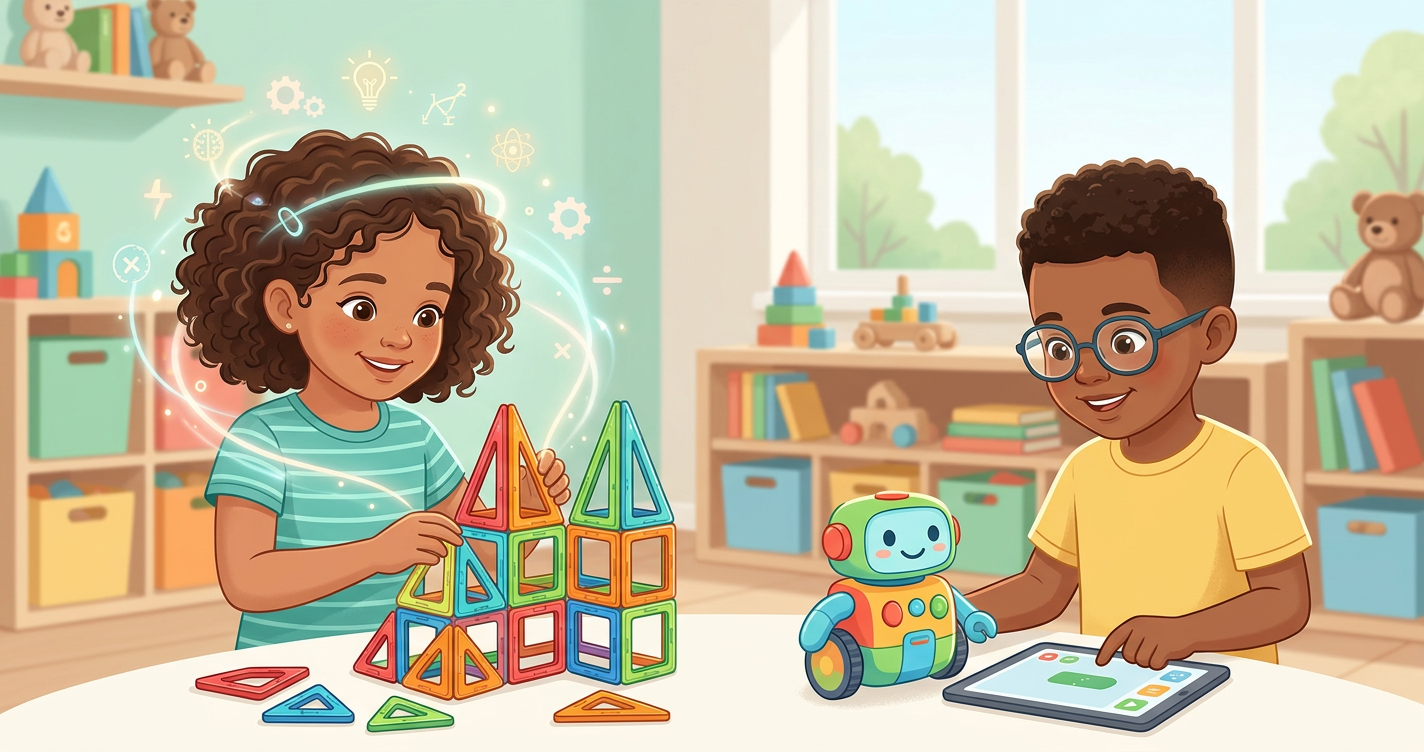
As parents, we all want to give our children the best start in life, nurturing their curiosity and preparing them for a future filled with possibilities. In today's rapidly evolving world, that often means thinking beyond traditional ABCs and 123s. This is where STEM toys come into play, offering a powerful, playful pathway to unlocking your child's full potential from their earliest years.
You might associate STEM – Science, Technology, Engineering, and Mathematics – with complex concepts or older students. But the truth is, the foundational skills for STEM thinking begin developing long before kindergarten. Educational toys specifically designed with STEM principles in mind can ignite a lifelong love for learning, critical thinking, and problem-solving in toddlers and preschoolers. Join us as we explore the incredible benefits of integrating STEM toys into your young child's world, helping them build bright minds, one playful discovery at a time. this excellent toy product
What Exactly Are STEM Toys? (And Why They're Not Just for Older Kids!)
At its core, STEM is an interdisciplinary approach that encourages children to think critically, experiment, and innovate. STEM toys are simply playthings that naturally promote these skills. They aren't necessarily high-tech gadgets (though some can be!); often, they are deceptively simple tools that invite open-ended exploration and discovery.
Think about a set of classic building blocks. When a child stacks them, they are engaging in engineering (structure, balance), mathematics (counting, patterns), and even a bit of physics (gravity, stability). When they discover what happens if they try to build too high without a wide base, they’re conducting a scientific experiment! STEM toys for young children are designed to be hands-on, engaging their senses and encouraging them to ask 'what if?' and 'why?' questions, fostering a natural curiosity about how the world works.
The Incredible Benefits of STEM Toys for Young Children
Introducing STEM toys early on offers a wealth of developmental advantages:
Fostering Critical Thinking and Problem-Solving Skills
Perhaps the most significant benefit of STEM toys is their ability to cultivate critical thinking. Whether it's figuring out how to connect two pieces of a puzzle, making a tower stand without toppling, or understanding cause and effect with a simple gear set, children are constantly engaging their brains to analyze situations and devise solutions. This repeated practice builds neural pathways essential for higher-order thinking.
Boosting Fine Motor Skills and Hand-Eye Coordination
Many STEM toys require manipulation, sorting, stacking, and connecting small pieces. These actions are fantastic for developing fine motor skills – the coordination of small muscles in the hands and fingers. Improved dexterity and hand-eye coordination are crucial for tasks like writing, drawing, and self-care activities as they grow.
Encouraging Early Math and Science Concepts
Without even realizing it, children playing with STEM toys are internalizing fundamental math and science principles. They learn about shapes, sizes, patterns, counting, measurement, gravity, balance, and even simple physics. A child stacking blocks might intuitively learn about stability and weight distribution, while a toddler playing with a water table explores concepts like volume and buoyancy.
Sparking Creativity and Imagination
Contrary to popular belief, STEM is not just about logic; it's also about innovation. Many STEM toys are open-ended, meaning there's no single 'right' way to play. This encourages children to use their imagination to build new structures, invent scenarios, and experiment with different possibilities. Magnetic tiles, for instance, can become a castle, a rocket ship, or an abstract sculpture, all depending on the child's creative vision.
Developing Language and Communication Skills
As children play with STEM toys, they often narrate their actions, describe their creations, or ask questions. Parents and caregivers can enhance this by asking open-ended questions like, 'What are you building?' or 'How did you make that stand up?' This interaction promotes vocabulary development, sentence structure, and the ability to articulate thoughts and ideas, which are vital for overall communication.
Age-Appropriate STEM Fun: What to Look For
Choosing the right STEM toys means considering your child's developmental stage. What excites a toddler might frustrate a preschooler, and vice-versa.
STEM Toys for Toddlers (1-3 years)
For this age group, focus on sensory exploration, cause-and-effect, and basic manipulation. Toys should be sturdy, safe (no small choke hazards), and easy for little hands to grasp.
- Stacking and Nesting Toys: Cups, rings, or blocks teach size differentiation, sequencing, and spatial reasoning.
- Shape Sorters: Introduce geometric shapes and problem-solving through trial and error.
- Sensory Bins: Filled with rice, pasta, water, or sand, combined with scoops and small toys, these encourage exploration and early scientific observation.
- Simple Puzzles: Chunky knob puzzles or basic form boards help with shape recognition and fine motor skills.
- Cause-and-Effect Toys: Buttons that make sounds, levers that move objects, or simple ramps for balls.
STEM Toys for Preschoolers (3-5 years)
As children grow, they're ready for more complex challenges that encourage planning, design, and early engineering principles.
- Building Sets: LEGO Duplo, Magna-Tiles, or wooden blocks allow for more elaborate constructions, promoting spatial awareness and architectural thinking.
- Simple Science Kits: Magnifying glasses, prism sets, or beginner microscope kits to explore the natural world.
- Early Engineering Kits: Gears, simple machines, or construction sets with nuts and bolts introduce basic mechanical principles.
- Screen-Free Coding Toys: Robots that can be programmed with physical buttons or cards introduce computational thinking and sequencing without screens.
- Pattern Blocks and Geoboards: Excellent for exploring geometry, fractions, and spatial relationships in a hands-on way.
Making STEM Play Engaging and Effective
It's not just about the toy; it's about how your child interacts with it and how you engage with them.
- Join in the Fun (But Don't Take Over!): Sit with your child, ask questions, and show interest in their creations. Your presence can be incredibly encouraging.
- Ask Open-Ended Questions: Instead of 'What color is that?', try 'What do you think would happen if...?' or 'How did you figure that out?' This encourages deeper thinking.
- Embrace Mistakes as Learning Opportunities: If a tower falls, help them analyze why. 'Oh, it fell! Why do you think that happened? What could we try differently next time?'
- Connect to Real-World Experiences: Point out real-life examples of what they're playing with. 'Look, our bridge is like the one you built with your blocks!'
- Follow Their Lead: Let your child direct the play. Their interests are the best guide for sustained engagement and genuine learning.
Beyond the Toy Box: Integrating STEM into Everyday Life
STEM learning isn't confined to specific toys. You can weave STEM principles into your daily routine:
- In the Kitchen: Cooking involves measuring (math), observing changes (science), and following sequences (engineering/coding).
- Outdoors: Explore nature – watch bugs, plant seeds, talk about weather patterns. These are all natural science lessons.
- Building Forts: A classic childhood activity, fort-building is a fantastic exercise in engineering and spatial reasoning.
- Sorting Laundry: Sorting by color or type is an early lesson in classification and pattern recognition.
Choosing Quality: What to Consider When Buying STEM Toys
When selecting STEM toys, keep these points in mind:
- Durability and Safety: Ensure toys are made from non-toxic materials, are well-constructed, and appropriate for your child's age to prevent hazards.
- Open-Ended Play Potential: Look for toys that can be used in multiple ways, encouraging creativity and longevity.
- Age-Appropriateness: A toy that's too complex can lead to frustration, while one that's too simple might quickly lose interest.
- Material: Consider sustainable and eco-friendly options when possible.
By thoughtfully choosing and engaging with STEM toys, you're not just providing entertainment; you're investing in your child's cognitive development, fostering their innate curiosity, and equipping them with essential skills for a future that will undoubtedly demand innovation and adaptability. So, let's play, explore, and build those bright minds together!