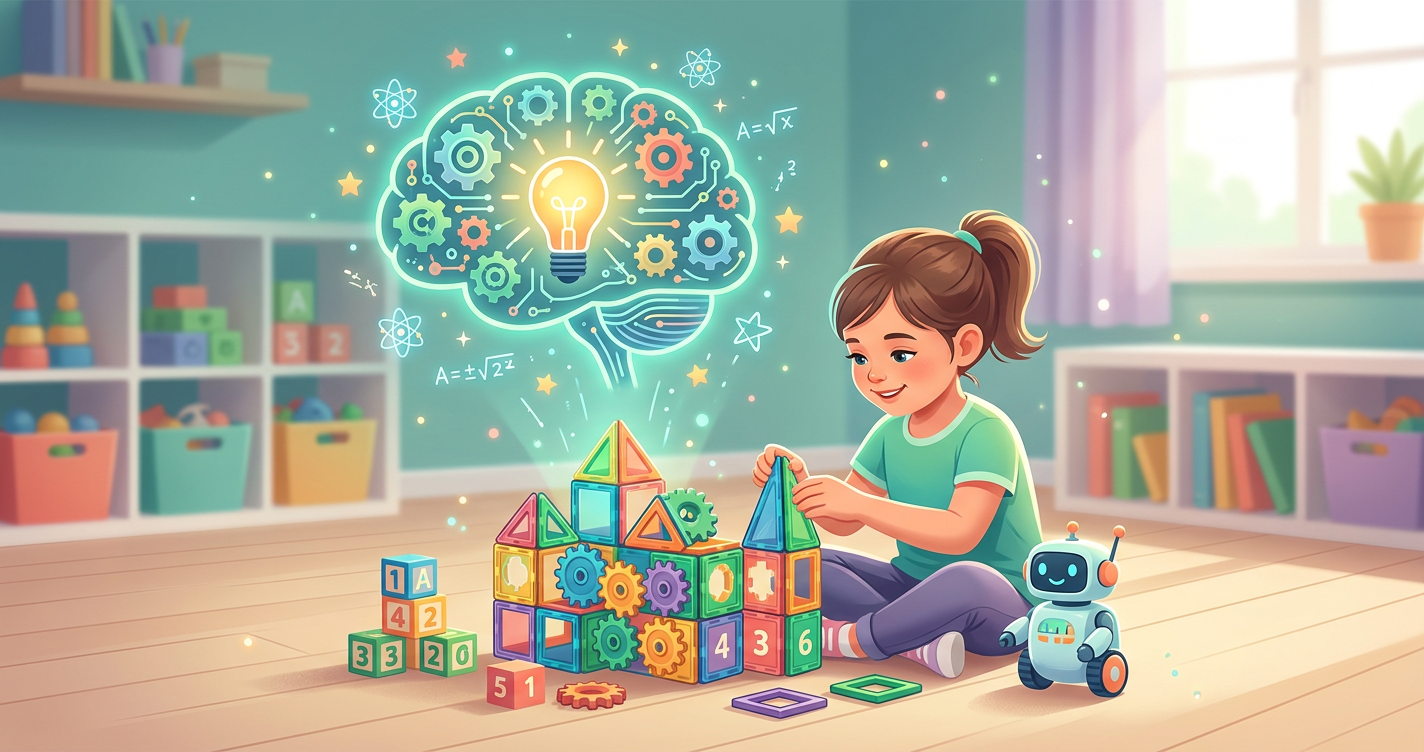
As parents and educators, we constantly seek ways to nurture our children's potential, preparing them for a world that's rapidly evolving. In this quest, one powerful tool often stands out: play. But not just any play – we're talking about the magic of STEM toys. These aren't just another set of playthings; they are gateways to discovery, innovation, and critical thinking, laying foundational skills that will serve our little ones for a lifetime. If you've ever wondered how to ignite a lifelong love for learning in your child, especially in the crucial early years, then understanding the profound impact of STEM toys is your next step.
What Exactly Are STEM Toys? Beyond Just 'Educational'
The acronym STEM stands for Science, Technology, Engineering, and Mathematics. While many toys are educational, STEM toys are specifically designed to introduce and reinforce concepts from these four interconnected disciplines in an engaging, hands-on way. They go beyond rote memorization, encouraging children to explore, experiment, and problem-solve. this excellent toy product
Think building blocks that teach balance and structure (Engineering), simple circuit kits that illuminate lights (Technology/Science), magnetic tiles that demonstrate spatial reasoning (Math/Engineering), or even a basic microscope that reveals the wonders of nature (Science). The key is active engagement and experiential learning, where children aren't just consumers of information but active creators and discoverers.
The Playful Path to Brilliance: Why STEM Toys Are Crucial for Young Minds
The early years (birth to age eight) are a period of incredible brain development. During this time, children are natural scientists, constantly observing, questioning, and experimenting with their surroundings. STEM toys harness this innate curiosity, transforming playtime into powerful learning opportunities. Research consistently shows that early exposure to STEM concepts through play can significantly impact a child's cognitive development, creativity, and problem-solving abilities.
They teach children that it's okay to try, fail, and try again – building resilience and a growth mindset. Instead of simply providing answers, STEM toys encourage children to ask 'how' and 'why,' fostering a deeper understanding of the world around them.
Building Blocks of Success: Core Skills Fostered by STEM Play
Nurturing Problem-Solving and Critical Thinking
From figuring out how to make a tower stand taller without toppling to designing a marble run, STEM toys inherently present challenges that require children to think critically and devise solutions. They learn cause and effect, test hypotheses, and adapt their strategies, developing vital analytical skills.
- Example: A child building with LEGOs learns about stability and structure through trial and error.
- Evidence: Studies highlight that open-ended play with construction toys significantly improves spatial reasoning and problem-solving skills in preschoolers.
Sparking Creativity and Innovation
While often associated with logic, STEM also thrives on creativity. Engineering isn't just about following instructions; it's about imagining new solutions. Science isn't just about facts; it's about innovative exploration. STEM toys provide the tools for children to invent, design, and express their unique ideas, fostering a spirit of innovation from a young age.
- Example: Using magnetic tiles to build an imaginative castle or a futuristic spaceship.
- Evidence: Play-based learning environments that incorporate STEM elements are shown to boost divergent thinking, a key component of creativity.
Demystifying Early Math and Science Concepts
Without even realizing it, children playing with STEM toys are engaging with fundamental mathematical and scientific principles. They learn about gravity, balance, measurement, patterns, shapes, and numbers in a concrete, experiential way that's far more effective than abstract lessons.
- Example: Counting gears, understanding symmetry with pattern blocks, or observing plant growth with a child-friendly science kit.
- Evidence: Research indicates that children who engage in early math and science activities through play demonstrate stronger academic performance later in these subjects.
Enhancing Fine Motor Skills and Persistence
Manipulating small parts, fitting pieces together, or carefully conducting a simple experiment all contribute to the development of fine motor skills and hand-eye coordination. Beyond physical dexterity, the process of working through a challenge, even a small one, teaches persistence and resilience – invaluable life skills.
- Example: Connecting circuits in a snap-together electronics kit or carefully balancing weights on a scale.
- Evidence: The American Academy of Pediatrics emphasizes the role of play in developing executive function skills, including self-regulation and persistence.
Navigating the World of STEM Toys: Age-Appropriate Choices
The beauty of STEM toys is their versatility across age groups. Here’s a quick guide to help you choose the best fit for your child:
For Our Littlest Explorers (Toddlers 1-3)
Focus on sensory exploration and basic cause-and-effect. Think large building blocks, shape sorters, stacking toys, simple puzzles, and water play sets. These introduce concepts like size, shape, balance, and gravity.
For Budding Innovators (Preschoolers 3-5)
This is when imagination truly takes flight. Magnetic tiles, simple gears, construction sets, introductory coding robots (screen-free options are great!), and basic science experiment kits are fantastic. These toys encourage more complex building, pattern recognition, and early logical thinking.
For Curious Young Scientists (Early Elementary 5-7)
Children in this age group are ready for more structured challenges. Think robotics kits, advanced building sets, chemistry sets for kids, engineering kits, and telescopes or microscopes. These toys deepen their understanding of scientific principles and engineering design.
Maximizing the Magic: Tips for Parents and Caregivers
Simply providing STEM toys isn't enough; your involvement can amplify their impact:
- Be a Facilitator, Not a Director: Allow your child to lead the play. Offer suggestions, but resist the urge to take over or provide immediate answers. Let them struggle a little; that's where true learning happens.
- Ask Open-Ended Questions: Instead of, "What color is this?" try "What do you think would happen if...?" or "How could we make this stronger?" This encourages critical thinking.
- Connect to Real Life: Point out how STEM concepts appear in everyday life. "Look, the bridge uses triangles, just like your building!" or "That ramp helps the car go faster, just like our experiment."
- Embrace Mistakes: Frame failures as learning opportunities. "That didn't work, but what did we learn? What can we try differently next time?"
- Create a STEM-Friendly Environment: Dedicate a space for exploration, keep materials accessible, and celebrate their discoveries, no matter how small.
Conclusion: Invest in Their Future, One Playtime at a Time
Investing in educational STEM toys is more than just buying another plaything; it's an investment in your child's future. It's about empowering them with the skills to think critically, solve problems creatively, and approach challenges with confidence. By embracing the power of play through STEM, we're not just preparing children for careers in science or technology; we're nurturing well-rounded individuals who are curious, innovative, and ready to navigate the complexities of the 21st century. So, go ahead, explore the wonderful world of STEM toys, and watch your child's brilliance unfold, one playful discovery at a time!