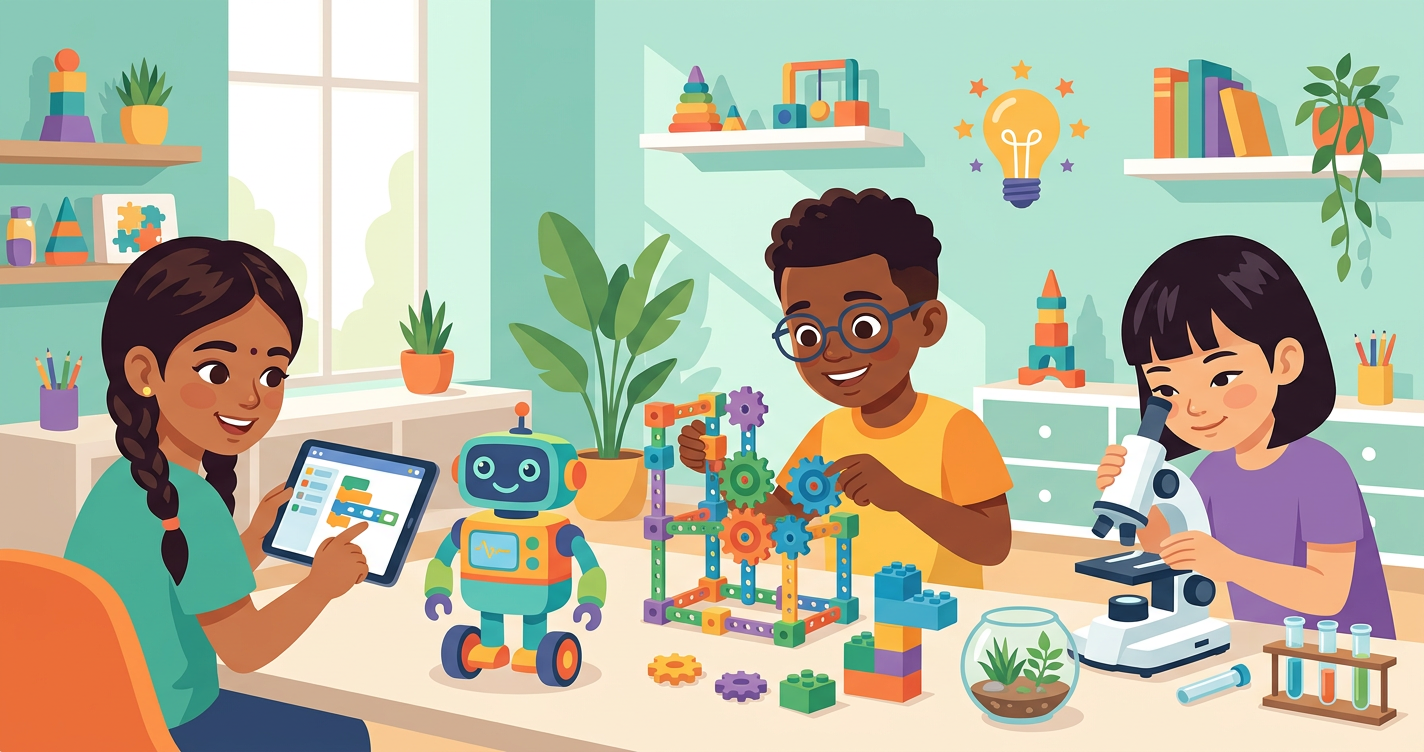
In today's rapidly evolving world, preparing children for the future means equipping them with more than just basic knowledge. It means fostering a love for discovery, a knack for problem-solving, and the resilience to tackle complex challenges. This is where STEM — Science, Technology, Engineering, and Mathematics — education truly shines, and it starts much earlier than you might think. For elementary-aged children, the most engaging and effective gateway into the world of STEM isn't a textbook; it's through the magic of educational toys.
You might be wondering, are these just fancy gadgets, or do they truly make a difference? Research consistently shows that early exposure to STEM concepts through play can significantly boost a child's cognitive development, critical thinking skills, and even their confidence. As parents and educators, we have a unique opportunity to lay a strong foundation for future success, simply by choosing the right toys. Let's explore why STEM toys are not just fun, but absolutely essential for our elementary-aged innovators. this excellent toy product
What Exactly Are STEM Toys? More Than Just Gadgets!
Before we dive into the benefits, let's clarify what we mean by 'STEM toys.' These aren't just any toys; they are specifically designed to introduce and reinforce concepts from Science, Technology, Engineering, and Mathematics in an interactive, hands-on way. They transform abstract ideas into tangible experiences, making learning an adventure rather than a chore.
- Science: Think chemistry sets that bubble and fizz, anatomy models, or kits that explore weather patterns and plant growth.
- Technology: This can range from simple circuit boards and snap-together electronics to beginner coding robots and digital drawing tablets.
- Engineering: Building kits of all kinds – from intricate LEGO sets and magnetic tiles to K'nex and construction challenges that require structural integrity.
- Mathematics: Puzzles that teach geometry, games that involve counting and pattern recognition, or logic challenges that build foundational mathematical reasoning.
The beauty of STEM toys lies in their ability to integrate these disciplines, showing children how they connect and interact in the real world. They encourage experimentation, hypothesis testing, and iterative design – all crucial skills for future innovators.
Beyond the Fun: Core Benefits of Engaging with STEM Toys
While the immediate joy a child experiences with a new STEM toy is evident, the long-term benefits are truly profound. Experts in child development and education consistently highlight several key advantages:
Cultivating Critical Thinking & Problem-Solving Skills
Perhaps the most significant benefit of STEM toys is their power to transform children into natural problem-solvers. Whether it's figuring out why a robot isn't moving, how to make a bridge stronger, or what combination of chemicals creates a particular reaction, children are constantly challenged to think critically. They learn to analyze situations, identify obstacles, devise solutions, and test them out. This iterative process of trial and error builds resilience and a growth mindset, teaching them that mistakes are simply steps toward discovery.
Sparking Creativity & Innovation
STEM isn't just about logic; it's also about imagination! Many STEM toys are open-ended, meaning there isn't just one right way to play. Building sets can be reconfigured endlessly, coding games allow for unique sequences, and science kits invite children to experiment beyond the instructions. This freedom fosters creativity, encouraging children to think outside the box, design their own solutions, and innovate new ideas. They learn that their imagination is a powerful tool for creation.
Building Persistence & Resilience
Let's face it, not every experiment works perfectly on the first try, and not every engineering marvel clicks into place instantly. STEM toys inherently involve challenges and occasional setbacks. When a child's tower collapses or their circuit doesn't light up, they learn the invaluable lesson of persistence. They're encouraged to try again, adjust their approach, and not give up. This resilience is a life skill that extends far beyond the playroom, preparing them for academic and personal challenges.
Fostering Collaboration & Communication
Many STEM toys are fantastic for group play, encouraging children to work together to achieve a common goal. Building a complex structure, programming a robot to navigate a maze, or conducting a multi-step science experiment often requires teamwork. Children learn to communicate their ideas, listen to others, divide tasks, and resolve conflicts – all essential social and emotional skills that are vital for success in school and future careers.
Early Exposure to Future-Ready Skills
The job market of tomorrow will undoubtedly demand a strong foundation in STEM. By introducing these concepts early, we're not just giving children a head start; we're making these fields less intimidating and more appealing. Early positive experiences with STEM can ignite a lifelong passion, potentially guiding them towards fulfilling careers in engineering, technology, medicine, research, and countless other innovative fields.
STEM in Action: Age-Appropriate Examples for Elementary Kids
Choosing the right STEM toy means considering your child's developmental stage and interests. Here's a quick guide:
Early Elementary (K-2nd Grade)
- Focus: Hands-on exploration, basic concepts, fine motor skills.
- Examples: Large magnetic building tiles, simple science experiment kits (e.g., growing crystals, making slime), beginner coding robots that use directional buttons, gears and cog sets, balance scales.
Mid-Elementary (3rd-4th Grade)
- Focus: More complex problem-solving, introduction to basic mechanics, early programming logic.
- Examples: Snap circuit kits, more intricate LEGO Technic sets, advanced magnetic construction, beginner robotics kits with block-based coding (like Scratch Jr.), microscopes, solar-powered kits.
Upper Elementary (5th-6th Grade)
- Focus: Advanced concepts, deeper understanding of systems, more complex coding, engineering design challenges.
- Examples: Advanced chemistry sets, hydraulic arm kits, programmable drones, electronic building blocks with microcontrollers, detailed anatomy models, telescope kits for astronomy.
Always consider your child's unique personality. Some children thrive on structured experiments, while others prefer open-ended building challenges. The best toy is one that genuinely captures their curiosity.
Choosing the Right STEM Toy: A Parent's Guide
With so many options available, selecting the perfect STEM toy can feel overwhelming. Here are some tips to help you make an informed choice:
- Consider Age-Appropriateness: Check the recommended age range, but also gauge your child's individual skill level and interests. A toy that's too simple will quickly lose appeal, while one that's too complex can lead to frustration.
- Align with Interests: If your child loves animals, look for biology-focused kits. If they're always building forts, an engineering construction set might be perfect. Tapping into their passions makes learning feel natural and exciting.
- Look for Open-Ended Play: The best STEM toys aren't one-and-done. They can be played with in multiple ways, allowing for continuous exploration and creativity. Toys that encourage imaginative scenarios and different solutions offer lasting value.
- Durability & Safety: Ensure the toy is made from high-quality, non-toxic materials and is built to withstand enthusiastic play. Always check for safety certifications.
- Educational Value: Read reviews and descriptions to understand what specific STEM concepts the toy teaches. Does it encourage experimentation, logical thinking, or design principles?
Integrating STEM Toys into Daily Life: Making Learning Fun
The true magic of STEM toys unfolds when they become a natural part of your child's environment. Here's how to maximize their impact:
- Make it a Family Affair: Join in the fun! Building a robot together, conducting a science experiment, or solving a logic puzzle as a family not only strengthens bonds but also models enthusiasm for learning.
- Encourage Exploration, Not Just Instruction: While instructions are helpful, encourage your child to go beyond them. Ask open-ended questions like, "What do you think would happen if...?" or "How else could we make this work?"
- Connect to Real-World Applications: Help your child see how the principles they're learning apply to the world around them. Point out bridges, buildings, simple machines, or even how your smartphone works, and relate it back to their play.
- Celebrate Efforts, Not Just Outcomes: Focus on the process of discovery and problem-solving. Praise their persistence, their creative ideas, and their willingness to try new things, even if the end result isn't perfect.
Igniting a Lifelong Love for Learning
Investing in STEM toys for elementary-aged children isn't just about buying a product; it's about investing in their future. It's about providing them with tools that don't just entertain, but educate, inspire, and empower. By fostering curiosity, critical thinking, and a resilient spirit through playful exploration, we're helping to raise a generation of innovators ready to tackle the challenges and opportunities of tomorrow.
So, the next time you're looking for a gift or just a new way to engage your child, consider the incredible potential of a STEM toy. You might just be sparking the next great scientist, engineer, technologist, or mathematician!