
The Brain-Boosting Power: How Educational Toys Fuel Toddler Development
Toddlerhood is a whirlwind of discovery, growth, and boundless energy. As your little one navigates this incredible stage, their brain is undergoing an astonishing period of development, making more than a million new neural connections every second! It's a critical window where every interaction, every experience, and every moment of play lays the foundation for future learning and success.
While it might look like simple fun, the right educational toys are powerful tools that do far more than just entertain; they are architects of cognitive, physical, and emotional growth. But how exactly do these seemingly simple objects transform into brain-boosting powerhouses? Let’s dive into the fascinating world of educational toys and uncover the evidence-backed ways they fuel your toddler's incredible journey of development. this excellent toy product
Understanding Toddler Brain Development
Between the ages of one and three, a toddler's brain is a superhighway of neurological activity. This period, often referred to as a "critical period" for brain development, sees an explosion in synaptic pruning and myelination – processes that make the brain more efficient and faster at processing information. Key areas like the prefrontal cortex, responsible for executive functions such as problem-solving, memory, and impulse control, are rapidly maturing.
During this time, toddlers are not just passively observing; they are actively constructing their understanding of the world through sensory experiences and motor actions. They’re developing object permanence, cause-and-effect reasoning, and early language skills. Providing stimulating environments and appropriate tools, like educational toys, can significantly enhance these natural developmental processes, creating a robust neural architecture that supports lifelong learning.
More Than Just Play: The Science Behind Educational Toys
It's easy to dismiss play as mere entertainment, but for toddlers, play is learning. Educational toys are specifically designed to harness a child's natural curiosity and instinct to explore, directing it towards activities that foster specific developmental skills.
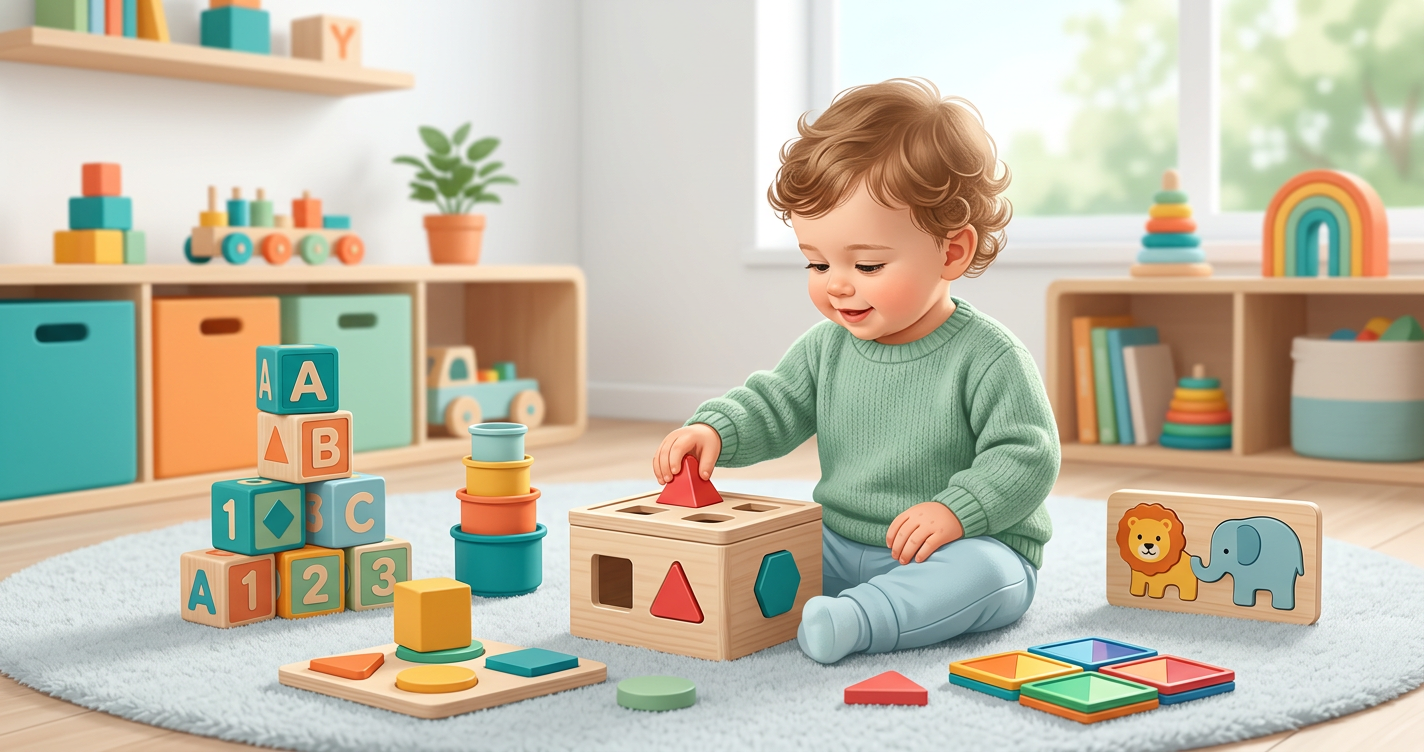
When a toddler stacks blocks, they're not just building a tower; they're experimenting with balance, spatial reasoning, and gravity. When they fit shapes into a sorter, they're learning about classification, problem-solving, and fine motor control. These activities engage multiple parts of the brain simultaneously. For instance, a toy that requires grasping and manipulating stimulates the motor cortex, while the challenge of figuring out how it works activates the prefrontal cortex for problem-solving and the parietal lobe for spatial awareness.
Research consistently shows that engaging in play with well-chosen toys can improve cognitive flexibility, enhance memory, and even boost language acquisition. The beauty lies in the fact that children are intrinsically motivated by play, making the learning process enjoyable and highly effective.
Key Developmental Areas Targeted by Educational Toys
Educational toys aren't a one-size-fits-all solution; they cater to a wide range of developmental milestones. Here’s a look at some key areas and how specific toys contribute:
- Cognitive Development: This includes problem-solving, memory, reasoning, and critical thinking. Toys like shape sorters, puzzles, stacking rings, and simple construction sets challenge toddlers to think, plan, and execute. They learn about cause and effect, patterns, and object permanence.
- Fine Motor Skills: The coordination of small muscles, especially in the hands and fingers, is crucial for tasks like writing, drawing, and self-feeding. Building blocks, lacing beads, playdough, chunky puzzles, and activity cubes help refine hand-eye coordination, grasp, and dexterity.
- Gross Motor Skills: Involving the larger muscles for movement and balance, these skills are vital for walking, running, jumping, and climbing. Push-and-pull toys, ride-on toys, soft play equipment, and large balls encourage movement, balance, and coordination.
- Language and Communication: Toys that encourage interaction, storytelling, and imaginative play are fantastic for language development. Picture books, puppets, baby dolls, pretend play sets (kitchens, doctor kits), and musical instruments inspire toddlers to vocalize, mimic sounds, and expand their vocabulary.
- Social-Emotional Learning: Sharing, turn-taking, empathy, and understanding emotions are fundamental social skills. Dollhouses, action figures, animal sets, and play kitchens facilitate imaginative scenarios where toddlers can practice social roles, express emotions, and learn cooperation, especially during parallel play or early interactive play with peers or caregivers.
Choosing the Right Brain-Boosting Toys for Your Toddler
Navigating the vast array of educational toys can feel overwhelming. Here are some evidence-based tips for selecting toys that truly benefit your toddler:
- Age-Appropriateness is Key: Always check the recommended age range. Toys too simple will quickly lose interest, while those too complex can lead to frustration. The best toys offer a slight challenge, encouraging growth without overwhelming.
- Prioritize Open-Ended Play: Toys that can be used in multiple ways stimulate creativity and imagination far more than single-function toys. Blocks, art supplies, scarves, and loose parts encourage toddlers to invent their own games and narratives, fostering divergent thinking.
- Look for Durability and Safety: Toddlers are explorers! Choose non-toxic, sturdy toys with no small, detachable parts that could pose a choking hazard. Safety certifications (like ASTM F963 in the US or EN71 in Europe) are good indicators.
- Consider Sensory Engagement: Toys that appeal to multiple senses (touch, sight, sound) can provide richer learning experiences. Textured blocks, musical instruments, and light-up toys can be highly engaging.
- Less is Often More: A few high-quality, versatile toys are often more beneficial than a room full of flashy, overstimulating ones. Rotate toys periodically to maintain interest and prevent overwhelm.
Integrating Educational Play into Daily Routines
You don't need a dedicated "learning time" for educational toys to be effective. Integrate them naturally into your toddler's day:
- Morning Exploration: Offer a puzzle or stacking toy while you prepare breakfast.
- Snack Time Learning: Use play food for pretend cooking, or count pieces of fruit.
- Outdoor Adventures: Bring a ball for gross motor play, or collect natural items for sorting.
- Bedtime Wind-Down: Read an interactive picture book or engage in quiet imaginative play with soft toys.
The key is to make play a consistent, enjoyable part of their routine, showing them that learning happens everywhere and all the time.
Beyond the Toy: The Parent's Role in Play
While educational toys are fantastic tools, they reach their full potential when paired with engaged adult interaction. Your presence, encouragement, and participation are invaluable:
- Be Present and Engaged: Sit on the floor, get curious, and join in the play. Your attention validates their efforts and makes the experience more meaningful.
- Narrate and Ask Questions: "Oh, you're putting the blue block on top of the red one! What will happen if we add another?" "Can you find the big dog?" These comments and questions build vocabulary, reinforce concepts, and encourage critical thinking.
- Follow Their Lead: Let your toddler dictate the play whenever possible. This fosters autonomy and deeper engagement. Offer suggestions, but don't take over.
- Celebrate Efforts, Not Just Outcomes: Praise their perseverance, their attempts, and their creativity, even if the tower falls or the puzzle isn't perfectly solved. This builds resilience and a love for learning.
- Model Play: Show them how to use a toy in different ways. Demonstrate stacking, sorting, or pretending, then let them experiment.
Conclusion: Unlocking Potential Through Play
The toddler years are a fleeting yet profoundly impactful chapter in a child's life, a time when the very architecture of their brain is being built. Educational toys, far from being mere distractions, are vital partners in this extraordinary process. By carefully selecting age-appropriate, open-ended toys and, most importantly, engaging with your child during play, you're not just fostering a love for learning; you're actively wiring their brains for future success.
So, embrace the beautiful mess of toddler play, knowing that every stack, every sort, and every imaginative adventure is a powerful step towards unlocking your child's full potential. What educational toy will you introduce to your little one today to spark their next big discovery?


