As parents and caregivers, we all want to give our children the best possible start in life. We marvel at their rapid growth, their insatiable curiosity, and their incredible capacity to learn. But have you ever stopped to think about the unsung heroes in this developmental journey? Often, they're brightly colored, oddly shaped, and found scattered across the living room floor: educational toys.
These aren't just mere playthings; they are powerful tools designed to stimulate young minds, build crucial skills, and lay the groundwork for lifelong learning. In the whirlwind of early childhood, where every day brings new discoveries, understanding how to harness the power of play through educational toys can truly supercharge your child's cognitive development. Let's dive into the fascinating world where fun meets fundamental learning. this excellent toy product
What Exactly Are "Educational Toys"? (And Why They Matter So Much)
You might be wondering, aren't all toys educational in some way? While it's true that children learn through all forms of play, educational toys are specifically designed with a learning objective in mind. They go beyond simple entertainment, intentionally targeting specific developmental milestones and cognitive skills. Think of them as playful professors in disguise!
These toys are crafted to:
- Stimulate specific cognitive functions: Such as problem-solving, memory, critical thinking, and spatial reasoning.
- Encourage active engagement: Requiring children to manipulate, explore, and interact rather than passively observe.
- Promote skill development: Ranging from fine motor skills and hand-eye coordination to early literacy and numeracy.
- Spark curiosity and exploration: Fostering a love for discovery and understanding how things work.
The beauty of a well-chosen educational toy lies in its ability to make learning feel effortless and joyful. When children are having fun, their brains are more receptive, leading to deeper engagement and more effective skill acquisition. This isn't just about 'getting ahead'; it's about building a robust foundation for future academic success and overall well-being.
The Science Behind Play: How Toys Build Brain Pathways
Early childhood, roughly from birth to age five, is a period of explosive brain development. During these critical years, billions of neural connections (synapses) are forming at an astonishing rate. This process, known as synaptogenesis, is heavily influenced by a child's experiences and interactions with their environment. And guess what's a huge part of that environment? Play!
When a child engages with an educational toy – whether they're stacking blocks, solving a puzzle, or matching shapes – their brain is actively working. They're making observations, testing hypotheses, remembering patterns, and adjusting their actions based on feedback. Each of these actions strengthens existing neural pathways and creates new ones. This incredible adaptability of the brain is called neuroplasticity, and it's highest in early childhood.
Research consistently shows that rich, stimulating play environments, often facilitated by educational toys, lead to better cognitive outcomes. It's not just about memorizing facts; it's about developing the underlying cognitive architecture that supports all future learning.
Key Cognitive Skills Educational Toys Nurture
Let's get specific. What are some of the vital cognitive skills that educational toys help cultivate?
Problem-Solving & Critical Thinking
From the moment a toddler tries to fit a square peg into a round hole, they're engaging in problem-solving. Puzzles, building blocks, shape sorters, and even simple cause-and-effect toys (like pressing a button to make something pop up) challenge children to think, strategize, and learn from trial and error. These experiences teach perseverance and the joy of figuring things out independently.
Memory & Recall
Memory games, matching cards, sequencing toys, and even story-based play all help children strengthen their working memory and long-term recall. Remembering where a specific piece goes in a puzzle or recalling the order of events in a story are fundamental memory exercises that boost cognitive function.
Language Development & Communication
Toys like alphabet blocks, picture books, puppets, and imaginative play sets can significantly enhance language skills. Children learn new vocabulary, practice storytelling, develop narrative skills, and even engage in early literacy by recognizing letters and words. Interactive toys that respond to speech or encourage dialogue further cement these abilities.
Spatial Reasoning & Visual Perception
Building with blocks, assembling LEGOs, or navigating a maze toy helps children understand concepts like size, shape, distance, and orientation. These activities are crucial for developing spatial awareness, a skill vital not only for math and science but also for everyday tasks like navigation and understanding maps.
Fine Motor Skills & Hand-Eye Coordination
While often seen as physical skills, fine motor development is deeply intertwined with cognitive growth. Manipulating small objects, stringing beads, drawing, or fitting intricate pieces together requires immense concentration and precision. These activities refine hand-eye coordination, strengthen small muscles in the hands and fingers, and prepare children for essential tasks like writing and self-care.
Early Math Concepts
Counting toys, abacuses, pattern blocks, and sorting games introduce fundamental mathematical concepts in an accessible way. Children learn about numbers, quantity, patterns, sequencing, and classification without even realizing they're doing math. This playful introduction builds a positive association with numbers and logical thinking.
Age-Appropriate Choices: Matching Toys to Milestones
The key to maximizing the benefits of educational toys is choosing ones that are appropriate for your child's developmental stage. A toy that's too simple might bore them, while one that's too complex could lead to frustration.
- Infants (0-12 months): Focus on sensory exploration. Soft books with different textures, rattles, stacking cups, and activity gyms stimulate senses and teach cause-and-effect.
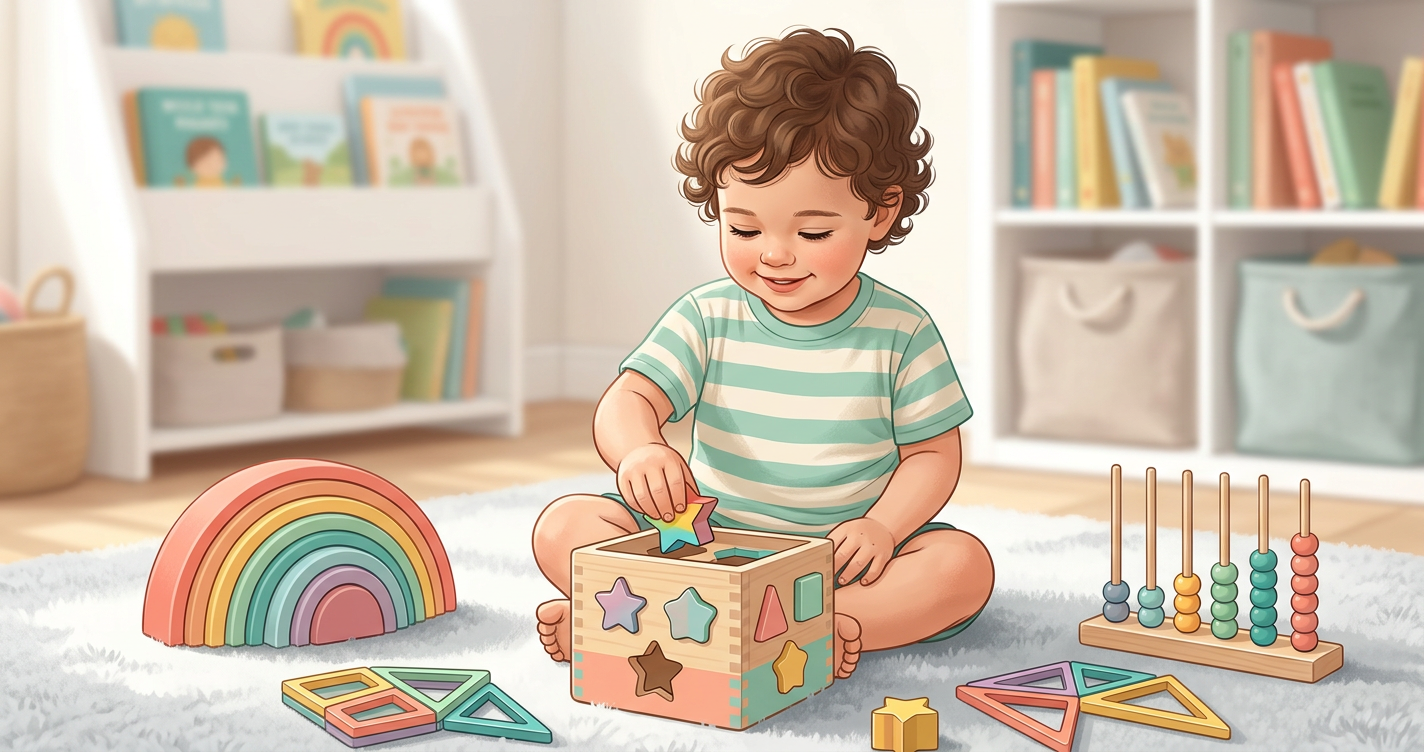
- Toddlers (1-3 years): Encourage exploration and early problem-solving. Shape sorters, simple puzzles, large building blocks, push-and-pull toys, and early musical instruments are excellent choices.
- Preschoolers (3-5 years): Foster imagination, complex problem-solving, and pre-academic skills. More intricate puzzles, construction sets, art supplies, role-playing kits, early board games, and science experiment kits are perfect.
Always remember that these are guidelines. Every child develops at their own pace, so observe your child's interests and abilities to make the best choices.
Beyond the Toy Box: Maximizing Learning Through Interaction
While educational toys are fantastic tools, their true power is unleashed through interaction. A toy sitting untouched in a corner won't teach much. Here's how you can amplify the learning:
- Join in the Play: Sit with your child, ask open-ended questions ("What are you building?", "What do you think will happen next?"), and model different ways to interact with the toy.
- Follow Their Lead: Let your child explore the toy in their own way, even if it's not the 'intended' use. This fosters creativity and independence.
- Describe and Narrate: Use rich vocabulary to describe what your child is doing, seeing, and feeling. "You're stacking the tallest block on top!" or "That's a very bright red car!"
- Encourage Persistence: When a child faces a challenge, offer encouragement rather than immediately solving it for them. "That's a tricky one! What if we try turning it this way?"
- Rotate Toys: Keep the play environment fresh by rotating toys every few weeks. This can reignite interest in forgotten items.
Dispelling Myths: Educational Toys Don't Have to Be Expensive or "Academic"
There's a common misconception that educational toys must be high-tech, branded, or explicitly labeled "educational" to be effective. This couldn't be further from the truth! Some of the best learning tools are simple, open-ended, and often found around the house.
- Everyday Items: Pots and pans, plastic containers, scarves, blankets, and even cardboard boxes can become incredible catalysts for imaginative play and learning.
- Open-Ended Play: Toys that don't have a single 'right' way to play (like blocks, play-doh, or art supplies) are incredibly valuable as they encourage creativity, flexibility, and problem-solving.
- Nature's Classroom: Sticks, leaves, stones, and sand offer endless opportunities for sensory exploration and imaginative play.
The goal isn't to fill your home with expensive gadgets, but to provide a thoughtful selection of toys that inspire curiosity, encourage exploration, and facilitate the natural learning process that is inherent in every child.
Empowering Lifelong Learners Through Play
In conclusion, educational toys are far more than just playthings; they are foundational instruments in shaping a child's cognitive landscape. By thoughtfully selecting age-appropriate, engaging toys and actively participating in your child's play, you're not just fostering fleeting moments of fun. You're building robust neural pathways, nurturing essential cognitive skills, and instilling a lifelong love for learning.
So, the next time you see your child engrossed in a puzzle or meticulously stacking blocks, know that they're not just playing; they're actively building their brain, one joyful interaction at a time. Embrace the power of play, and watch your child's brilliant mind flourish!