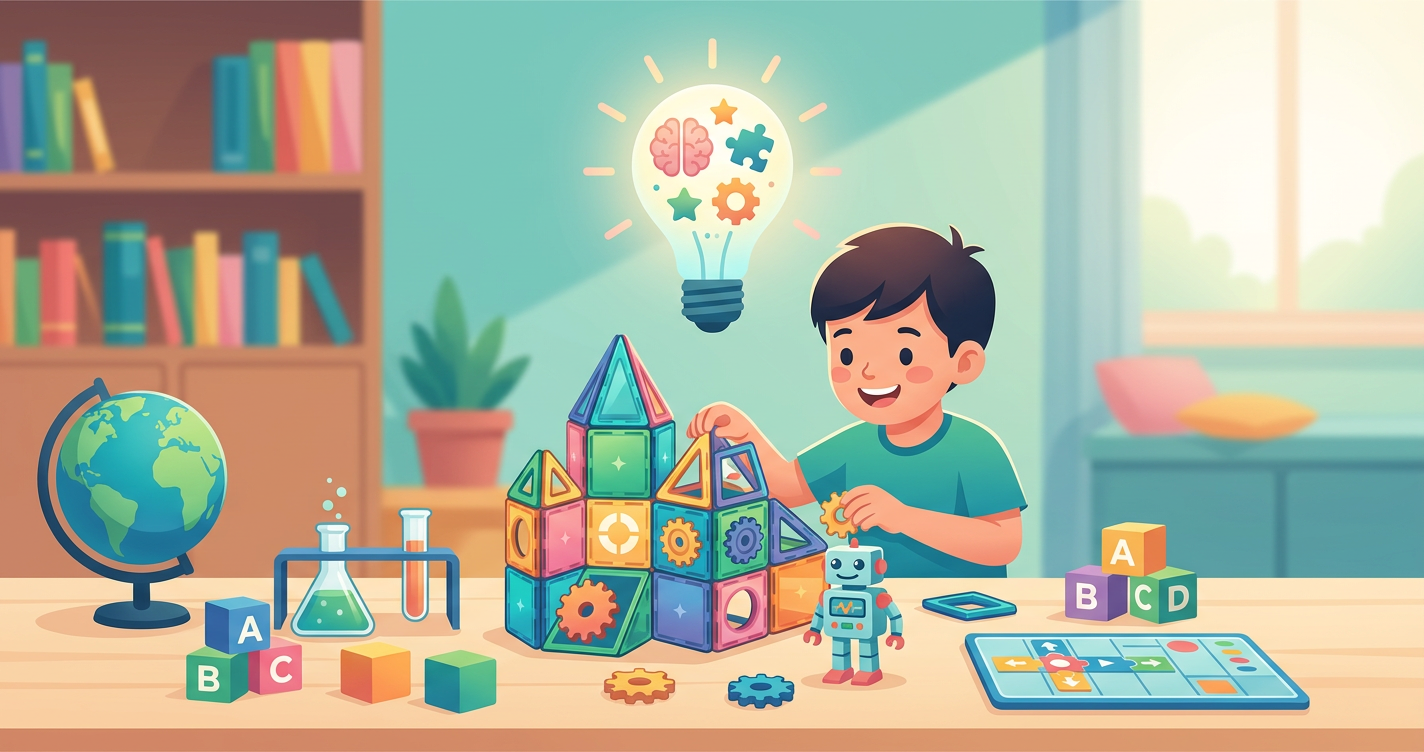
As parents, we all want the best for our children, striving to provide them with every opportunity to thrive. In a world brimming with screens and passive entertainment, it's easy to overlook the profound impact of something seemingly simple: play. Yet, play, especially with well-chosen educational toys, is far from simple – it's a powerful catalyst for your child's cognitive development. It's not just about keeping them occupied; it's about actively building the foundational skills they'll use for a lifetime of learning and problem-solving.
This post will delve into the incredible link between educational toys and cognitive growth, exploring how thoughtful play experiences can literally shape your child’s developing mind. We’ll uncover the science behind the fun, provide practical insights, and empower you to make informed choices that truly support your little one’s journey to brilliance. this excellent toy product
Understanding Cognitive Development: The Building Blocks of Brilliance
Before we dive into toys, let's briefly understand what cognitive development truly entails. Simply put, it's the construction of thought processes, including remembering, problem-solving, and decision-making, from childhood through adolescence to adulthood. It encompasses how a child perceives, thinks, and gains understanding of their world through the interaction of genetic and learned factors. Key aspects include:
- Memory: The ability to store and recall information.
- Attention: The capacity to focus on specific stimuli and filter out distractions.
- Problem-Solving: The skill to identify challenges and devise solutions.
- Language & Communication: Developing vocabulary, understanding grammar, and expressing thoughts.
- Reasoning: The process of thinking about something in a logical, sensible way.
- Perception: Interpreting sensory information.
These aren't isolated skills; they're interconnected and constantly developing, especially rapidly during the early childhood years. And guess what's a prime driver for this development? Play!
The Unrivaled Power of Play: A Child's Natural Classroom
For children, play isn't a break from learning; it is learning. Renowned developmental psychologists like Jean Piaget emphasized that children actively construct their understanding of the world through their experiences and interactions. Play provides the perfect environment for this construction. It’s intrinsically motivating, allows for exploration without fear of failure, and encourages hands-on experimentation. When children play, they are constantly testing hypotheses, adapting strategies, and processing new information – all crucial cognitive exercises.
Educational toys are specifically designed to harness this natural inclination to play, channeling it towards specific developmental goals. They transform abstract concepts into tangible, engaging experiences, making learning joyful and effective.
How Educational Toys Supercharge Key Cognitive Areas
Let's explore specific ways different types of educational toys contribute to cognitive development:
1. Boosting Problem-Solving & Critical Thinking
Many educational toys are inherently problem-solving tools. Think about it:
- Puzzles: Require children to analyze shapes, colors, and patterns, visualize how pieces fit together, and strategize to complete the image. This enhances spatial reasoning and logical thought.
- Building Blocks & Construction Sets: Challenge children to plan, design, and execute structures. They learn about balance, gravity, cause-and-effect, and spatial relationships. What happens if I put this block here? How can I make it taller without falling?
- Shape Sorters: Introduce concepts of categorization, matching, and identifying attributes (shape, size).
These activities encourage children to experiment, make mistakes, and learn from them, fostering resilience and a growth mindset vital for critical thinking.
2. Enhancing Memory & Attention Span
In today's fast-paced world, developing strong memory and attention skills is more important than ever. Educational toys can be fantastic aids:
- Matching Games & Memory Cards: Require children to remember the location of images or patterns, significantly boosting short-term memory and concentration.
- "Simon Says" type toys or sequencing games: Improve auditory memory and the ability to follow multi-step instructions.
- Storytelling & Interactive Books: Encourage active listening and recall of narrative details, enhancing both auditory memory and comprehension.
By engaging children in focused, repetitive, and rewarding activities, these toys help extend attention spans and strengthen memory pathways in the brain.
3. Cultivating Language & Communication Skills
Cognitive development is inextricably linked with language. The ability to articulate thoughts and understand others is fundamental, and educational toys can greatly assist:
- Role-Play & Pretend Play Sets: Kitchens, doctor kits, dress-up clothes – these toys spark imaginative scenarios where children naturally use language to negotiate roles, express ideas, and narrate stories. This expands vocabulary and improves conversational skills.
- Alphabet & Phonics Toys: Introduce letters, sounds, and early reading concepts in an interactive and fun way, building a strong foundation for literacy.
- Puppets & Storytelling Aids: Encourage children to create their own narratives, fostering creativity and verbal expression.
Through these playful interactions, children not only learn new words but also understand the nuances of communication, empathy, and social interaction.
4. Developing Spatial Reasoning & Fine Motor Skills
While often associated with physical development, fine motor skills and spatial reasoning have direct cognitive benefits:
- Construction Toys (e.g., LEGOs, magnetic tiles): Require precise manipulation and understanding of how objects fit in three-dimensional space. This directly supports spatial reasoning, a key component of mathematical and scientific thinking.
- Pegboards, Lacing Beads, Playdough: Strengthen small muscles in the hands and fingers, improving dexterity and hand-eye coordination. These activities also demand focus and careful planning.
- Art Supplies (crayons, markers, scissors): Allow children to express creativity while refining their grip, control, and understanding of visual representation.
The intricate movements and spatial awareness honed by these toys lay crucial groundwork for later academic tasks like writing and geometry.
5. Nurturing Creativity & Imagination
Perhaps one of the most vital cognitive benefits of educational toys is their ability to spark creativity and imagination. Open-ended toys, in particular, invite children to invent, explore, and think outside the box.
- Open-Ended Building Materials: Unlike toys with a single function, blocks, scarves, or cardboard boxes can become anything a child imagines – a castle, a car, a secret hideout. This fosters divergent thinking and imaginative play.
- Art & Craft Kits: Provide tools and materials for children to express themselves visually, encouraging originality and innovative thought.
Imagination is the birthplace of innovation and problem-solving. By providing toys that encourage creative play, we're nurturing future inventors, artists, and critical thinkers.
Evidence-Based Insights: The Science Behind Play
The benefits of educational play are not just anecdotal; they are backed by decades of research. Studies consistently show that children who engage in rich, interactive play experiences tend to exhibit stronger language skills, better problem-solving abilities, and higher levels of creativity compared to those with less stimulating environments. Neuroscientific research even illustrates how play activates and strengthens neural pathways in the brain, particularly in areas associated with executive functions like planning, working memory, and cognitive flexibility.
For instance, research published in journals like Pediatrics highlights the importance of play for healthy brain development, emphasizing its role in developing social-emotional skills, language, and executive functions. Piaget's constructivist theory, Vygotsky's socio-cultural theory, and Erikson's psychosocial stages all, in different ways, underscore the critical role of active engagement and play in cognitive and overall development.
Choosing the Right Educational Toys: A Parent's Guide
With so many options, how do you pick the best educational toys? Here are some friendly, evidence-based tips:
- Age-Appropriateness is Key: A toy that's too complex can be frustrating, while one that's too simple can be boring. Look for toys that align with your child's developmental stage.
- Prioritize Open-Ended Play: Toys that can be used in multiple ways (e.g., blocks, playdough, art supplies) often offer greater cognitive benefits than single-purpose toys. They encourage imagination and sustained engagement.
- Consider Your Child's Interests: If your child loves animals, animal-themed puzzles or building sets will be more engaging and effective than a generic alternative.
- Look for Durability & Safety: Ensure toys are made from non-toxic materials and are sturdy enough to withstand enthusiastic play. Safety always comes first.
- Balance & Variety: A mix of toys that target different skill sets – fine motor, gross motor, creative, logical – provides a well-rounded developmental experience.
- Less is Often More: A few high-quality, versatile toys are often more beneficial than a room full of overwhelming options.
Beyond the Toy: The Indispensable Role of Interaction
While educational toys are powerful tools, their magic is truly amplified by your involvement. Playing with your child, asking open-ended questions, narrating their actions, and encouraging their discoveries transforms a simple toy into a rich learning experience. Your presence provides emotional support, models problem-solving strategies, and strengthens your bond. Remember, the toy is a prop; the interaction is the lesson.
Conclusion: Investing in Play, Investing in Potential
Educational toys are more than just playthings; they are vital investments in your child's cognitive future. By thoughtfully selecting toys that engage their minds, spark their curiosity, and encourage active exploration, you are laying robust foundations for problem-solving, critical thinking, language acquisition, and boundless creativity. Embrace the power of play, participate in their discoveries, and watch as your child's brilliance unfolds, one joyful learning experience at a time. The journey of cognitive development is an exciting adventure, and with the right tools and your loving guidance, your child is set to achieve incredible things.