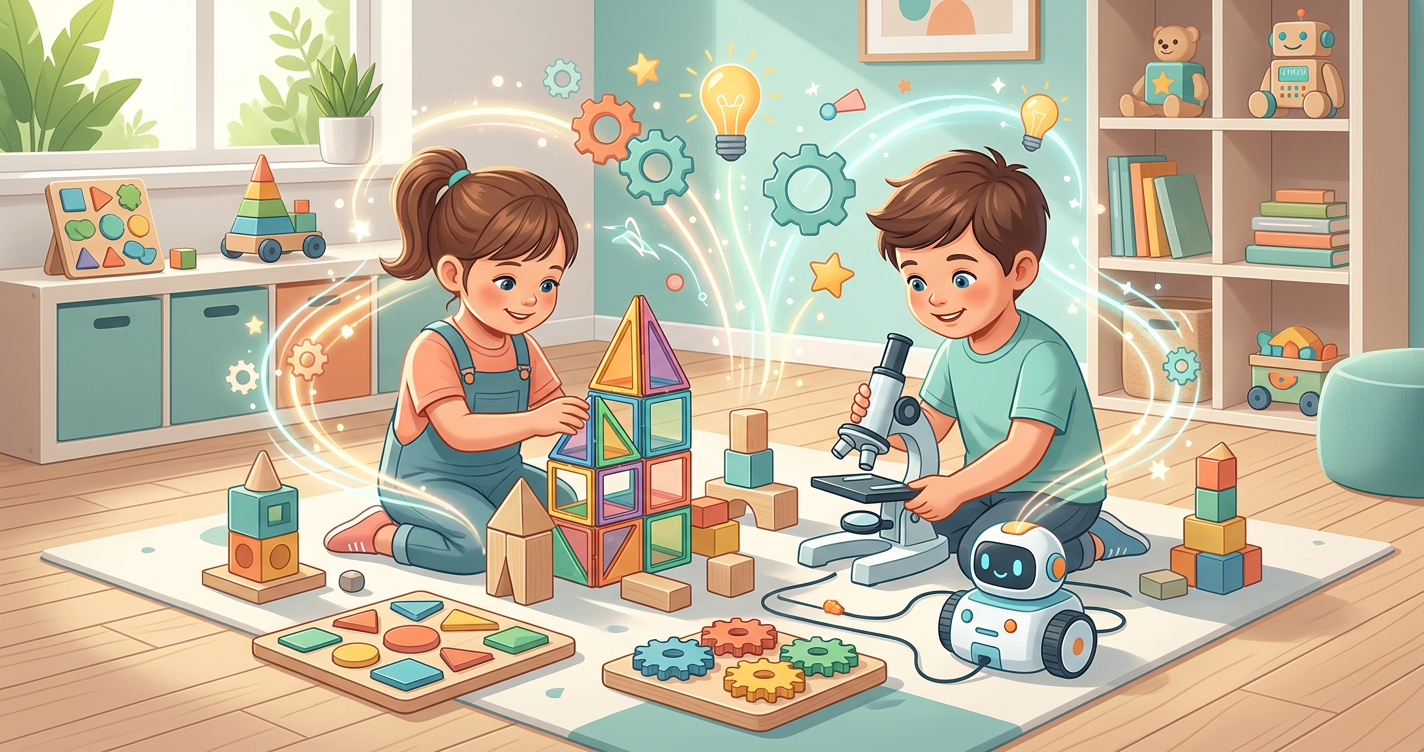
As parents, we all dream of giving our children the best possible start in life. We want them to be curious, intelligent, and well-equipped to navigate the world. While formal education plays a crucial role later on, the foundation for these vital skills is often laid much earlier – through something as simple and joyous as play. In fact, the toys our children interact with daily are far more than mere entertainment; they are powerful tools for fostering cognitive development.
But what exactly is cognitive development, and how can a humble set of blocks or a puzzle contribute to it? This isn't just about 'smart' toys; it's about understanding the profound impact of thoughtful play on a child's growing brain. Join us as we explore the science-backed ways educational toys can supercharge your child's thinking, problem-solving, and creative abilities, setting them up for a lifetime of learning and success. this excellent toy product
What Exactly is Cognitive Development?
Before diving into toys, let's clarify what we mean by cognitive development. In simple terms, it refers to the construction of thought processes, including remembering, problem-solving, and decision-making, from childhood through adolescence to adulthood. It encompasses how a child perceives, thinks, and gains understanding of their world through the interaction of genetic and learned factors.
Key areas of cognitive development include:
- Memory: The ability to store and recall information.
- Attention: The capacity to focus on specific stimuli while ignoring others.
- Perception: Interpreting sensory information (what they see, hear, touch).
- Problem-solving: Identifying a problem and finding a solution.
- Language: Developing communication skills, both receptive and expressive.
- Reasoning: The ability to think logically and make judgments.
- Creativity: Generating new ideas and approaches.
These skills aren't developed in isolation; they are deeply interconnected and constantly evolving. And guess what? Play is one of the most effective catalysts for this complex growth.
The Science Behind Play: How Toys Shape Young Minds
The human brain is an incredible organ, especially during early childhood. From birth to age three, a child's brain forms over a million new neural connections every second! This period of rapid development, known as brain plasticity, is when experiences literally shape the brain's architecture. Active engagement with educational toys provides precisely the kind of stimulating experiences needed to foster these crucial connections.
When a child plays with a toy, they are not just passively interacting. They are experimenting, testing hypotheses, making mistakes, and learning from them. For instance, stacking blocks requires spatial reasoning and an understanding of balance. A puzzle demands visual discrimination and logical deduction. These activities stimulate various parts of the brain, strengthening neural pathways and building a robust cognitive framework.
Research consistently shows that children who engage in rich, varied play experiences tend to have better academic outcomes, stronger social-emotional skills, and enhanced problem-solving abilities later in life. Educational toys are designed with this in mind, offering structured yet flexible pathways for exploration and discovery.
Types of Educational Toys and Their Cognitive Benefits
The world of educational toys is vast and exciting. Let's explore how different categories of toys target specific cognitive areas:
Problem-Solving & Critical Thinking
These toys challenge children to think logically, strategize, and overcome obstacles. They teach perseverance and the joy of finding a solution.
- Puzzles: From simple knob puzzles for toddlers to complex jigsaw puzzles for older children, puzzles enhance spatial reasoning, visual memory, and fine motor skills.
- Building Blocks (LEGOs, Magna-Tiles, Wooden Blocks): These encourage open-ended construction, fostering creativity, understanding of physics, balance, and engineering principles. Children learn about cause and effect and structural integrity.
- Shape Sorters & Stacking Toys: Perfect for younger children, these toys help develop object permanence, shape recognition, size discrimination, and hand-eye coordination.
- Logic Games & Mazes: Introduce early concepts of sequencing, pattern recognition, and strategic planning.
Language & Communication
Play is a natural stage for language acquisition. Toys can enrich vocabulary, encourage storytelling, and improve expressive and receptive language skills.
- Picture Books & Interactive Books: Beyond reading, these encourage discussion, identification of objects, and understanding of narratives.
- Puppets & Dollhouses: Facilitate imaginative play, allowing children to create stories, practice dialogue, and express emotions. This is vital for developing narrative skills and empathy.
- Alphabet & Phonics Toys: Introduce letters, sounds, and early literacy concepts in a fun, tactile way.
- Role-Playing & Pretend Play Sets (e.g., doctor kits, kitchen sets): Encourage children to mimic real-world scenarios, expanding their vocabulary and understanding of social roles.
Creativity & Imagination
These toys fuel a child's inner world, allowing them to explore possibilities without boundaries, which is crucial for flexible thinking and innovation.
- Art Supplies (Crayons, Paint, Play-Doh): Promote self-expression, fine motor skill development, and sensory exploration. There's no right or wrong way to create, fostering confidence.
- Open-Ended Construction Materials (e.g., loose parts, fabrics): Unlike structured toys, these allow children to invent their own rules and outcomes, stimulating divergent thinking.
- Dress-Up Clothes & Dramatic Play Sets: Encourage imaginative scenarios, character development, and emotional exploration.
Fine Motor Skills & Sensory Exploration
While often overlooked in cognitive discussions, the development of fine motor skills (using small muscles in hands and fingers) is intrinsically linked to cognitive tasks like writing and manipulating objects. Sensory exploration builds a child's understanding of their physical world.
- Beads & Stringing Toys: Improve dexterity, hand-eye coordination, and concentration.
- Sand & Water Tables: Offer rich sensory experiences, introducing concepts of volume, weight, and texture.
- Playdough & Clay: Strengthen hand muscles, enhance creativity, and provide calming sensory input.
- Lacing Cards: Develop pincer grasp, hand-eye coordination, and pattern recognition.
Early STEM Skills (Science, Technology, Engineering, Math)
Introducing STEM concepts early lays a strong foundation for future learning and problem-solving in these critical areas.
- Simple Science Kits: Allow children to conduct safe experiments, observe reactions, and develop curiosity about the natural world.
- Coding Robots & Logic Games: Introduce foundational concepts of sequencing, algorithms, and computational thinking in an accessible, playful manner.
- Gear Sets & Magnets: Teach basic physics principles, cause and effect, and mechanical reasoning.
- Counting & Sorting Toys: Help children grasp numerical concepts, classification, and one-to-one correspondence.
Beyond the Toy Itself: The Power of Guided Play
It's important to remember that a toy, however educational, is just a tool. Its true potential is unlocked when a child engages with it actively, and even more so when parents or caregivers join in. This is where guided play comes into its own.
Guided play means interacting with your child during their play, asking open-ended questions, offering suggestions, and expanding on their ideas without taking over. For example, instead of just watching them stack blocks, you might ask, "What if we put the big block on top? What do you think will happen?" or "Can you make a tower taller than me?"
This interaction transforms play into a powerful learning dialogue, encouraging critical thinking, communication, and deeper engagement. It also strengthens your bond with your child, creating a positive association with learning.
Choosing the Right Educational Toys for Your Child
With so many options, selecting the "best" educational toys can feel overwhelming. Here are some friendly, evidence-based tips:
- Age-Appropriateness: Always check recommended age ranges for safety and developmental suitability. A toy that's too advanced can be frustrating, while one that's too simple might quickly lose interest.
- Open-Endedness: Prioritize toys that can be used in multiple ways, encouraging creativity and imaginative play over single-purpose items. Blocks, art supplies, and dramatic play sets are excellent examples.
- Durability & Safety: Choose well-made toys from non-toxic materials that can withstand enthusiastic play. Safety certifications are a good indicator.
- Child's Interest: Observe what your child is naturally drawn to. If they love animals, animal-themed puzzles or puppet sets will be more engaging.
- Promotes Active Engagement: Look for toys that require your child to do something – build, manipulate, create, interact – rather than passively watch or listen.
- Encourages Interaction: Toys that can be played with alongside others (siblings, friends, parents) foster social skills and collaborative problem-solving.
Dispelling Myths: It's Not About Expensive Gadgets
A common misconception is that "educational toys" must be high-tech, expensive gadgets. While some digital tools can be beneficial, the most impactful educational toys are often the simplest ones. A set of wooden blocks, a box of crayons, or even natural elements like sticks and stones can provide richer cognitive experiences than many flashy electronic toys.
The key isn't the price tag or the number of buttons; it's the opportunity for active exploration, creativity, and problem-solving that the toy facilitates. Remember, the best educational toy is one that sparks curiosity, encourages engagement, and grows with your child's developing mind.
Conclusion: Play, Learn, Thrive!
The journey of cognitive development in young children is a remarkable one, and play is its most joyful vehicle. By thoughtfully selecting educational toys and, more importantly, by engaging in meaningful play alongside our children, we are not just occupying their time; we are actively nurturing their brains, building essential skills, and fostering a lifelong love for learning.
So, go ahead – embrace the mess, encourage the questions, and delight in the discoveries. Every block stacked, every puzzle piece placed, and every imaginative story told is a step towards unlocking your child's incredible potential. Happy playing!