
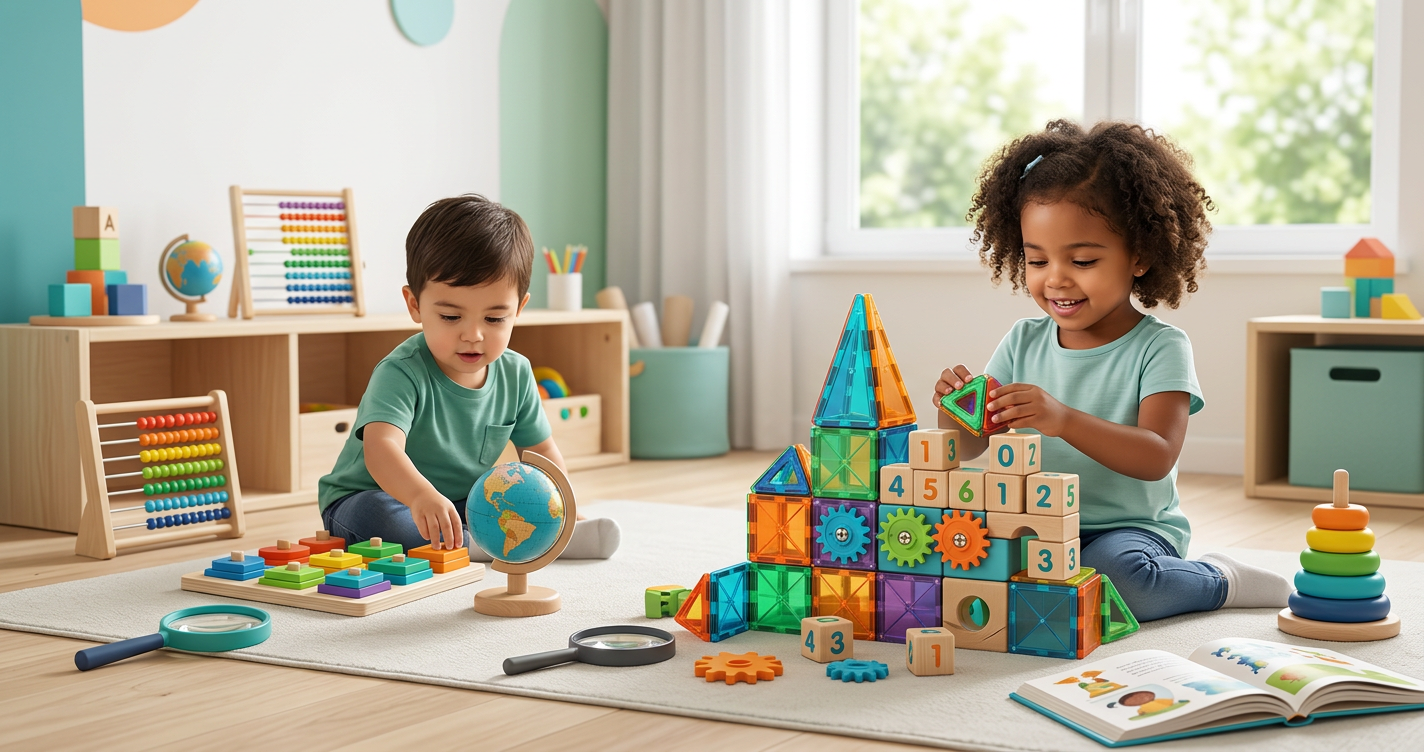
As parents, we often marvel at the boundless energy and curiosity of young children. Their world is a playground of discovery, and every interaction is an opportunity for learning. While spontaneous play is undeniably crucial, the intentional introduction of educational toys can significantly amplify this natural developmental process. Far from being mere distractions, these thoughtfully designed tools are powerful catalysts, shaping young minds and laying robust foundations for future success.
In this comprehensive guide, we'll explore the multifaceted ways educational toys contribute to early childhood development, backed by insights into how children learn best. We'll delve into their impact on cognitive, emotional, social, and physical growth, and offer practical advice on selecting the best toys to nurture your child's unique potential. Get ready to transform playtime into powerful learning time! this excellent toy product
More Than Just Play: Defining Educational Toys
What exactly elevates a toy from simple entertainment to an 'educational' tool? The distinction lies in its purpose and design. While all play offers some learning, an educational toy is specifically crafted to stimulate particular developmental areas. It's often open-ended, encouraging exploration, problem-solving, and critical thinking, rather than merely prescribing a single way to play.
- Purposeful Design: They are created with specific learning outcomes in mind, whether it's developing fine motor skills, understanding cause and effect, or fostering language.
- Engagement Over Distraction: Rather than passive entertainment, they demand active participation, encouraging children to manipulate, experiment, and interact.
- Age-Appropriateness: Effective educational toys align with a child's developmental stage, offering challenges that are stimulating but not overwhelming.
- Durability and Safety: Built to withstand enthusiastic play and made from safe, non-toxic materials, ensuring peace of mind for parents.
From simple wooden blocks that teach balance and spatial reasoning to complex STEM kits that introduce coding concepts, educational toys are diverse. They are an investment in your child's innate drive to learn and grow.
The Science Behind the Smiles: How Educational Toys Boost Cognitive Development
Cognitive development refers to how children think, explore, and figure things out. It's the development of knowledge, skills, problem-solving, and dispositions. Educational toys are incredibly effective at nurturing these crucial cognitive abilities.
- Problem-Solving Skills: Puzzles, shape sorters, and building sets challenge children to think critically and find solutions. They learn trial and error, persistence, and logical reasoning.
- Cause and Effect: Toys that react to a child's actions (e.g., pressing a button makes a sound, pushing a car makes it roll) help them understand how their actions create outcomes, a fundamental concept in scientific thinking.
- Memory and Concentration: Matching games, memory cards, and even storytelling with puppets enhance memory recall and the ability to focus on a task.
- Spatial Reasoning: Blocks, LEGOs, and magnetic tiles are superb for developing an understanding of space, shapes, and how objects fit together. This is a foundational skill for math and science.
Research consistently shows that children who engage with stimulating play materials tend to develop stronger cognitive skills, preparing them for academic success and lifelong learning. As child development expert Jean Piaget noted, children are 'little scientists,' actively constructing their understanding of the world through interaction.
Nurturing Emotional Intelligence and Social Skills Through Play
Playtime isn't just about solo exploration; it's a powerful arena for developing crucial social and emotional intelligence, especially when educational toys are involved in group settings.
- Empathy and Understanding: Dollhouses, action figures, and puppet shows encourage role-playing, allowing children to step into different characters' shoes, explore various emotions, and understand diverse perspectives.
- Sharing and Cooperation: Board games, cooperative building sets, and pretend play kitchens or stores naturally foster opportunities for sharing resources, taking turns, and working together towards a common goal. These interactions teach valuable lessons in negotiation and compromise.
- Communication Skills: Engaging in imaginative play often requires children to verbalize their ideas, listen to others, and articulate their needs. Storytelling toys or interactive playsets can prompt rich conversations.
- Emotional Regulation: Experiencing the joy of winning a game, the frustration of a puzzle piece not fitting, or the satisfaction of collaborating helps children learn to identify, express, and manage their emotions in a safe environment.
These early lessons in social and emotional intelligence are vital for forming healthy relationships, navigating school environments, and thriving in adulthood.
Fostering Creativity and Imagination: The Open-Ended Play Advantage
While some toys have a clear objective, many of the most valuable educational toys are those that are 'open-ended.' These are toys without a single prescribed way to play, inviting children to use their imagination and creativity to dictate the narrative.
- Unleashing Imagination: Simple items like building blocks, art supplies, play-dough, or even a collection of 'loose parts' (pinecones, pebbles, fabric scraps) become anything a child imagines. A block can be a phone, a car, or a piece of cake.
- Encouraging Innovation: When there's no right or wrong way to play, children are free to experiment, invent stories, and create unique structures. This fosters innovative thinking and problem-solving.
- Developing Abstract Thought: Open-ended play helps children move beyond concrete thinking, allowing them to create mental representations and explore 'what if' scenarios.
By providing materials that encourage children to be the architects of their own play, we empower them to think creatively, express themselves uniquely, and develop a lifelong love for innovation.
Building Foundational Skills: From STEM to Literacy
Educational toys are instrumental in developing specific foundational skills that are critical for academic readiness and holistic development.
Early STEM Exploration
STEM (Science, Technology, Engineering, and Math) concepts can be introduced even to very young children through play. Magnetic tiles, gears, simple circuit kits, and construction sets allow kids to experiment with physics, engineering principles, and mathematical concepts like symmetry and patterns without even realizing they're learning complex ideas.
Language and Literacy
Toys like alphabet puzzles, storytelling cards, interactive books, and puppet sets encourage vocabulary expansion, narrative development, and early literacy skills. When parents engage with these toys alongside their children, reading and communication become even richer experiences.
Fine and Gross Motor Skills
From stacking rings and lacing beads (fine motor skills crucial for writing) to tricycles and balance boards (gross motor skills for coordination and physical confidence), educational toys support physical development in engaging ways. These skills are fundamental for independence and participation in various activities.
Choosing the Right Educational Toys: A Parent's Guide
With an overwhelming array of options, selecting the best educational toys can feel daunting. Here are some friendly, evidence-based tips to guide your choices:
- Prioritize Age-Appropriateness: Always check age recommendations. A toy too advanced can lead to frustration, while one too simple might quickly lose interest.
- Look for Open-Endedness: Toys that can be used in multiple ways, rather than having a single function, offer greater longevity and foster more creativity. Think blocks, art supplies, or versatile playsets.
- Consider Your Child's Interests: If your child loves animals, choose animal-themed puzzles or building sets. Tapping into their passions makes learning more engaging.
- Focus on Durability and Safety: Opt for high-quality, non-toxic materials that can withstand enthusiastic play and meet safety standards.
- Encourage Active Participation: Choose toys that require your child to do something – build, sort, create, imagine – rather than passively observe.
- Balance Variety: Ensure a mix of toys that address different developmental areas: cognitive (puzzles), creative (art supplies), physical (balls, riding toys), and social/emotional (dolls, role-play sets).
- Remember Less Can Be More: A few thoughtfully chosen, high-quality toys are often more beneficial than a room full of overwhelming options.
The goal isn't to buy every 'educational' toy on the market, but to curate a collection that genuinely supports your child's unique developmental journey.
The Lasting Legacy: Investing in Future Success
The early years are a critical window of opportunity, a time when the brain is developing at an astonishing rate. By thoughtfully incorporating educational toys into your child's environment, you're not just providing entertainment; you're actively participating in their growth and development. You're fostering a love for learning, building resilience, nurturing creativity, and equipping them with essential skills that will serve them well throughout their academic careers and beyond.
Every block stacked, every puzzle solved, every story imagined contributes to a rich tapestry of experiences that shapes who your child will become. So, embrace the power of play, choose wisely, and watch your child flourish!
Thank you for joining us on this exploration of the profound impact of educational toys. We hope you feel inspired and empowered to make informed choices that enrich your child's early childhood development journey.


