
As parents, we often focus on the ABCs and 123s, celebrating every cognitive milestone our children achieve. And rightfully so! Learning to read, write, and count are foundational skills. But what about the equally crucial, often overlooked, realm of social-emotional development? How do we equip our little ones with the ability to understand their feelings, navigate friendships, and make responsible decisions?
The good news is that fostering these vital 'soft skills' doesn't always require formal lessons or complex interventions. Sometimes, the most powerful tools are right in the toy box! Educational toys, often celebrated for boosting cognitive abilities, are unsung heroes in nurturing a child's social-emotional superpowers. From learning empathy to mastering self-regulation, these playful tools offer a fun, low-pressure environment for children to develop the emotional intelligence that will serve them for a lifetime. this excellent toy product
Join us as we dive into the fascinating world where play meets emotional growth, exploring how thoughtfully chosen educational toys can become your child's best teachers in the journey of becoming a well-rounded, emotionally intelligent individual.
What Exactly Are Social-Emotional Skills (SEL), and Why Do They Matter So Much?
Before we explore the toys, let's clarify what we mean by social-emotional skills, often referred to as SEL (Social-Emotional Learning). According to leading educational frameworks, SEL encompasses five core competencies:
- Self-Awareness: Understanding one's own emotions, thoughts, and values, and how they influence behavior.
- Self-Management: Regulating one's emotions, thoughts, and behaviors effectively in different situations; managing stress, controlling impulses, and motivating oneself.
- Social Awareness: Taking the perspective of and empathizing with others, including those from diverse backgrounds and cultures.
- Relationship Skills: Establishing and maintaining healthy and supportive relationships and effectively navigating diverse settings.
- Responsible Decision-Making: Making constructive choices about personal behavior and social interactions based on ethical standards, safety concerns, and societal norms.
Why are these skills so crucial? Research consistently shows that strong SEL skills are linked to academic success, better mental health, reduced behavioral problems, and stronger relationships throughout life. Children with well-developed SEL are more resilient, better problem-solvers, and more likely to thrive in school and beyond. In an increasingly complex world, fostering emotional intelligence is just as important, if not more, than cognitive prowess.
The Unsung Heroes: How Different Educational Toys Foster SEL
Let's look at how various types of educational toys naturally encourage the development of these essential social-emotional competencies.
Dollhouses, Action Figures, and Pretend Play Sets: Stepping into Someone Else's Shoes
Pretend play is a powerhouse for SEL. When children engage with dollhouses, action figures, or dress-up clothes, they're not just playing; they're experimenting with different roles, perspectives, and emotions. A child might be a nurturing parent, a brave superhero, or a shy classmate, all within the span of an hour. This type of play is invaluable for developing empathy, as they imagine what it feels like to be someone else.
They learn to express and understand a wide range of emotions through their characters, from happiness and excitement to anger and sadness. Furthermore, when playing with others, children naturally practice negotiation, sharing, and compromise as they co-create a shared imaginary world. "My doll is sad because she lost her teddy!" can open up discussions about feelings and comfort.
Board Games and Card Games: Learning to Play Fair and Manage Frustration
Board games and card games are miniature boot camps for social-emotional growth. Think about it: every game involves rules, turns, winning, and losing. These structured play experiences are fantastic for teaching self-management skills. Children learn patience (waiting for their turn), impulse control (not grabbing all the pieces), and how to cope with frustration when things don't go their way.
The act of winning and losing gracefully is a huge lesson in itself, fostering resilience and sportsmanship. Games also require communication, strategic thinking, and often, collaboration (especially in cooperative games), which hones relationship skills and responsible decision-making. "It's okay, we can try again!" becomes a common, reassuring phrase.
Building Blocks and Construction Sets: Collaboration and Conflict Resolution
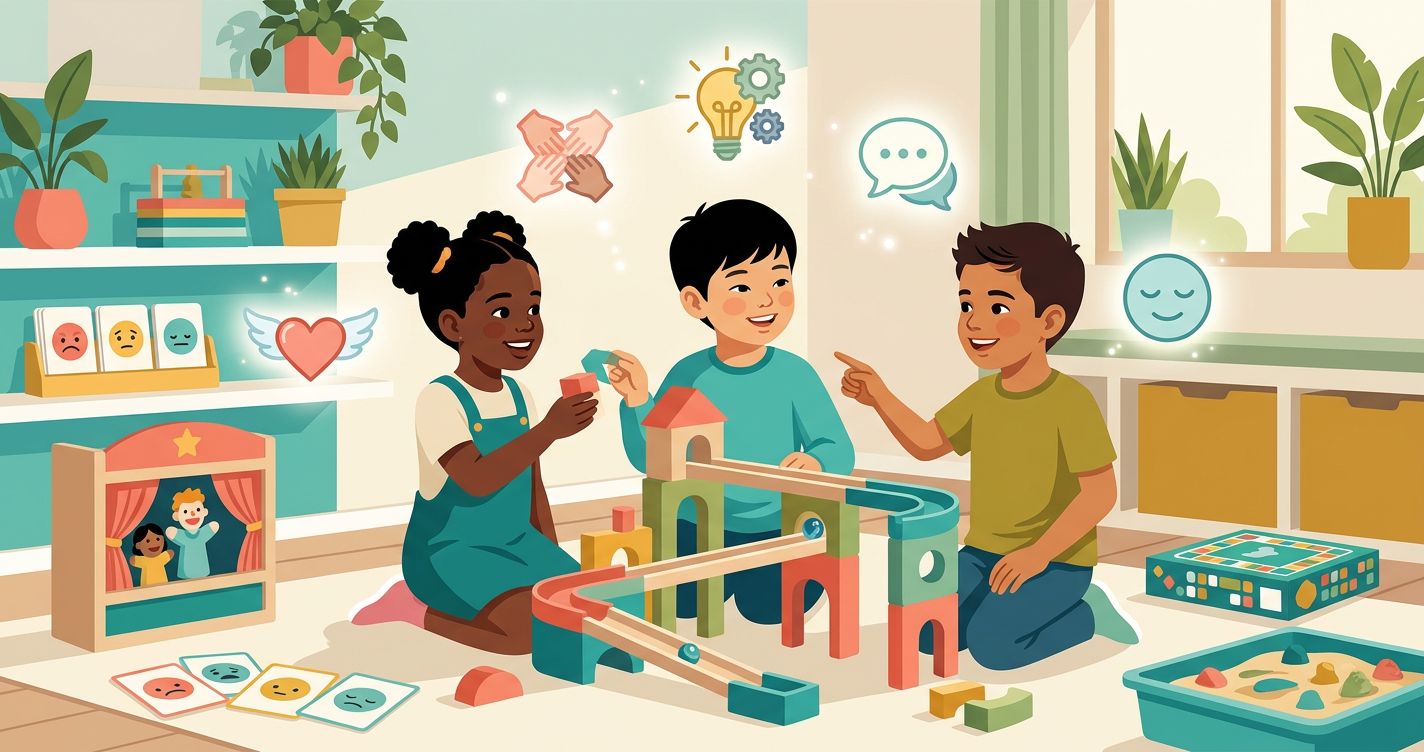
Whether it's LEGOs, wooden blocks, or magnetic tiles, construction toys are more than just tools for spatial reasoning; they're platforms for social interaction. When children build together, they learn to share resources, negotiate space, and communicate their ideas. "I need that long blue piece!" "But I wanted to put the roof here!" These interactions, guided by an adult or peers, are prime opportunities for practicing conflict resolution.
They learn to listen to others' suggestions, compromise on a shared vision, and celebrate collective achievements. The process of planning, executing, and sometimes re-planning a structure together strengthens relationship skills and fosters a sense of shared accomplishment, building self-esteem and social awareness.
Puppet Theaters and Storytelling Kits: Expressing Emotions and Understanding Narratives
Puppets and storytelling kits provide a safe, imaginative space for children to explore complex emotions and social situations. A child can use a puppet to express feelings they might find difficult to articulate themselves, such as anger, fear, or sadness. This can be incredibly therapeutic and helps develop self-awareness.
As they create narratives, they're also developing social awareness by interpreting the 'emotions' and 'motivations' of their characters. They learn about cause and effect in social interactions ("The bear was sad because the fox took his berries"), and they can experiment with different solutions to problems within their stories. This builds both empathy and responsible decision-making skills.
Cooperative Games and Team Challenges: The Power of "Us"
While many games are competitive, a growing category of cooperative games specifically focuses on teamwork. In these games, all players work together towards a common goal against the game itself. This eliminates the pressure of individual winning or losing and puts the spotlight entirely on collaboration. Children learn to communicate effectively, listen to each other's ideas, and provide mutual support.
They discover the power of collective effort and the joy of shared success. These types of toys – whether a cooperative board game where everyone tries to save the forest, or a building challenge where the whole group must construct a bridge – are excellent for explicitly teaching relationship skills, social awareness, and responsible decision-making for the common good.
Beyond the Toy Box: Maximizing the SEL Benefits
It's important to remember that the toy itself is only half the equation. The real magic happens through interaction and guidance. Here's how to maximize the social-emotional benefits of educational toys:
- Play Together: Join in the play! Your presence allows you to model positive social behaviors, guide interactions, and facilitate conversations about emotions and problem-solving.
- Ask Open-Ended Questions: Instead of, "Are you having fun?" try, "What is your doll feeling right now?" or "What do you think your friend needs to finish this tower?" This encourages reflection and empathy.
- Narrate and Validate Emotions: When a child gets frustrated with a game, acknowledge it: "It looks like you're feeling a bit frustrated that your turn hasn't come yet. That's a tough feeling!" Then, guide them through coping strategies.
- Create a Supportive Environment: Ensure play is a safe space where mistakes are learning opportunities, and all feelings are allowed (within respectful boundaries).
- Observe and Guide: Pay attention to your child's play. Are they struggling with sharing? Are they avoiding certain social scenarios? Toys can be diagnostic tools, helping you understand where they might need a little extra support.
Choosing the Right SEL-Boosting Toys for Your Child
When selecting educational toys with social-emotional growth in mind, consider these factors:
- Age Appropriateness: Ensure the toy aligns with your child's developmental stage to prevent frustration and maximize engagement.
- Child's Interests: A toy that genuinely excites your child will naturally lead to more sustained and meaningful play.
- Open-Ended Play: Toys that can be used in multiple ways encourage creativity and allow children to dictate their own social narratives.
- Durability and Safety: Always prioritize toys that are safe, non-toxic, and built to withstand enthusiastic play.
- Encourages Interaction: Look for toys that naturally invite children to play together or that prompt imaginative role-playing scenarios.
Conclusion
Investing in educational toys that foster social-emotional skills is an investment in your child's holistic development. While academic achievements are important, the ability to understand oneself, navigate relationships, and make thoughtful decisions forms the bedrock of a happy, successful, and fulfilling life. By thoughtfully choosing toys that encourage empathy, cooperation, self-regulation, and communication, we empower our children to build their emotional intelligence, one playful interaction at a time.
So, the next time you're looking for a gift or simply refreshing the toy box, remember that some of the most profound lessons aren't found in textbooks, but in the vibrant, imaginative, and wonderfully social world of play. Let's help our children build not just towers and puzzles, but also strong hearts and brilliant minds.


