
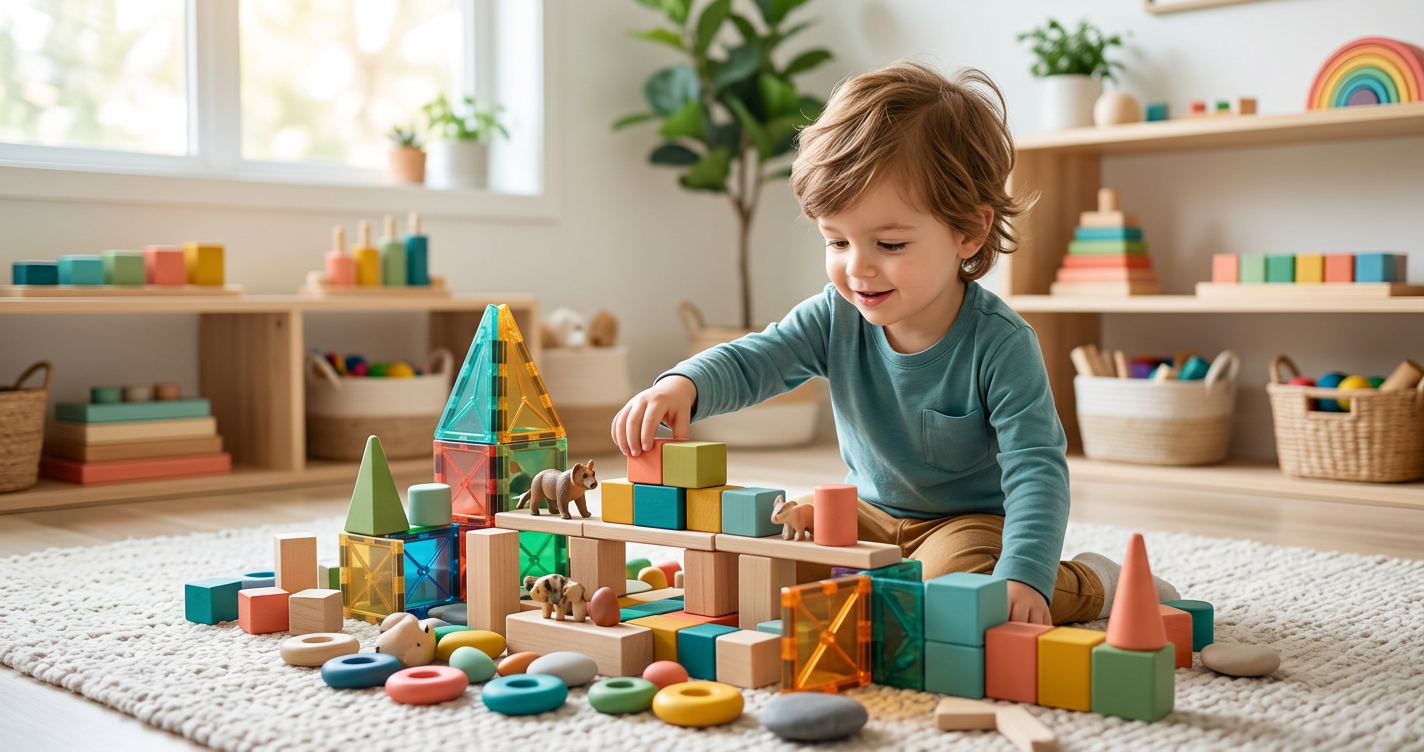
In today's fast-paced world, parents are constantly seeking ways to give their children the best start in life. We often find ourselves drawn to highly structured activities or the latest tech gadgets, hoping they'll provide that crucial edge. But what if the most powerful tools for development are often the simplest, requiring no batteries or complex instructions? Enter open-ended educational toys – a category of playthings that stand out for their incredible ability to foster holistic child development.
Forget the toys that do all the work for your child. We're talking about toys that invite imagination, critical thinking, and boundless creativity. This isn't just about fun; it's about laying robust foundations for learning, problem-solving, and emotional intelligence. In this post, we'll dive deep into what makes open-ended play so profoundly beneficial and how these 'simple' toys can unlock your child's full potential. this excellent toy product
What Exactly Are Open-Ended Educational Toys?
At its core, an open-ended toy is one that doesn't have a single, predetermined outcome or a 'right' way to play. Unlike a puzzle with one solution or a battery-operated toy with limited functions, open-ended toys are a blank canvas. They empower the child to dictate the rules, create the narratives, and explore possibilities without external constraints.
- No Instructions: They come without a manual because the child writes their own.
- Multiple Uses: A block isn't just a block; it can be a phone, a car, food, part of a castle, or a stepping stone.
- Child-Led: The play is entirely driven by the child's imagination and current interests.
- Timeless: These are often classic toys that transcend generations and trends.
Think about classic wooden blocks, LEGO bricks, Play-Doh, art supplies, scarves, simple dolls, or even natural elements like sand and water. These are the tools that transform ordinary moments into extraordinary adventures, nurturing a child's inner world rather than dictating it.
Igniting Creativity and Imagination
Perhaps the most obvious benefit of open-ended educational toys is their unparalleled ability to spark creativity and imagination. When a toy doesn't tell a child what to do, the child's mind steps in to fill that void. This is where the magic happens!
Children invent elaborate scenarios, assume different roles, and solve imaginary challenges. A pile of blankets becomes a fort, a wooden train set morphs into a bustling city, and a simple stick transforms into a magic wand. This constant act of creation isn't just fun; it's a vital exercise for the brain. It fosters divergent thinking – the ability to generate multiple solutions to a problem – which is a cornerstone of innovation in adulthood.
By regularly engaging in imaginative play, children learn to think outside the box, develop storytelling skills, and build rich internal worlds. These are not just pleasant pastimes; they are critical skills for future adaptability and problem-solving in an ever-changing world.
Fostering Critical Thinking and Problem-Solving Skills
While open-ended play might look like pure fun, it's a powerful workshop for developing essential cognitive skills. When building a tower with blocks, a child instinctively learns about balance, gravity, and structural integrity. If the tower falls, they don't give up; they analyze what went wrong and try a new approach. This trial-and-error process is the essence of problem-solving.
- Experimentation: Children test hypotheses and observe outcomes.
- Spatial Reasoning: Understanding how objects relate in space is crucial for building and construction.
- Logical Thinking: Working out cause and effect relationships in their play.
- Persistence: Learning to stick with a challenge until a solution is found.
Whether they're figuring out how to make a dollhouse stable, designing a complex marble run, or strategizing how to move a 'treasure' across a 'lava pit,' children are constantly engaging their critical thinking faculties. These experiences build confidence in their ability to tackle challenges and find solutions independently.
Boosting Social-Emotional Development
Play is often described as the 'work of the child,' and nowhere is this more evident than in its role in social and emotional growth. Open-ended toys, especially when shared, provide rich opportunities for children to practice vital social skills.
- Collaboration: Playing together requires sharing, negotiating, and compromising on ideas.
- Empathy: Role-playing allows children to step into different shoes, understand various perspectives, and practice emotional expression.
- Conflict Resolution: Disagreements naturally arise during shared play, offering chances to learn how to resolve conflicts peacefully.
- Self-Regulation: Managing frustration when a creation doesn't turn out as planned, or waiting for a turn, helps build emotional control and patience.
- Confidence: The sense of accomplishment from self-directed play builds self-esteem and a belief in one's own capabilities.
These social-emotional competencies are not just beneficial for childhood; they are fundamental for healthy relationships, academic success, and overall well-being throughout life.
Supporting Academic Foundations (STEAM/STEM in Disguise)
You might think of educational toys as those specifically designed to teach letters or numbers. However, open-ended toys are often the best 'teachers' because they integrate learning so seamlessly into play that children absorb concepts without even realizing it. They are fantastic for building early STEAM (Science, Technology, Engineering, Art, Math) skills.
- Science: Exploring properties of materials (e.g., how water flows, how sand feels), understanding gravity and balance.
- Technology: Experimenting with simple mechanisms, cause-and-effect (e.g., knocking down a block tower).
- Engineering: Designing and constructing structures, understanding stability and design principles.
- Art: Self-expression, developing fine motor skills, understanding color, texture, and form.
- Math: Counting, sorting, identifying patterns, spatial awareness, and even basic measurement concepts (e.g., 'taller,' 'shorter,' 'more,' 'less').
This hands-on, experiential learning is incredibly powerful. It builds a strong intuitive understanding of academic concepts long before they encounter them in a classroom setting, making formal learning feel more natural and engaging.
Tips for Curating an Open-Ended Play Environment
Ready to harness the power of open-ended play? Here are some friendly, evidence-based tips for creating an environment that encourages deep, imaginative engagement:
- Less is More: A cluttered playroom can be overwhelming. Rotate toys every few weeks to keep things fresh and encourage deeper engagement with fewer items.
- Prioritize Quality Over Quantity: Invest in durable, versatile materials like wooden blocks, high-quality art supplies, or sturdy building sets that will last for years and inspire endless play.
- Mix Textures and Materials: Offer a variety of elements – wood, fabric, natural objects (pinecones, shells), water, sand – to stimulate different senses and encourage diverse explorations.
- Observe Your Child: Pay attention to what genuinely sparks their interest. Sometimes, the most 'mundane' objects become the most treasured playthings.
- Join In (Sometimes): Model imaginative play, but mostly, let your child lead. Resist the urge to direct their play or show them the 'right' way to use a toy.
- Embrace the Mess: A truly engaged child often leaves a trail of creative chaos. View it as evidence of deep learning and exploration.
- Provide Simple Storage: Easy-to-access bins and baskets allow children to take out and put away toys independently, fostering responsibility.
Conclusion
In a world that often pushes for more, faster, and flashier, the beauty of open-ended educational toys lies in their simplicity and timeless appeal. They don't just entertain; they educate, inspire, and empower. By choosing these thoughtful playthings, you're not just providing toys; you're offering your child the invaluable gift of self-discovery, creativity, critical thinking, and social-emotional intelligence – building blocks for a truly successful and fulfilling life.
So, take a deep breath, clear out some clutter, and watch as your child, armed with just a few versatile tools, builds entire worlds and unlocks the boundless potential within themselves. The power of play is truly transformative!


