In a world that's constantly evolving, where technology reshapes industries and innovation drives progress, equipping our children with the skills to thrive isn't just an option—it's a necessity. This is where educational toys, specifically STEM toys, step into the spotlight. Far more than just playthings, these thoughtfully designed tools are gateways to discovery, critical thinking, and a lifelong love for learning. But what exactly are STEM toys, and how can they truly make a difference in your child’s development? Let’s dive into the fascinating world of Science, Technology, Engineering, and Math through play!
What Exactly Are STEM Toys? Beyond Just Fun and Games
STEM stands for Science, Technology, Engineering, and Math. A STEM toy, therefore, is any toy that encourages children to explore and experiment with concepts from these four crucial fields. They’re designed to be hands-on, engaging, and often open-ended, allowing children to learn by doing, failing, and trying again. Think beyond traditional textbooks and rote memorization; STEM toys transform abstract ideas into tangible, playful experiences. this excellent toy product
- Science: Toys that explore natural phenomena, biology, chemistry, or physics (e.g., chemistry sets, observation kits, telescopes).
- Technology: Toys that introduce basic coding, robotics, or digital literacy (e.g., coding robots, circuit kits, programmable drones).
- Engineering: Toys that involve building, designing, and problem-solving structures or mechanisms (e.g., building blocks, LEGOs, K'nex, magnetic tiles).
- Math: Toys that teach counting, patterns, geometry, logic, or spatial reasoning (e.g., shape sorters, abacus, pattern blocks, logic puzzles).
The beauty of STEM toys lies in their ability to integrate these subjects, showing children how they are interconnected and essential for understanding the world around them.
The Brain-Boosting Benefits: Why STEM Toys Matter for Development
The advantages of incorporating STEM toys into a child's playtime are extensive, impacting not just their academic readiness but also crucial life skills. Experts and developmental psychologists consistently highlight the profound benefits of active, exploratory play.
Cultivating Critical Thinking and Problem-Solving
When a child is building a bridge that keeps collapsing or trying to make a robot follow a specific path, they're engaging in complex problem-solving. They learn to identify the issue, brainstorm solutions, test hypotheses, and adapt their approach. This iterative process is the foundation of critical thinking, a skill invaluable in every aspect of life, from school projects to future careers.
Igniting Creativity and Innovation
While often associated with logic and structure, STEM toys are also powerful tools for fostering creativity. Open-ended building sets, for instance, allow children to imagine and construct anything they can dream up. They learn that there isn't just one 'right' way to solve a problem, encouraging innovative thinking and the confidence to express unique ideas.
Enhancing Fine Motor Skills and Spatial Reasoning
Manipulating small pieces, connecting circuits, or carefully stacking blocks all require precision and control, significantly boosting fine motor skills. Simultaneously, children develop spatial reasoning – the ability to visualize and understand objects in space. This skill is critical for everything from reading maps to understanding geometry and even excelling in sports.
Fostering Persistence and Resilience
Let's be honest: not every experiment works on the first try! STEM toys often present challenges that require multiple attempts. This process teaches children the invaluable lessons of persistence and resilience. They learn that failure isn't an endpoint but a stepping stone to discovery, fostering a 'growth mindset' crucial for overcoming future obstacles.
Choosing the Right STEM Toys for Every Age and Stage
The world of STEM toys is vast, with options tailored for every developmental stage. Here’s a quick guide to help you select the perfect educational toys for your child:
Infants & Toddlers (0-3 Years): Foundations of Discovery
At this age, STEM play is all about sensory exploration and basic cause-and-effect. Look for toys that encourage stacking, sorting, and manipulating. Simple building blocks, shape sorters, nesting cups, and sensory tables introduce foundational concepts like size, shape, gravity, and basic engineering principles.
Preschoolers (3-5 Years): Hands-On Exploration
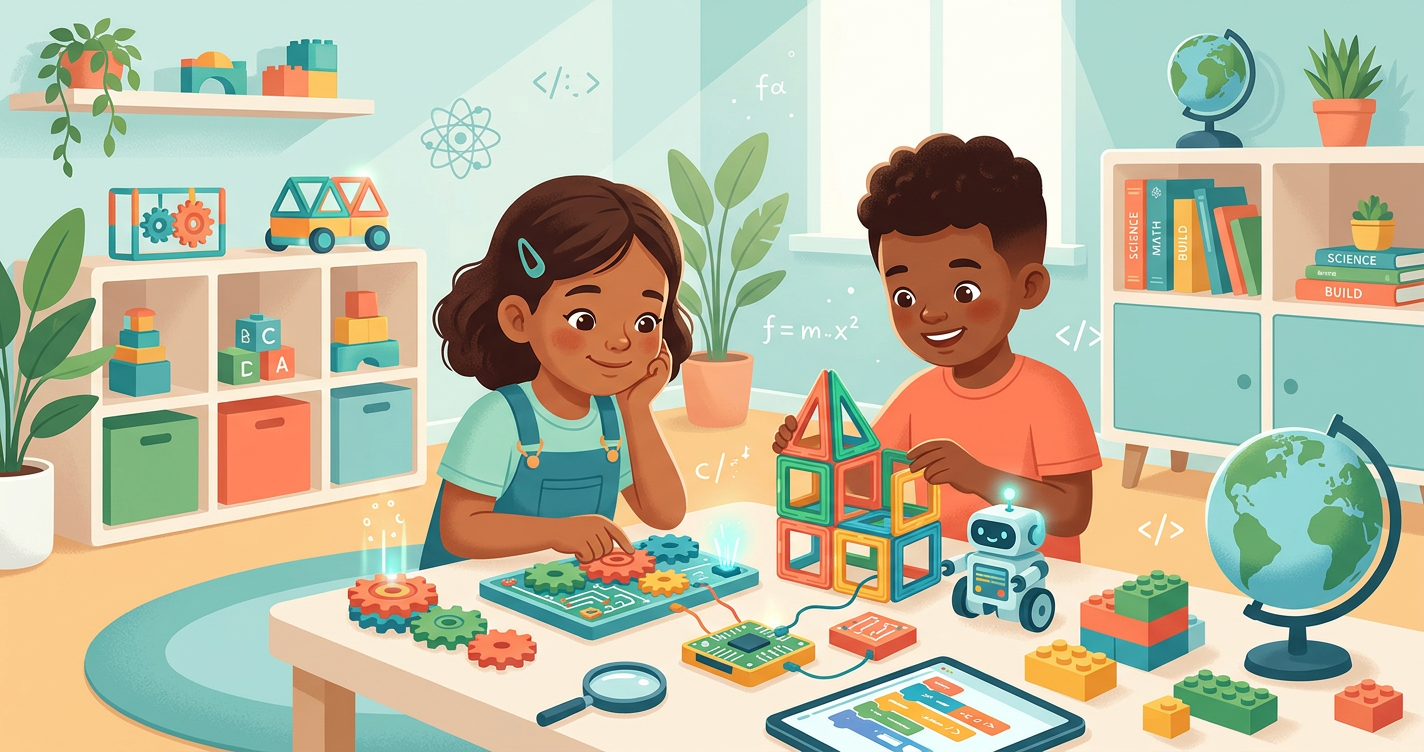
Preschoolers are curious and ready for more complex challenges. Magnetic tiles, larger LEGO DUPLO sets, simple gear systems, and beginner circuit kits are excellent choices. These toys encourage imaginative construction, understanding connections, and early logical thinking, all while developing fine motor skills.
School-Aged Kids (6+ Years): Advanced Challenges and Real-World Connections
As children grow, they can tackle more intricate STEM concepts. Robotics kits, coding games, advanced chemistry sets, telescopes, microscope kits, and intricate model-building sets become highly engaging. These toys not only deepen their understanding of STEM principles but also connect these concepts to real-world applications and potential career paths.
Screen Time vs. STEM Play: Finding a Healthy Balance
In our digital age, balancing screen time with hands-on play is a common challenge for parents. While certain educational apps and games can offer valuable learning experiences, nothing quite replaces the tactile, multi-sensory engagement of physical STEM toys. Hands-on play stimulates different parts of the brain, encourages physical manipulation, and often involves collaborative interaction, which screens cannot fully replicate.
Consider STEM toys as a fantastic alternative or complement to digital entertainment. They offer an active form of learning, where children are the creators and problem-solvers, rather than passive consumers of content. By providing appealing STEM options, you can naturally draw your child away from screens and into a world of tangible discovery.
Practical Tips for Parents: Maximizing the STEM Toy Experience
Simply buying a STEM toy isn't enough; how you engage with it can significantly amplify its benefits. Here are some friendly, evidence-based tips:
- Play Together: Join in the fun! Your enthusiasm is contagious. Playing alongside your child shows them you value their learning and provides opportunities for shared discovery.
- Ask Open-Ended Questions: Instead of giving instructions, ask questions like, "What do you think will happen if...?" "How could we make this stronger?" or "What else could this do?" This encourages critical thinking and creativity.
- Embrace Failure: When a tower tumbles or an experiment doesn't work, frame it as a learning opportunity. "That didn't work the way we expected. What did we learn? What can we try differently next time?"
- Connect to Real Life: Point out how STEM concepts appear in everyday life. "Look at how that bridge is built – just like your LEGO structure!" or "That recipe is like a science experiment!"
- Provide a "STEM Space": Dedicate a corner or table where your child can freely explore and leave projects in progress. This fosters a sense of ownership and encourages sustained engagement.
Beyond the Toy Box: Integrating STEM into Everyday Life
The principles of STEM aren't confined to specific toys; they're all around us! You can foster a STEM mindset in your child by:
- Cooking and Baking: Measuring ingredients, understanding chemical reactions (like yeast rising), and following steps are all scientific and mathematical.
- Gardening: Observing plant growth, understanding ecosystems, and basic biology.
- Nature Walks: Identifying plants and animals, discussing weather patterns, and observing natural phenomena.
- Simple Home Repairs: Involving them in fixing things (safely!), showing how tools work, and understanding basic mechanics.
- Travel and Exploration: Using maps, understanding distances, and learning about different cultures and technologies.
Conclusion: Building Brighter Futures, One STEM Toy at a Time
Investing in STEM toys is more than just buying another plaything; it’s an investment in your child's future. By providing opportunities for hands-on exploration, critical thinking, and creative problem-solving, you're not just nurturing a love for science, technology, engineering, and math – you're building the foundations for adaptable, innovative, and resilient individuals. So, go ahead, explore the wonderful world of STEM toys. Encourage curiosity, celebrate experimentation, and watch as your child discovers their innate potential to become a future innovator, one exciting build, code, or experiment at a time!