
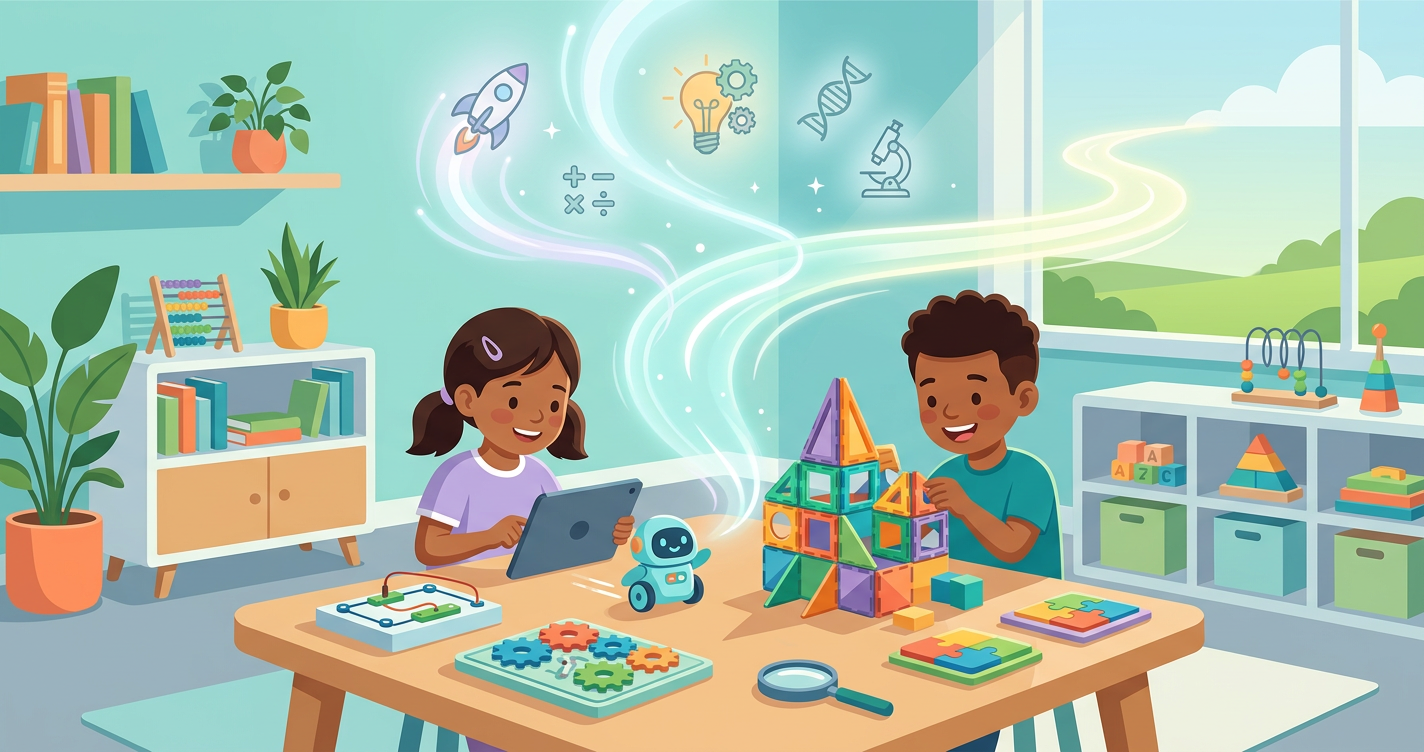
In a world that’s constantly evolving, preparing our children for the future means equipping them with more than just basic knowledge. It means fostering curiosity, critical thinking, problem-solving skills, and a love for discovery. This is where STEM toys come into play – a powerful category of educational toys designed to engage young minds in Science, Technology, Engineering, and Mathematics, often without them even realizing they’re learning!
Far from being rigid or academic, the best STEM toys are all about playful exploration. They transform abstract concepts into tangible experiences, allowing children to build, experiment, and innovate from their earliest years. Let’s dive into how these remarkable toys are not just fun, but foundational for early childhood development. this excellent toy product
What Exactly Are STEM Toys and Why Do They Matter?
STEM is an acronym for Science, Technology, Engineering, and Mathematics. STEM toys are specifically designed to introduce children to these four interconnected disciplines in an accessible, engaging, and age-appropriate manner. They aren't just about memorizing facts; they're about fostering a mindset of inquiry, creativity, and resilience.
Why do they matter so much, especially for young children? Research consistently shows that early exposure to STEM concepts can significantly impact a child's cognitive development, problem-solving abilities, and even their future academic and career paths. By integrating these areas into play, children develop:
- Critical Thinking: Analyzing situations and making reasoned judgments.
- Problem-Solving: Identifying challenges and devising solutions.
- Creativity and Innovation: Imagining new ideas and bringing them to life.
- Collaboration: Working with others to achieve a common goal.
- Perseverance: Sticking with a task even when it's challenging.
These aren't just skills for future scientists or engineers; they are essential life skills that empower children to navigate complexities in any field, making STEM toys an invaluable investment in their holistic development.
Science in Play: Nurturing Curiosity and Observation
Science is all about exploring the natural world, asking questions, and understanding how things work. STEM toys that focus on science are brilliant for sparking a child's innate curiosity. Think of a simple magnifying glass that transforms a common leaf into a world of intricate veins, or a discovery kit that lets them unearth 'fossils'.
Examples of science-focused toys include:
- Nature Exploration Kits: Magnifying glasses, bug viewers, binoculars for bird watching.
- Simple Chemistry Sets: Safe, non-toxic experiments that teach about reactions (e.g., baking soda volcanoes).
- Sensory Bins: Exploring textures, weights, and properties of different materials.
- Building Blocks & Magnets: Understanding gravity, balance, and magnetic forces.
Through these playful interactions, children develop observational skills, learn to form hypotheses, and grasp basic scientific principles. This early exposure lays the groundwork for a lifelong appreciation of the natural world and a scientific approach to problem-solving. As Dr. Deborah Stipek, former Dean of Stanford University's Graduate School of Education, notes, "When children are encouraged to explore and experiment, they develop a positive attitude toward science and a sense of their own capabilities as learners."
Tech-Savvy Tots: Introducing Technology Without Screens
When we talk about technology in STEM toys for toddlers, we're not advocating for more screen time. Instead, it’s about understanding the fundamental principles behind technology – coding, logic, and how systems work. These toys introduce computational thinking, a crucial skill in our digital age.
Consider these examples:
- Coding Robots: Simple, screen-free robots (like Bee-Bot or Code & Go Robot Mouse) that children program with directional buttons to complete mazes or tasks. This teaches sequencing, cause and effect, and basic algorithms.
- Circuit Kits: Snap-together kits that allow children to build simple circuits, understanding how electricity flows to light up an LED or power a fan.
- Interactive Learning Systems: Toys that respond to inputs, teaching children about commands and feedback loops.
These toys demystify technology, making it less intimidating and more understandable. They foster logical reasoning and problem-solving skills, preparing children to be creators and innovators in a technologically driven world, rather than just passive consumers.
Engineering Minds: Building, Designing, and Innovating
Engineering is all about designing and building solutions to problems. This is perhaps the most visible aspect of many STEM toys, as it directly involves hands-on construction and creative design. Toys that encourage building are fantastic for developing spatial reasoning – the ability to understand and remember the spatial relationships between objects.
Popular engineering-focused toys include:
- LEGOs and Duplos: The classic building blocks that allow for endless creations, teaching stability, structure, and design.
- Magnetic Tiles: Combining geometric shapes with magnetic forces to build intricate 2D and 3D structures.
- K'nex and Lincoln Logs: Different connection methods that challenge children to think about joints and stability.
- Wooden Blocks: Simple yet powerful tools for understanding balance, weight, and architectural principles.
Through engineering play, children develop fine motor skills, hand-eye coordination, and a deep understanding of cause and effect. They learn to plan, execute, and troubleshoot – invaluable skills that build resilience and an innovative spirit. As children experiment with different designs and materials, they learn from trial and error, a cornerstone of the engineering process.
Making Math Fun: Numbers, Shapes, and Patterns
For many, math can seem daunting, but STEM toys make it approachable and enjoyable from an early age. They integrate mathematical concepts naturally into play, helping children develop number sense, spatial awareness, and logical reasoning without the pressure of formal learning.
Look for toys that incorporate:
- Counting and Sorting: Counting bears, abacuses, shape sorters, or even simple puzzles with numbered pieces.
- Geometry and Spatial Reasoning: Shape sorters, pattern blocks, tangrams, or even building blocks that teach about symmetry and dimensions.
- Measurement and Comparison: Balance scales, measuring cups in a play kitchen, or toys that involve comparing sizes and weights.
- Patterns and Sequencing: Beads for stringing in patterns, pattern blocks, or games that require logical sequencing.
By engaging with these toys, children develop a foundational understanding of mathematical concepts, making future learning much easier. They learn that math isn't just about numbers, but also about patterns, relationships, and problem-solving in a tangible way. This playful approach can turn potential math anxiety into math enthusiasm.
How to Choose the Best STEM Toys for Your Child
With so many options, selecting the right STEM toys can feel overwhelming. Here are some friendly, evidence-based tips to guide your choices:
- Consider Age Appropriateness: Toys should match your child's developmental stage. A toy too simple might bore them, while one too complex could frustrate them. Look for recommendations on packaging.
- Prioritize Open-Ended Play: The best STEM toys can be used in multiple ways, encouraging creativity and imagination. Toys with a single function might offer less long-term engagement than those that allow for varied experimentation.
- Durability and Safety First: Especially for younger children, ensure toys are made from safe, non-toxic materials and can withstand enthusiastic play.
- Follow Your Child's Interests: If your child loves animals, look for science kits related to nature. If they enjoy building, invest in advanced construction sets. Their intrinsic motivation is a powerful learning tool.
- Encourage Interaction: While some STEM toys are great for independent play, many offer wonderful opportunities for parent-child interaction. Playing alongside your child and asking open-ended questions can significantly enhance the learning experience.
Beyond the Toy Box: Maximizing STEM Learning at Home
Remember, a STEM toy is just a tool. The real magic happens through interaction, exploration, and the environment you create at home. Here’s how you can amplify the learning:
- Create a STEM-Friendly Space: Dedicate a corner for building, experimenting, or even just storing materials like recycled boxes, paper, and craft supplies for spontaneous engineering projects.
- Ask Open-Ended Questions: Instead of telling them what to do, ask, "What do you think will happen if…?" or "How could we make this stronger/taller/faster?" This encourages critical thinking.
- Embrace Experimentation and 'Failure': Not every experiment will work as planned, and that's okay! Teach them that mistakes are opportunities to learn and adjust. "What did we learn from that?" is a powerful question.
- Model Curiosity: Show your own interest in how things work. Point out STEM concepts in everyday life – the engineering behind a bridge, the science of cooking, the patterns in nature.
- Connect to Real-Life: Take trips to science museums, nature parks, or even just observe how a car works. Show them how STEM applies to the world around them.
Unlock Their Potential Today!
Investing in high-quality educational toys, particularly those focusing on STEM, is one of the most impactful ways to support your child's childhood development. These toys aren't just about preparing them for a specific career; they're about nurturing a lifelong love of learning, fostering resilience, and equipping them with the critical thinking skills needed to thrive in any future. So, go ahead – explore the wonderful world of STEM toys and watch your child's mind flourish!


