
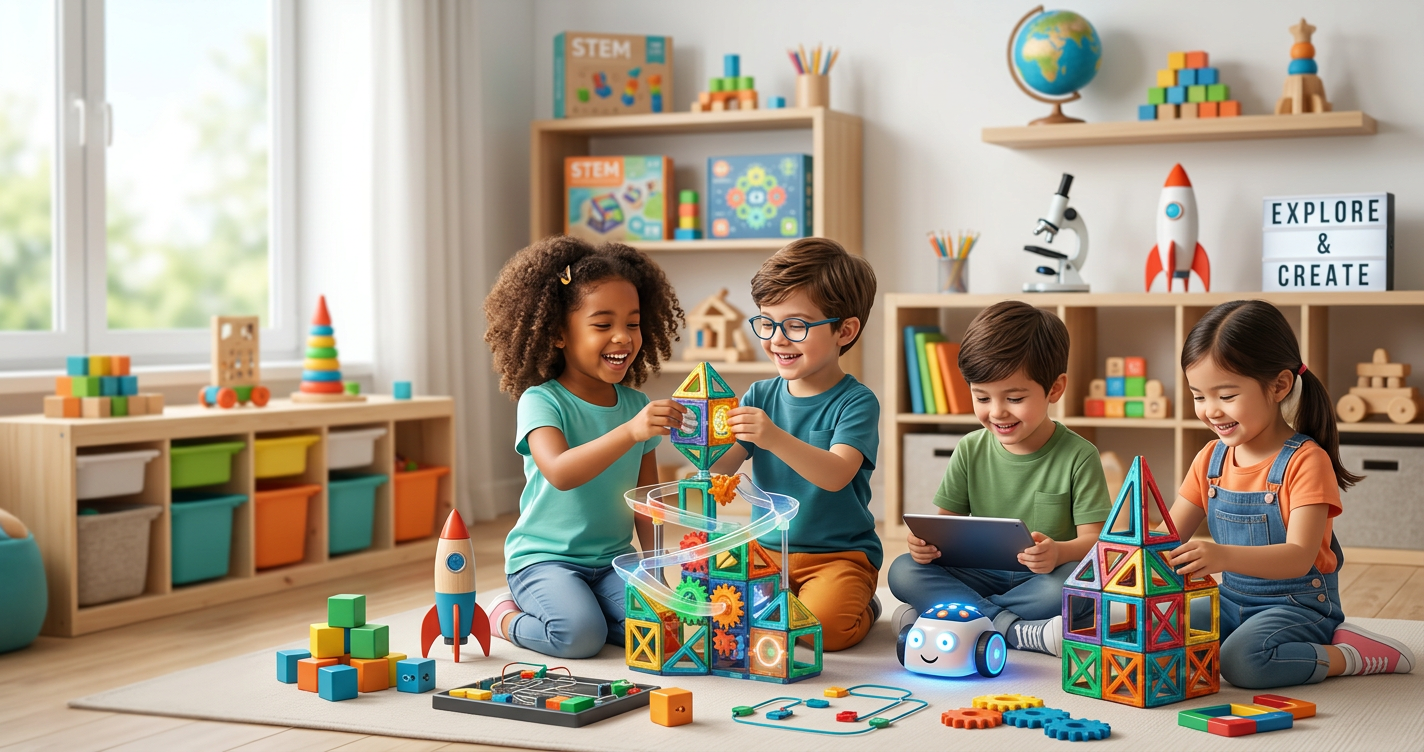
In a world that's constantly evolving, preparing our children for the future means equipping them with more than just rote knowledge. It means fostering curiosity, resilience, and a passion for discovery. This is where STEM toys — those focused on Science, Technology, Engineering, and Mathematics — shine brightest. Far from being mere playthings, these educational tools are powerful catalysts for cognitive development, critical thinking, and the foundational skills necessary for tomorrow's leaders and innovators. Let's explore how integrating STEM toys into your child's playtime can unlock their full potential and set them on a path of lifelong learning and success.
What Exactly Are STEM Toys? Beyond Just "Smart" Play
When we talk about STEM toys, we're not just referring to anything that looks vaguely scientific. True STEM toys are designed to engage children in hands-on exploration of the core principles of Science, Technology, Engineering, and Mathematics. They encourage experimentation, problem-solving, and creative thinking, rather than simply providing answers. this excellent toy product
Unlike traditional toys that might offer passive entertainment, STEM toys demand active participation. They transform abstract concepts into tangible, interactive experiences. Think beyond simple building blocks; imagine circuit kits that light up, robotics sets that teach basic coding, chemistry experiments that fizz and change color, or engineering challenges that require structural integrity and design. These are the tools that inspire children to ask "how" and "why," fostering a deeper understanding of the world around them.
The Cognitive Supercharge: How STEM Toys Build Brainpower
The benefits of STEM toys extend far beyond preparing children for a specific career path. They are fundamental in shaping cognitive abilities that are crucial for all aspects of life.
Fostering Critical Thinking and Problem-Solving
At the heart of STEM play lies the challenge. Whether it's figuring out why a robot isn't moving as expected or designing a bridge that can hold a specific weight, children are constantly presented with puzzles to solve. This process encourages them to analyze situations, develop hypotheses, test solutions, and learn from outcomes. Research consistently shows that engaging in such activities strengthens neural pathways associated with logical reasoning, strategic planning, and the ability to approach complex problems systematically.
Nurturing Creativity and Innovation
It's a common misconception that STEM is solely about rigid logic. In reality, innovation thrives on creativity. STEM toys, especially open-ended ones, provide a canvas for imagination. Children aren't just following instructions; they're often encouraged to design their own creations, find unique solutions, or invent new ways to use the components. This blend of structured learning and imaginative freedom is vital for developing the kind of out-of-the-box thinking that drives progress.
Enhancing Spatial Reasoning and Fine Motor Skills
Many STEM toys involve building, assembling, and manipulating objects. This hands-on interaction is excellent for developing spatial reasoning – the ability to understand and reason about objects in three-dimensional space. Children learn about shapes, sizes, angles, and how parts fit together. Simultaneously, the precise movements required to connect pieces, turn screws, or wire circuits significantly enhance fine motor skills and hand-eye coordination, which are foundational for writing, drawing, and many daily tasks.
Cultivating Resilience and a Growth Mindset
Not every experiment will succeed on the first try, and not every structure will stand tall. STEM play inherently involves trial and error, which can be frustrating but incredibly rewarding. When a child learns to persevere through challenges, to adjust their approach after a failure, and to celebrate the eventual success, they are building resilience. This process instills a "growth mindset," teaching them that abilities can be developed through dedication and hard work, rather than being fixed. This mindset is invaluable for overcoming obstacles throughout life.
Preparing for Tomorrow: STEM Toys and Future-Ready Skills
Beyond cognitive benefits, STEM toys directly address the demands of an increasingly technology-driven world, equipping children with skills that will be essential for their future.
Demystifying Technology and Coding Early On
In our digital age, understanding technology is no longer optional. Age-appropriate coding toys and robotics kits introduce children to the fundamentals of computational thinking – breaking down problems, recognizing patterns, and designing algorithms – often without a screen. This early exposure demystifies technology, builds confidence, and lays a crucial foundation for digital literacy, making children consumers and creators of technology.
Sparking Curiosity in Science and Engineering
STEM toys transform abstract scientific concepts into exciting, tangible experiences. A chemistry set can ignite a passion for chemical reactions, a telescope can spark wonder about astronomy, and an engineering kit can reveal the physics behind structures. By making science and engineering fun and accessible, these toys can foster a lifelong curiosity and potentially guide children towards pursuing these vital fields in their education and careers.
Developing Collaboration and Communication (Social STEM)
While often seen as individual pursuits, many STEM challenges benefit greatly from teamwork. Building a complex structure, conducting a multi-step experiment, or programming a robot can be fantastic collaborative activities. Children learn to share ideas, delegate tasks, communicate their thought processes, and negotiate solutions. These social skills are paramount in any future workplace and in life.
Choosing the Right STEM Toys for Every Age
The beauty of STEM toys is their adaptability. There's something for every developmental stage, ensuring engagement and appropriate challenge.
Toddlers (1-3 years)
For the youngest learners, focus on sensory exploration and basic cause-and-effect. Simple building blocks, shape sorters, nesting cups, and stacking toys introduce fundamental concepts like size, shape, balance, and spatial relationships. Look for durable, non-toxic materials that encourage open-ended play.
Preschoolers (3-5 years)
This age group thrives on exploration and early problem-solving. Magnet tiles, more complex construction sets (like LEGO Duplo), simple science kits (e.g., growing crystals, mixing colors), and screen-free coding games (e.g., coding robots that follow pathways) are excellent choices. These toys encourage storytelling and imaginative play alongside STEM concepts.
Early Elementary (6-8 years)
Children in early elementary are ready for more structured challenges. Robotics kits with basic programming, complex LEGO sets, simple circuit boards, beginner chemistry sets, and engineering challenges (e.g., K'nex, Erector sets) will capture their interest. These toys allow for longer engagement and a deeper dive into specific STEM principles.
Pre-Teens & Beyond (9+ years)
As children mature, they can handle more sophisticated concepts and intricate designs. Advanced robotics platforms, Arduino or Raspberry Pi kits, detailed chemistry or physics sets, drone building kits, and engineering design challenges offer endless opportunities for learning. At this stage, connecting their toy experiences to real-world applications can be incredibly motivating.
Beyond the Toy: Maximizing STEM Play at Home
While the toys themselves are powerful, adult involvement can significantly amplify their impact. You don't need to be a scientist or engineer to support your child's STEM journey.
- Encourage Exploration, Don't Just Provide Answers: When your child faces a challenge, resist the urge to jump in and solve it. Instead, ask guiding questions like, "What do you think went wrong?" or "What's another way you could try that?"
- Join in the Play: Show genuine interest in what they're building or discovering. Play alongside them, ask questions, and share in their excitement when they succeed.
- Connect Play to the Real World: Point out how the concepts they're exploring with their toys apply to everyday life. "Look, that bridge uses the same arch design you built!" or "This recipe is like a chemistry experiment!"
- Celebrate Effort, Not Just Outcomes: Emphasize the learning process, the persistence, and the creativity, even if the final outcome isn't perfect.
- Create a "STEM-Friendly" Environment: Provide a dedicated space for building and experimenting, and don't be afraid of a little mess! Offer resources like books about inventors, scientists, or engineers.
Conclusion
Investing in STEM toys is an investment in your child's future. These aren't just gadgets; they are gateways to understanding, innovation, and self-discovery. By fostering critical thinking, creativity, resilience, and essential future-ready skills, STEM toys empower children to become active participants in shaping their world. So, embrace the power of playful exploration, encourage their natural curiosity, and watch as your child embarks on an exciting journey of lifelong learning and brilliance. The future innovators are playing right now, and with the right tools, their potential is limitless!


