Unlocking Brilliance: How STEM Toys Build Critical Thinking and Problem-Solving Skills in Children
In a rapidly evolving world, preparing our children for future success means equipping them with more than just facts; it means fostering essential skills like critical thinking, creativity, and adaptability. Enter STEM toys – the unsung heroes of modern playrooms. Far from being just fun distractions, these engaging educational tools are powerful catalysts for developing the very cognitive abilities children need to thrive. If you’ve ever wondered how to ignite a passion for learning and equip your child with real-world problem-solving prowess, you're in the right place. Let’s explore how STEM toys are revolutionizing playtime and building the innovators of tomorrow.
What Exactly Are STEM Toys? A Foundation for Future Innovators
Before diving into the benefits, let's clarify what we mean by STEM. STEM stands for Science, Technology, Engineering, and Mathematics. A STEM toy is any plaything specifically designed to introduce children to these core concepts in an interactive, hands-on, and often playful way. Unlike traditional toys that might focus solely on imagination or physical activity, STEM toys challenge children to explore, experiment, and think logically. this excellent toy product
They are not just about memorizing scientific principles or mathematical formulas. Instead, they encourage:
- Science: Fostering curiosity about the natural world, encouraging observation, and hypothesis testing.
- Technology: Introducing basic digital literacy, coding concepts, or understanding how simple machines work.
- Engineering: Developing design skills, construction principles, and understanding structural integrity.
- Mathematics: Enhancing spatial reasoning, pattern recognition, logical sequencing, and measurement concepts.
The beauty of these educational toys lies in their ability to make complex ideas accessible and exciting, turning learning into an adventure.
Beyond Rote Learning: The Core Benefits of STEM Play
The impact of engaging with STEM toys extends far beyond basic subject matter. They are instrumental in cultivating a suite of invaluable cognitive and life skills.
Cultivating Critical Thinking: Asking "Why?" and "How?"
Critical thinking is the ability to analyze information objectively and make a reasoned judgment. STEM toys inherently promote this by presenting challenges that require children to think deeply. Whether it's figuring out why a bridge keeps collapsing, debugging a simple line of code, or understanding the cause-and-effect of a science experiment, children are constantly asking, “Why did this happen?” and “How can I make it better?” This process strengthens their analytical skills, encourages logical deduction, and teaches them to evaluate different approaches.
Mastering Problem-Solving: From Challenge to Triumph
Perhaps one of the most significant benefits, problem-solving skills are at the heart of STEM play. Children are naturally curious and often encounter obstacles when building, experimenting, or coding. STEM toys provide a safe, engaging environment for them to practice identifying problems, brainstorming solutions, testing those solutions (often through trial and error), and adapting their strategies. This iterative process builds resilience, persistence, and the confidence to tackle real-world challenges later in life.
Sparking Creativity and Innovation
While often associated with logic, STEM fields are deeply rooted in creativity. Educational STEM toys empower children to design unique solutions, invent new contraptions, and think outside the box. They learn that there isn't always one right answer and that innovative thinking often leads to breakthroughs. Building a robot that can navigate an obstacle course or designing a structure that withstands a simulated earthquake requires immense imaginative thinking.
Fostering Collaboration and Communication
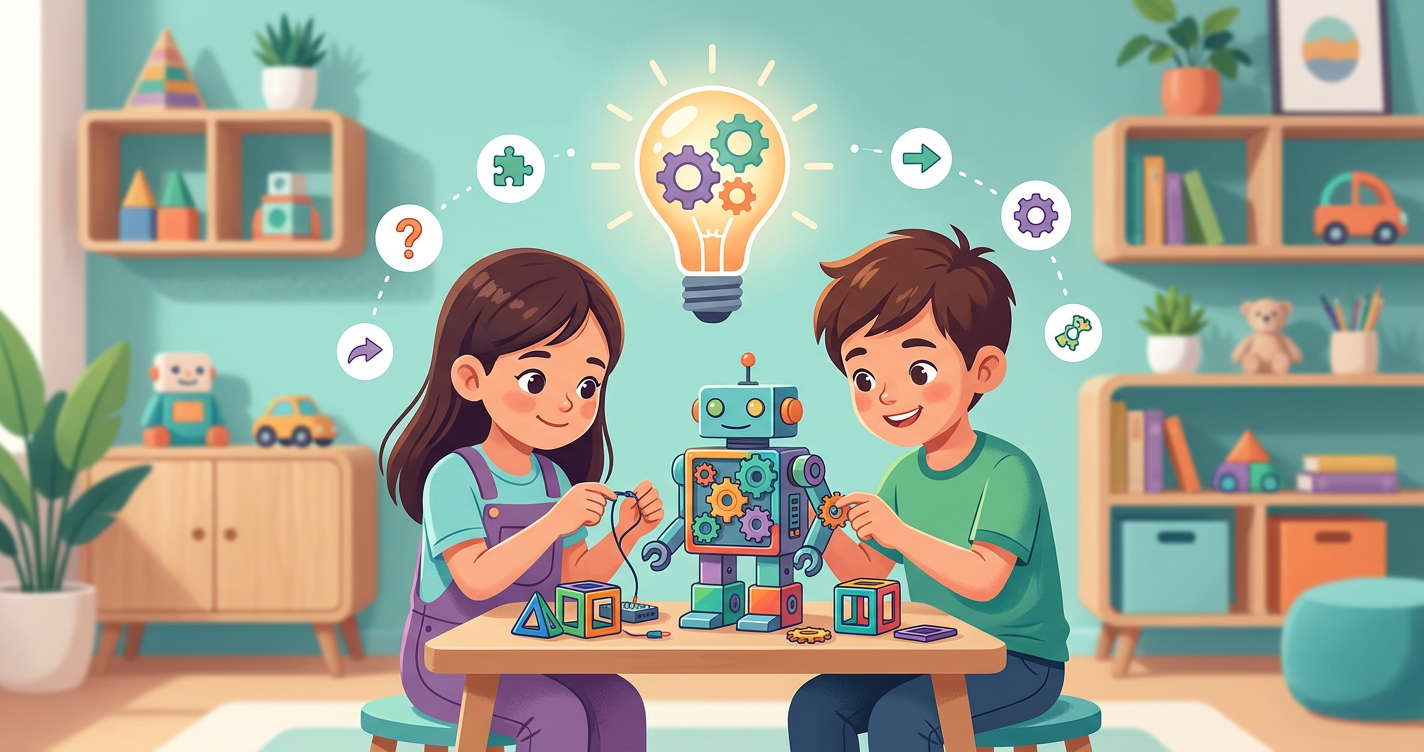
Many STEM activities lend themselves perfectly to group play. Working together on a complex building project, programming a robot as a team, or conducting a science experiment with a partner encourages children to communicate their ideas, listen to others, and negotiate solutions. These collaborative experiences are crucial for developing social skills and learning the value of teamwork.
STEM in Action: Age-Appropriate Toy Ideas for Every Stage
The beauty of STEM toys is that they cater to a wide range of developmental stages, ensuring that learning is always engaging and appropriately challenging.
Toddlers & Preschoolers (Ages 2-5): Laying the Groundwork
For our youngest learners, STEM play focuses on foundational concepts. Look for:
- Large Building Blocks (e.g., DUPLO, magnetic tiles): Develop spatial reasoning, balance, and early engineering concepts.
- Shape Sorters and Simple Puzzles: Enhance pattern recognition, logic, and fine motor skills.
- Discovery Tables and Sensory Bins: Encourage early science exploration through textures, weights, and water play.
Early Elementary (Ages 6-9): Exploring & Experimenting
As children grow, their capacity for more complex challenges expands. Consider:
- Basic Robotics Kits (e.g., snap circuits, simple coding robots): Introduce circuits, cause-and-effect, and sequential thinking without screens.
- Science Experiment Kits (e.g., volcano kits, crystal growing sets): Provide hands-on experience with chemistry and physics fundamentals.
- Construction Kits (e.g., LEGO Technic, K'nex): Foster advanced engineering design and structural understanding.
Upper Elementary & Middle School (Ages 10-14): Deepening Engagement
Older children are ready for more sophisticated challenges that truly hone their critical thinking.
- Advanced Robotics and Drone Kits: Involve complex engineering, programming, and understanding of mechanics.
- Circuitry and Electronics Projects: Offer deeper insights into technology and electrical systems.
- Logic Puzzles and Strategy Games: Sharpen advanced critical thinking, deductive reasoning, and strategic planning.
The Science Behind the Play: Evidence for STEM's Impact
The effectiveness of STEM toys isn't just anecdotal; it's backed by educational psychology and cognitive science. Research consistently shows that hands-on, play-based learning, especially in STEM fields, significantly boosts cognitive development. When children actively manipulate objects, experiment with ideas, and solve problems, they build stronger neural pathways. This direct engagement fosters deeper understanding and retention than passive learning methods. Experts in early childhood development, such as Jean Piaget and Lev Vygotsky, emphasized the critical role of active exploration and social interaction in children's learning, principles that STEM toys embody perfectly.
Choosing the Right STEM Toy: A Parent's Practical Guide
With so many options, selecting the perfect educational toy can feel overwhelming. Here are some tips:
- Consider Age-Appropriateness: A toy should be challenging enough to engage but not so difficult that it causes frustration. Always check manufacturer recommendations.
- Align with Interests: If your child loves dinosaurs, look for a STEM kit that explores paleontology or builds a robotic dino. Passion fuels engagement!
- Prioritize Open-Ended Play: The best STEM toys can be used in multiple ways, encouraging imaginative design and diverse problem-solving approaches rather than a single solution.
- Look for Durability and Safety: High-quality, non-toxic materials ensure the toy can withstand repeated use and is safe for your child.
- Check for Educational Value: Does it genuinely teach a concept or just provide entertainment? Look for toys that encourage experimentation and critical thought.
Integrating STEM Play into Daily Life: More Than Just Toys
The benefits of STEM toys can be amplified by integrating STEM principles into everyday life. Here’s how parents can encourage continuous learning:
- Ask Open-Ended Questions: Instead of giving answers, prompt curiosity. “What do you think will happen if…?” or “How could we make this stronger?”
- Encourage Experimentation: Allow for mistakes and celebrate the learning process. “Let’s try it another way!”
- Connect to Real-World Scenarios: Point out how STEM concepts are present everywhere – the engineering of a bridge, the technology in a smartphone, the math in baking.
- Provide a Supportive Environment: Create a space where exploration is encouraged, and failures are seen as opportunities to learn.
Conclusion: Building a Brighter Future, One STEM Toy at a Time
STEM toys are more than just playthings; they are vital investments in our children’s future. By engaging with these incredible educational toys, children don't just learn about science, technology, engineering, and math; they develop the critical thinking, problem-solving, and creative skills essential for navigating an increasingly complex world. As parents, embracing STEM play is one of the most powerful ways we can empower our children to become confident, capable, and innovative thinkers ready to shape a brighter tomorrow. So, go ahead – explore the exciting world of STEM toys and watch your child’s brilliance unfold!