
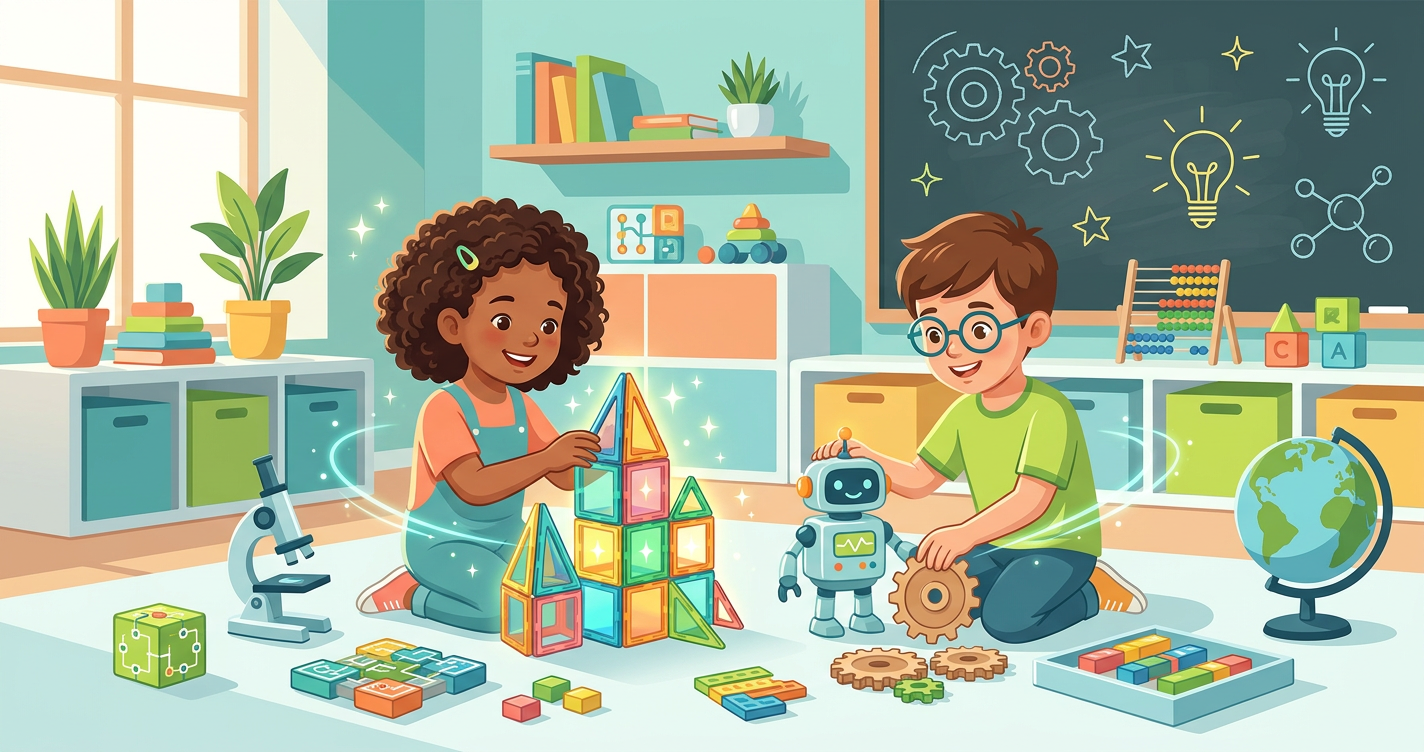
As parents, we all want to give our children the best possible start in life. In a world that's constantly evolving with technological advancements, nurturing foundational skills from an early age has never been more crucial. This is where STEM toys come into play – a powerful, playful gateway to critical thinking, creativity, and problem-solving for our little ones. Far from being just a buzzword, STEM (Science, Technology, Engineering, and Math) education, especially when introduced through engaging play, lays a robust groundwork for future learning and success.
You might be thinking, "My toddler can barely tie their shoes; how can they grasp engineering?" And that's a perfectly natural thought! But STEM for early childhood isn't about complex equations or coding algorithms. It's about fostering curiosity, encouraging exploration, and building a love for discovery through hands-on experiences. Imagine your child stacking blocks, observing how water flows, or figuring out how a simple gear mechanism works – they're already engaging with STEM principles without even realizing it. In this friendly, evidence-based guide, we'll dive into why STEM toys are invaluable for toddlers and preschoolers, how they fuel brain growth, and how you can seamlessly integrate them into your child's daily play. this excellent toy product
What Exactly Are STEM Toys and Why Do They Matter for Little Ones?
At its core, STEM stands for Science, Technology, Engineering, and Mathematics. When we talk about STEM toys for young children, we're referring to playthings specifically designed to introduce these concepts in an age-appropriate, hands-on, and fun way. They aren't textbooks in disguise; they are tools for exploration and discovery.
- Science: Encourages observation, prediction, and experimentation. Think magnifying glasses, simple chemistry sets (safe ones!), or toys that explore natural phenomena.
- Technology: Involves using tools to solve problems or create things. This doesn't necessarily mean screens; it can be as simple as a pulley system or a toy robot.
- Engineering: Focuses on design, construction, and problem-solving. Building blocks, LEGOs, magnetic tiles, and construction sets are prime examples.
- Mathematics: Develops number sense, patterns, shapes, and spatial reasoning. Puzzles, sorting games, and counting toys fit here.
Why do they matter so much in early childhood? Because a child's brain develops at an astonishing rate during their first five years. This period is a critical window for developing cognitive, social, emotional, and motor skills. Engaging with STEM toys during these formative years helps build crucial neural pathways, fostering skills that are transferable to all areas of life, not just academics. It's about nurturing natural curiosity and turning it into a lifelong love of learning.
The Science Behind the Play: How STEM Toys Fuel Brain Growth
It's not just anecdotal; research consistently shows the profound impact of early hands-on learning on brain development. When children engage with STEM toys, they're not just playing; they're actively building and strengthening their cognitive abilities:
Boosting Problem-Solving and Critical Thinking
Whether it's figuring out how to make a tower stand taller, how to connect circuit pieces to light up, or how to get a marble through a maze, STEM toys present mini-challenges. These challenges require children to think critically, experiment with different solutions, and learn from trial and error. This iterative process builds resilience and fosters a "can-do" attitude towards challenges.
Enhancing Spatial Reasoning
Many STEM toys, particularly construction sets, require children to visualize how different pieces fit together in three-dimensional space. This develops spatial reasoning – the ability to understand and manipulate objects in space – which is a powerful predictor of success in math and science later in life.
Cultivating Creativity and Innovation
While STEM might sound rigid, it's actually a huge playground for imagination. STEM toys are often open-ended, allowing children to create their own designs, experiments, and solutions. There isn't just one "right" way to play, which encourages innovative thinking and self-expression. They learn to think outside the box, a skill invaluable in any future endeavor.
Developing Early Scientific Concepts
Through simple experiments, children begin to grasp fundamental scientific principles like cause and effect, gravity, balance, and properties of materials. A child watching a ramp car accelerate understands momentum, even if they don't know the word for it yet!
The beauty of STEM play is that it makes learning invisible. Children are so engrossed in the fun, they don't realize they're building the very foundations for future academic and life success.
Beyond Academics: Holistic Benefits of STEM Play
While the academic advantages are clear, the benefits of STEM toys extend far beyond cognitive development, touching upon crucial social-emotional and physical milestones:
Fostering Social and Emotional Skills
Many STEM toys are perfect for collaborative play. Building a large structure with friends, sharing tools, or working together to solve a puzzle teaches valuable lessons in cooperation, communication, negotiation, and turn-taking. When an experiment doesn't go as planned, children learn resilience and how to manage frustration, developing crucial emotional regulation skills.
Refining Fine Motor Skills and Hand-Eye Coordination
Manipulating small blocks, connecting intricate gears, pouring liquids, or drawing lines requires precision and control. These actions significantly strengthen fine motor skills – the coordination between small muscles, especially in the hands and fingers – which are essential for tasks like writing, drawing, and self-care.
Boosting Language and Communication
As children play with STEM toys, they naturally engage in rich conversations. They describe what they're doing, ask questions, explain their ideas, and narrate their discoveries. Parents and caregivers can enhance this by asking open-ended questions like, "What do you think will happen if...?" or "Tell me about your amazing creation!" This verbal interaction expands vocabulary and strengthens communication abilities.
Building Confidence and Self-Esteem
Every successful construction, every solved puzzle, and every working experiment gives a child a sense of accomplishment. These small victories build confidence and self-efficacy, encouraging them to tackle new challenges and believe in their own abilities.
Choosing the Right STEM Toys for Different Ages (Toddlers & Preschoolers)
Selecting the perfect STEM toy depends heavily on your child's developmental stage. What excites a toddler might frustrate a preschooler, and vice-versa. Here's a guide to help you choose:
For Toddlers (1-3 Years): Focus on Exploration and Cause-and-Effect
At this age, children are learning through their senses and discovering how their actions impact the world. Look for toys that are:
- Safe and Durable: Large pieces, non-toxic materials, and sturdy construction are key.
- Simple Cause-and-Effect: Toys where pushing a button makes something happen, or stacking blocks makes a tower fall.
- Sensory Rich: Textured blocks, water tables, sand play, or simple musical instruments.
- Shape Sorters and Stacking Toys: Introduce basic geometry and spatial awareness.
- Large Building Blocks: Wooden blocks, soft blocks, or Mega Bloks encourage early construction and balance.
- Simple Puzzles: Knob puzzles with few pieces help develop problem-solving and fine motor skills.
Examples: Shape sorters, nesting cups, large interlocking blocks, simple gear toys, water play sets, pull-apart magnetic animals.
For Preschoolers (3-5 Years): Introduce Construction and Early Concepts
Preschoolers are developing more complex thought processes and fine motor control. They're ready for more intricate challenges:
- Construction Sets: LEGO DUPLO, magnetic tiles (Magna-Tiles, PicassoTiles), wooden building planks (Kapla, Tegu) allow for elaborate creations.
- Early Engineering Kits: Simple tools, nuts and bolts sets, or beginner robotics kits that don't require screens.
- Science Exploration Kits: Magnifying glasses, bug catchers, simple mixing labs (with safe household ingredients), or kits for growing plants.
- Math Manipulatives: Counting bears, pattern blocks, linking cubes, or simple abacus.
- Logic and Coding Games (Screen-Free): Board games that involve sequencing, or robot toys that can be programmed with physical buttons or cards.
- Circuit Kits: Snap Circuits Jr. or similar kits that allow kids to build simple, safe electrical circuits.
Examples: Magnetic building tiles, LEGO DUPLO, simple circuit kits, beginner microscopes, pattern blocks, coding robots (like Code & Go Robot Mouse).
Making STEM Play a Daily Adventure: Tips for Parents
Bringing STEM into your home doesn't require a dedicated lab or a degree in engineering. It's about fostering an environment of curiosity and exploration:
- Join in the Play: Your enthusiasm is contagious! Sit down with your child, ask questions, and explore alongside them. "What do you think will happen if we add another block here?"
- Ask Open-Ended Questions: Instead of "What color is this?" try "How did you make that stand so tall?" or "Tell me about what you're building." This encourages descriptive language and critical thinking.
- Create a "STEM Zone": Designate a small area where STEM toys are easily accessible. This could be a corner with blocks, a shelf with science tools, or a table for building.
- Emphasize Process Over Product: The learning happens in the "doing," not just in the finished product. Celebrate the effort, the experimentation, and the discoveries, even if the tower falls down or the experiment doesn't work as expected.
- Connect to Real Life: Point out STEM in everyday activities. "Look how the wheels on the shopping cart turn! That's engineering!" "Let's count how many apples we have – that's math!"
- Don't Force It; Keep It Fun: If your child isn't interested in a particular toy today, that's okay. Offer it again another time. The goal is to make learning enjoyable, not a chore.
- Embrace "Failure" as Learning: When something doesn't work, it's a perfect opportunity to ask, "Why do you think that happened? What could we try differently next time?"
Busting Myths: STEM Toys Aren't Just for "Smart Kids"
One common misconception is that STEM toys are only for children who are already academically inclined or "gifted." This couldn't be further from the truth! Every child possesses a natural curiosity about the world around them. STEM toys are designed to tap into that innate wonder, providing engaging experiences that cater to diverse learning styles and abilities.
You don't need to be an expert in science or math to introduce these concepts to your child. The key is to provide opportunities for hands-on exploration and to encourage their natural inquisitiveness. Some children might gravitate towards building, others towards observing nature, and still others towards logical puzzles. The beauty of the wide range of STEM toys available is that there's something to spark interest in every little learner. Remember, it's not about producing child prodigies; it's about nurturing well-rounded, confident, and curious individuals who are equipped to navigate a complex world with creativity and intelligence.
Embrace the Future of Play!
In conclusion, STEM toys are much more than just playthings; they are powerful educational tools that lay a vital foundation for your child's future. By integrating them into daily play, you're not just buying a toy; you're investing in cognitive development, problem-solving skills, creativity, and a lifelong love of learning. From strengthening fine motor skills to fostering social cooperation, the benefits are holistic and far-reaching.
So, go ahead and explore the exciting world of STEM toys. Encourage your little ones to build, experiment, question, and discover. Watch as their eyes light up with understanding and their confidence grows with every successful creation. By embracing STEM play in early childhood, you're helping to unlock their full potential and prepare them not just for school, but for a future where innovation and critical thinking are paramount. Happy playing, and happy learning!


