Unlock Their Potential: How STEM Toys Spark Brilliant Minds in Early Childhood
As parents, we all want the best for our children. We want them to be curious, intelligent, and well-prepared for the future. In today's rapidly evolving world, where innovation is key, the skills fostered by Science, Technology, Engineering, and Mathematics (STEM) are more crucial than ever. But how do you introduce complex STEM concepts to a toddler or preschooler? The answer, surprisingly, is through play!
Forget the image of a child hunched over a textbook. We're talking about engaging, hands-on experiences that make learning feel like pure fun. Educational toys have come a long way, and today, STEM toys are at the forefront of early childhood development. They're not just gadgets; they're powerful tools designed to ignite curiosity, develop critical thinking, and build a strong foundation for future learning. In this post, we'll dive into the fascinating world of STEM toys and explore how they can empower your child to become a confident, creative problem-solver from their earliest years. this excellent toy product
What Exactly Are STEM Toys? Beyond the Buzzword
Before we explore the benefits, let's clarify what we mean by a "STEM toy" for young children. STEM stands for Science, Technology, Engineering, and Mathematics. For adults, these might sound like daunting, complex subjects. But for kids, it's about foundational concepts and ways of thinking:
- Science: Observing the world, understanding cause and effect, experimenting.
- Technology: Exploring tools, understanding how things work (even simple machines).
- Engineering: Designing, building, problem-solving, creating structures.
- Mathematics: Recognizing patterns, counting, understanding shapes, sizes, and quantities.
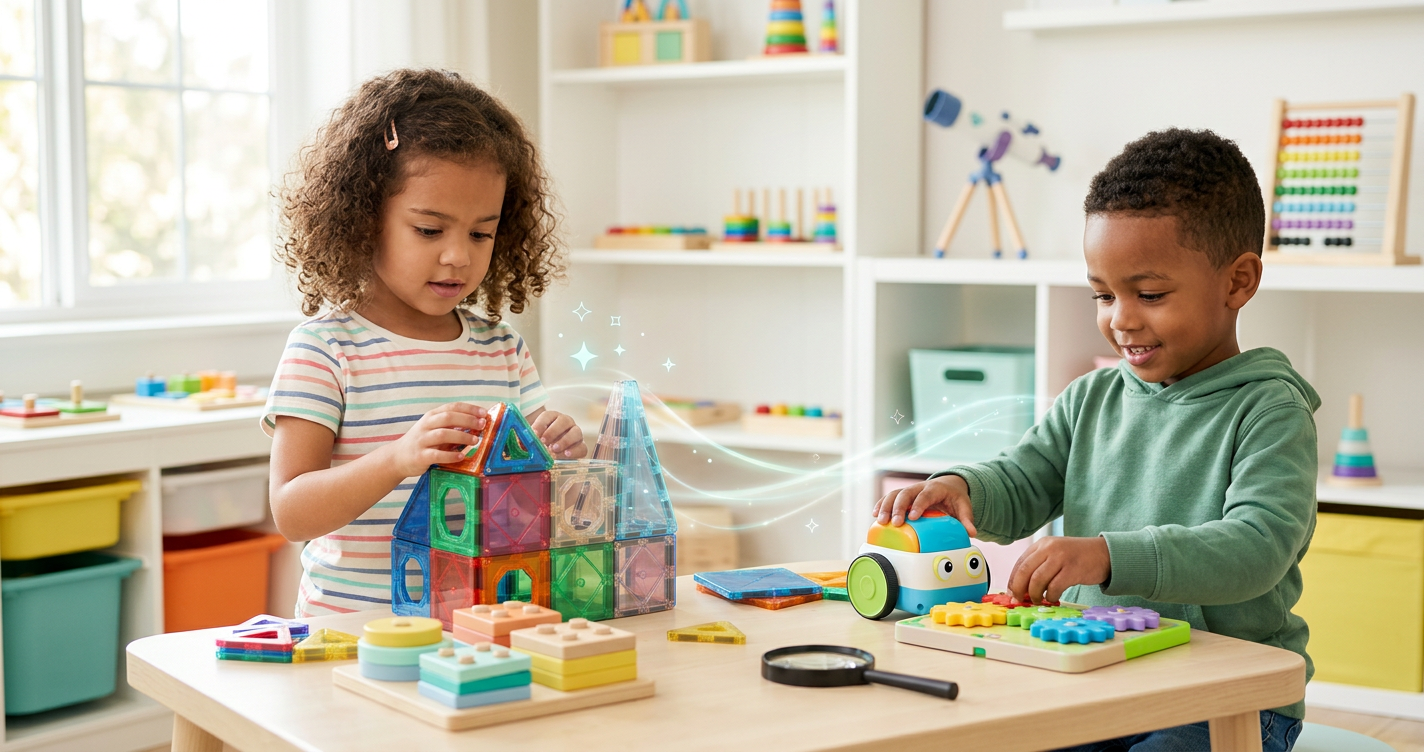
A STEM toy isn't necessarily a robot or a complex circuit board (though those exist for older kids!). For early childhood, STEM toys are typically open-ended playthings that encourage exploration, experimentation, and critical thinking. Think classic wooden blocks, LEGO Duplo, magnetic tiles, simple magnifying glasses, shape sorters, gears, or even a water table. The key is that they allow children to manipulate, build, discover, and learn through doing, rather than just passively observing.
The Science Behind the Play: How STEM Toys Boost Brain Development
It's no exaggeration to say that early childhood is a period of incredible brain development. Every interaction, every new experience, helps to build neural pathways. STEM toys are particularly effective because they engage multiple areas of the brain simultaneously, offering a rich environment for growth:
Developing Cognitive Skills
- Problem-Solving: When a tower falls, a child learns about gravity and stability. When a puzzle piece doesn't fit, they strategize and try a different approach. This trial-and-error process is the bedrock of problem-solving.
- Critical Thinking: "Why did that happen?" "What if I try this instead?" STEM toys encourage children to ask questions and seek answers, fostering analytical skills.
- Logical Reasoning: Understanding sequences, patterns, and cause-and-effect relationships (e.g., if I push this button, the light turns on).
Enhancing Fine Motor Skills and Spatial Reasoning
Manipulating small parts, stacking blocks precisely, fitting gears together – these actions are excellent for developing fine motor skills, hand-eye coordination, and dexterity. Furthermore, building and construction toys significantly boost spatial reasoning, helping children understand shapes, dimensions, and how objects relate to each other in space. This skill is vital not just for engineering but for everyday tasks like packing a backpack or navigating a room.
Fostering Language and Communication
Engaging with STEM toys often sparks conversation. Children describe what they are building, ask questions about what they observe, and explain their discoveries. This process naturally expands their vocabulary and improves their ability to articulate thoughts and ideas, especially when playing with a parent or peer.
Building Blocks for Future Success: STEM and School Readiness
Early exposure to STEM concepts through play does more than just entertain; it lays a crucial groundwork for academic success and a lifelong love of learning. Children who engage with STEM toys from a young age are more likely to:
- Develop a Growth Mindset: When they encounter a challenge while building or experimenting, they learn persistence and resilience. They understand that mistakes are part of the learning process, fostering a positive attitude towards tackling difficulties.
- Cultivate Curiosity: STEM toys naturally encourage children to explore, question, and seek answers. This innate curiosity is a powerful driver for learning across all subjects.
- Be Prepared for Formal Education: Familiarity with basic STEM concepts, vocabulary, and problem-solving strategies makes the transition to formal schooling smoother. They enter classrooms with a foundational understanding and a positive association with these subjects, reducing potential anxiety later on.
- Develop a Love for Learning: When learning is fun and engaging from the start, children are more likely to become lifelong learners, eager to discover new things and embrace intellectual challenges.
More Than Just Science: Nurturing Creativity and Social Skills
One common misconception is that STEM is purely logical and devoid of creativity. In fact, many STEM toys, particularly those for early childhood, are incredibly effective at nurturing imaginative play and artistic expression. For example, construction sets allow children to design and build anything they can imagine, from a towering castle to a futuristic spaceship. This freedom of creation blends engineering principles with artistic vision, often referred to as STEAM (Science, Technology, Engineering, Art, and Mathematics).
Beyond individual creativity, STEM toys also excel at fostering social and emotional development. When children play with building blocks or a collaborative science kit, they learn to:
- Cooperate and Collaborate: Working together to achieve a common goal, like building a large structure or solving a shared problem.
- Communicate Effectively: Discussing ideas, negotiating roles, and expressing needs and frustrations.
- Share and Take Turns: Essential social skills practiced naturally during play.
- Empathy and Understanding: Learning to consider another's perspective or ideas during group projects.
These social interactions are just as vital as cognitive development, preparing children for successful relationships and teamwork in all aspects of life.
Choosing the Right STEM Toys for Different Ages (and Stages!)
With so many options available, selecting the right STEM toys can feel overwhelming. Here are some guidelines to help you choose age-appropriate and engaging options:
For Infants and Toddlers (0-2 years)
Focus on sensory exploration and simple cause and effect. Look for:
- Stacking Rings & Cups: Teach size, order, and balance.
- Shape Sorters: Introduce shapes, problem-solving, and fine motor skills.
- Activity Cubes & Boards: Explore buttons, levers, and textures.
- Large Building Blocks: Encourage early construction and spatial awareness.
Prioritize safety: ensure no small parts that could be choking hazards.
For Preschoolers (3-5 years)
This is a prime age for open-ended construction and early scientific exploration. Consider:
- Magnetic Tiles & Blocks: Excellent for creative building and understanding magnetism.
- Simple Gear Sets: Introduce basic mechanical principles.
- Early Coding Games (Screen-Free): Teach sequential thinking and problem-solving (e.g., robot building kits with simple commands).
- Science Kits: Magnifying glasses, bug viewers, simple mixing sets for safe experiments.
- Water & Sand Play: Explore properties of materials, volume, and cause and effect.
For Early Elementary (5-7 years)
Children at this stage can handle more complex challenges and structured activities.
- Advanced Building Sets: More intricate LEGOs, K'nex, or similar construction kits.
- Basic Robotics Kits: Introduce programming concepts through tangible robots.
- Circuit Kits: Simple snap-together circuits to understand electricity.
- Engineering Challenges: Kits that prompt kids to build bridges, catapults, or vehicles.
Remember, the best STEM toys are often those that are open-ended, durable, and invite repeated engagement and different outcomes each time they are played with.
Integrating STEM Play into Everyday Life: Tips for Parents
You don't need a dedicated "STEM room" to foster these skills. Integrating STEM play can be a natural, joyful part of your family's daily routine:
- Be a Facilitator, Not a Director: Instead of telling your child what to build or how to solve a problem, ask open-ended questions like, "What do you think will happen if...?" or "How could we make this stronger?" Observe their play and offer support when needed.
- Connect to the Real World: Point out STEM concepts in everyday life. "Look how that crane works!" "Why does this toy float and that one sink?" "How many apples do we need for everyone?"
- Embrace Messes and Experimentation: Learning often involves trial and error, and sometimes, a little mess. Allow for safe experimentation with water, sand, or craft supplies.
- Provide a Rich Environment: Ensure easy access to a variety of materials: blocks, craft supplies, natural objects (pinecones, leaves), simple tools, and books.
- Read STEM-Themed Books: Picture books about engineers, scientists, or how things work can spark imagination and introduce new vocabulary.
- Visit Science Centers and Museums: These places are specifically designed for hands-on STEM exploration and can be incredibly inspiring.
Empowering Future Innovators, One Play Session at a Time
The world our children will inherit will demand critical thinkers, creative problem-solvers, and innovators. By embracing STEM toys and encouraging STEM play in early childhood, you're not just providing entertainment; you're investing in your child's future. You're helping them develop essential cognitive, social, and emotional skills that will serve them well in school, in their careers, and throughout their lives.
Remember, play is a child's most important work. By making STEM a fun, integrated part of that work, you're opening up a world of possibilities and helping to spark the brilliant minds of tomorrow. So go ahead, build that tower, explore that bug, and watch your child's potential unfold!