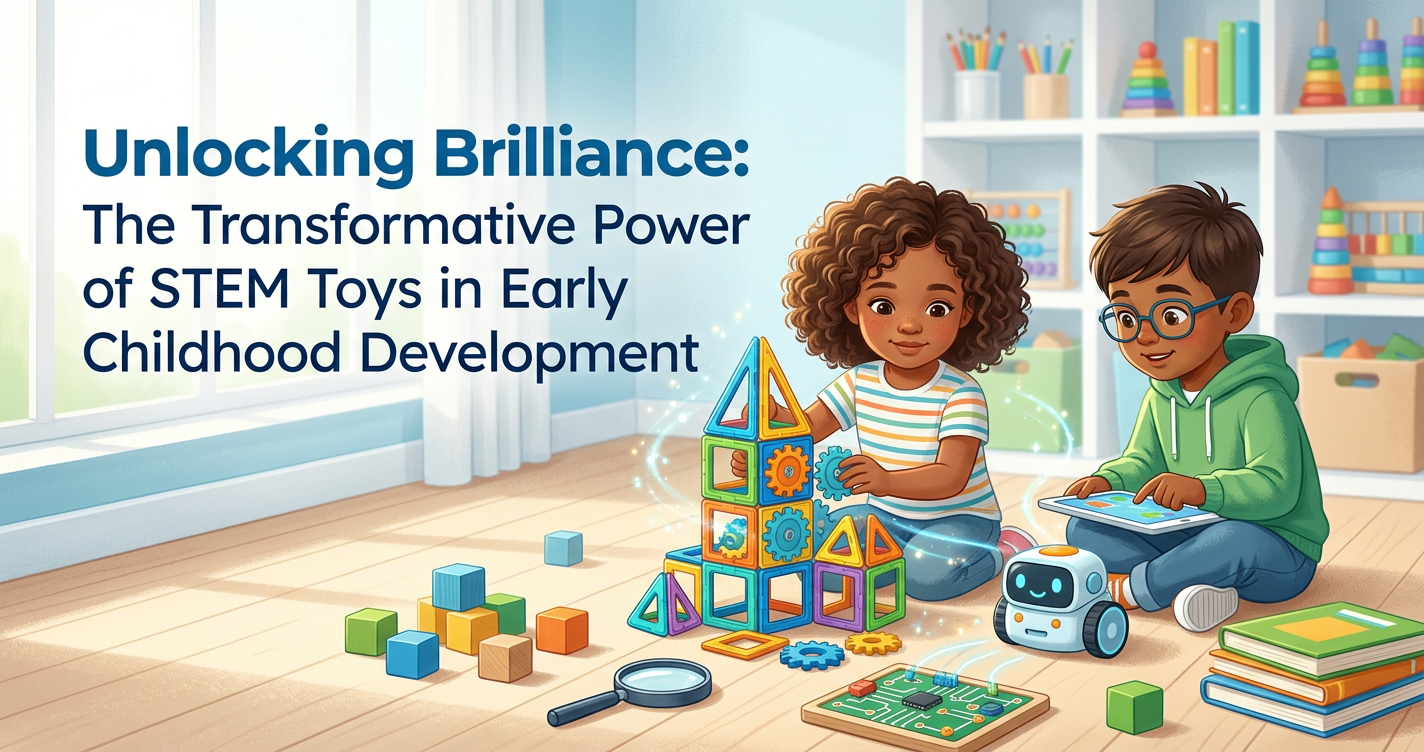
As parents, educators, and caregivers, we all share a common goal: to nurture our children's innate curiosity and equip them with the skills they need to thrive in a rapidly evolving world. While traditional play is invaluable, there's a special category of toys that offers a unique advantage: STEM toys. These aren't just playthings; they are powerful tools designed to introduce foundational concepts in Science, Technology, Engineering, and Mathematics from the earliest ages. But what exactly makes them so special, and how can they truly transform your child's early development?
In this comprehensive guide, we'll dive deep into the evidence-based benefits of integrating STEM toys into your child's playtime. We'll explore how these engaging tools foster critical thinking, spark creativity, and lay the groundwork for a lifetime of learning and innovation, all while keeping the fun factor front and center. Get ready to discover how you can unlock your child's full potential, one playful discovery at a time! this excellent toy product
What Exactly Are STEM Toys? (And Why Early Childhood Matters So Much!)
STEM is an acronym for Science, Technology, Engineering, and Mathematics. When we talk about STEM toys, we're referring to playthings specifically designed to introduce children to these four interconnected disciplines in an age-appropriate and engaging way. Think building blocks that teach balance and structure, simple circuit kits that explain electricity, or even a magnifying glass that encourages scientific observation.
Why is early childhood such a crucial period for introducing these concepts? Research consistently shows that the first five years of a child's life are a time of incredible brain development. During this period, neural pathways are formed at an astonishing rate, laying the foundation for future learning and cognitive abilities. Exposing children to STEM concepts through play during these formative years can:
- Stimulate curiosity: Children are naturally curious, and STEM toys provide avenues for them to explore 'how' and 'why' things work.
- Build problem-solving skills: From figuring out how to make a tower stand to understanding cause and effect, STEM play is inherently about solving mini-challenges.
- Develop a growth mindset: When children experiment and learn from 'failures' (like a tower falling), they learn resilience and the value of persistence.
- Counteract stereotypes: Early exposure helps normalize STEM as fun and accessible for everyone, regardless of gender or background, before societal biases can set in.
The Core Benefits: More Than Just Playtime Fun
Beyond the immediate joy, STEM toys deliver a wealth of developmental advantages. They are meticulously crafted to engage multiple areas of a child's brain, fostering holistic growth.
Developing Problem-Solving Skills and Critical Thinking
At the heart of STEM is problem-solving. Whether your child is trying to fit pieces together, build a stable structure, or make a simple machine work, they are constantly engaged in critical thinking. They learn to:
- Identify a challenge (e.g., 'How do I make this car roll further?').
- Brainstorm potential solutions.
- Experiment with different approaches.
- Analyze the results and adjust their strategy.
This iterative process is fundamental to scientific inquiry and engineering design, teaching children to think logically and systematically.
Fostering Creativity and Innovation
While often associated with logic, STEM toys are powerful catalysts for creativity. Many are open-ended, meaning there's no single 'right' way to play. Building sets, art supplies with a scientific twist (like color mixing experiments), or even simple gear toys encourage children to imagine, design, and innovate. They learn to:
- Transform abstract ideas into tangible creations.
- Experiment with different combinations and possibilities.
- Think outside the box to achieve unique outcomes.
This blend of structured thinking and imaginative freedom is key to nurturing future innovators.
Building Foundational Math and Science Concepts
You might not realize it, but simple play with STEM toys introduces complex concepts in an intuitive way. Children learn about:
- Mathematics: Counting, sorting, patterns, shapes, measurement, spatial reasoning, and basic geometry through blocks, puzzles, and stacking toys.
- Science: Gravity, balance, cause and effect, simple physics (levers, ramps), properties of materials, and observation skills through experiments, nature kits, and construction toys.
- Engineering: Design, structure, stability, and problem-solving through building sets, fort kits, and simple machines.
- Technology: Basic coding concepts (sequencing, algorithms) through robotic toys or screen-free coding games, and understanding how simple mechanisms work.
These early experiences demystify complex subjects, making them approachable and exciting rather than intimidating.
Enhancing Fine Motor Skills and Hand-Eye Coordination
Many STEM toys require precise manipulation – fitting small parts, connecting circuits, drawing, or stacking blocks. This active engagement is excellent for developing fine motor skills, which are crucial for tasks like writing, dressing, and using tools. Hand-eye coordination also gets a significant boost as children learn to synchronize what they see with their hand movements to achieve a desired outcome.
Boosting Language and Social Skills
Play, especially with STEM toys, often involves communication. As children build, experiment, and discover, they naturally talk about what they're doing, describing shapes, colors, actions, and outcomes. When playing with others, they learn to:
- Share ideas and materials.
- Collaborate on projects.
- Negotiate roles and tasks.
- Explain their thought process.
This social interaction not only enhances language development but also teaches valuable teamwork and communication skills.
Age-Appropriate STEM Fun: A Guide for Parents
Choosing the right STEM toys for your child's developmental stage is key to maximizing their engagement and learning. Here's a quick guide:
Infants (0-12 months): Sensory Exploration and Cause-and-Effect
- Focus: Sensory stimulation, basic cause-and-effect, object permanence.
- Examples: Soft building blocks (large, easy to grasp), sensory balls with different textures, activity gyms with dangling toys (reaching, batting), simple shape sorters with big pieces, discovery bottles.
- How they learn: Pushing a button to hear a sound, stacking and knocking down blocks, exploring textures and shapes with their hands and mouth.
Toddlers (1-3 years): Stacking, Sorting, and Early Engineering
- Focus: Fine motor skills, spatial reasoning, problem-solving, early language.
- Examples: Larger interlocking blocks (e.g., DUPLO), magnetic tiles, nesting cups, simple puzzles, water play tables with scoops and funnels, chunky gear toys.
- How they learn: Building taller towers, figuring out which shapes fit where, observing water flow, understanding how gears turn each other.
Preschoolers (3-5 years): Complex Building, Simple Experiments, Early Coding
- Focus: Advanced problem-solving, critical thinking, creativity, early scientific method, sequencing.
- Examples: More intricate building sets (e.g., LEGO Classic), simple chemistry kits (safe for kids), magnifying glasses for nature exploration, basic robotics kits (screen-free coding robots), engineering kits with nuts and bolts, circuit boards for kids.
- How they learn: Designing and constructing complex structures, conducting simple experiments with everyday materials, programming a robot to follow a path, understanding how levers and pulleys work.
Beyond the Box: Maximizing the Impact of STEM Toys
Simply buying a STEM toy isn't enough; how you engage with it can significantly amplify its benefits. Here are some tips to truly unlock its potential:
- Join the Play: Don't just hand over the toy and walk away. Sit down and play with your child! Ask open-ended questions like, 'What do you think will happen if...?' or 'How could we make this stronger?' Your involvement models curiosity and shows them that learning is a shared, enjoyable experience.
- Embrace Mess and Experimentation: STEM is all about trial and error. Encourage your child to experiment, even if it means making a mess or 'failing' a few times. Celebrate the effort and the learning process, not just the perfect outcome. 'Oops, that fell! Why do you think that happened? What can we try differently next time?'
- Rotate Toys: Keep the excitement fresh by rotating STEM toys in and out of play. Don't overwhelm your child with too many options at once. A smaller selection encourages deeper engagement and more imaginative use of each toy.
- Connect to Real-World Concepts: Help your child see how STEM concepts apply to everyday life. 'Look, just like our building blocks, that bridge has a strong base!' or 'When we mix these colors, it's like a science experiment!' This helps them understand the relevance and practical application of their play.
Dispelling Myths: STEM Toys Aren't Just for 'Gifted' Kids
One common misconception is that STEM toys are only for children who are already showing advanced aptitude in these areas. This couldn't be further from the truth! Every child, regardless of their perceived 'giftedness,' can benefit immensely from early exposure to STEM concepts. These toys are designed to spark interest, build foundational skills, and foster a love for discovery in all children.
They are not about creating child prodigies, but about nurturing natural curiosity, developing critical thinking, and ensuring that every child has the opportunity to explore and understand the world around them. By making STEM accessible and fun, we empower all children to develop the confidence and skills that will serve them well in school and throughout their lives.
Ready to Spark a Lifetime of Learning?
Integrating STEM toys into your child's play isn't just about preparing them for future academic success; it's about enriching their present. It's about providing them with opportunities to explore, question, create, and solve problems in a joyful and engaging way. From developing crucial fine motor skills to fostering a deep love for discovery, the benefits are truly transformative.
So, take a moment to observe your child's current interests. Are they fascinated by how things move? Do they love to build? Are they constantly asking 'why'? There's a STEM toy out there waiting to ignite their passion. By thoughtfully choosing age-appropriate STEM toys and actively engaging in their playtime, you're not just buying a toy; you're investing in their boundless potential. Start exploring today, and watch your child's brilliance unfold!