
As parents, we all want the best for our children – to see them grow into confident, curious, and capable individuals. In today's rapidly evolving world, preparing our little ones for future success means equipping them with more than just basic knowledge. It means nurturing their innate curiosity, their problem-solving prowess, and their ability to think creatively. This is where educational toys, particularly STEM toys, play an absolutely pivotal role in early childhood development.
You might hear 'STEM' and picture complex equations or advanced robotics, but at its heart, STEM (Science, Technology, Engineering, and Mathematics) is about a way of thinking – exploring, questioning, experimenting, and innovating. And the beautiful truth is, these foundational skills aren't just for older students; they can, and should, be cultivated from the earliest years through engaging, hands-on play. Let's dive into why STEM toys aren't just a trend, but a vital investment in your child's developmental journey. this excellent toy product
What Exactly Are STEM Toys? (And Why They Matter So Much)
Before we explore the 'why,' let's clarify the 'what.' STEM toys are specifically designed to introduce children to the core concepts of Science, Technology, Engineering, and Mathematics in an age-appropriate, interactive, and fun way. Unlike traditional toys that might focus solely on imagination or physical activity, STEM toys often encourage experimentation, building, logic, and discovery.
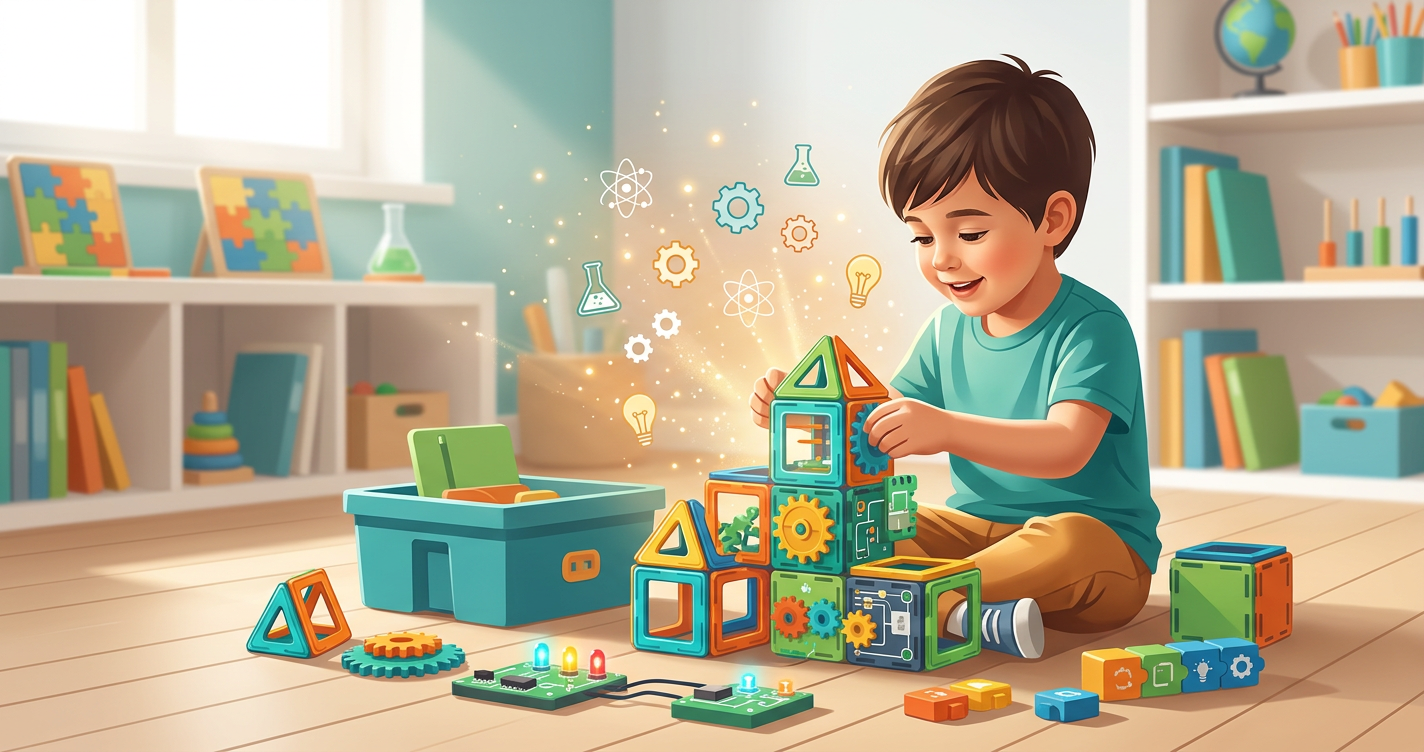
Think beyond just building blocks – though they are fantastic! STEM toys encompass a wide range, from magnetic tiles that teach spatial reasoning and balance, to simple circuit kits that introduce electricity, to coding robots that demystify algorithmic thinking. These toys aren't about rote memorization; they're about active learning, where children learn by doing, observing, and figuring things out for themselves. This hands-on approach is incredibly powerful because it aligns with how young children naturally learn and explore their world.
The Science of Play: How STEM Toys Build Brainpower
The benefits of integrating STEM toys into your child's playtime are immense and far-reaching. They tap into various cognitive, social, and emotional domains, laying a robust foundation for future learning.
Fostering Curiosity and Exploration
Children are born scientists, constantly observing, questioning, and testing hypotheses about how the world works. STEM toys capitalize on this natural inclination. A simple magnifying glass, a set of gears, or a sensory bin filled with different textures can spark endless questions: "How does this work?" "What happens if I do this?" "Why does this float?" By providing tools for exploration, STEM toys encourage children to investigate their surroundings, develop observational skills, and embrace a lifelong love of learning and discovery.
Cultivating Problem-Solving and Critical Thinking
Perhaps one of the most significant advantages of STEM toys is their ability to develop robust problem-solving skills. Whether it's figuring out how to make a tower stand taller, connecting circuit pieces to light up an LED, or navigating a simple robot through a maze, children are constantly presented with challenges. They learn to analyze situations, devise strategies, test solutions, and learn from their mistakes. This iterative process of trial and error is fundamental to critical thinking and resilience, teaching them that 'failure' is simply a step towards finding a solution.
Enhancing Creativity and Innovation
While STEM might sound purely logical, it's deeply intertwined with creativity. Many STEM toys are open-ended, meaning there's no single 'right' way to play. Building sets, art robots, or engineering kits encourage children to design, invent, and express their unique ideas. They learn to think outside the box, combine elements in novel ways, and bring their imaginative visions to life. This blend of logical thinking and creative expression is crucial for innovation.
Developing Fine Motor Skills and Hand-Eye Coordination
Manipulating small pieces, connecting circuits, stacking blocks precisely, or guiding a robot all require considerable fine motor control and hand-eye coordination. These physical skills are essential for everything from writing and drawing to dressing themselves and using tools. STEM toys provide a fun and engaging way to refine these crucial developmental milestones, strengthening the muscles and neural pathways necessary for intricate tasks.
Building Foundational Math and Spatial Reasoning
Long before formal schooling, STEM toys introduce fundamental mathematical concepts. Children learn about shapes, patterns, counting, measurement, and basic geometry through play. Building with blocks or magnetic tiles inherently teaches spatial reasoning – understanding how objects fit together in space, visualizing structures from different angles, and grasping concepts like balance and symmetry. These experiences build a strong intuitive understanding of mathematical principles, making later abstract concepts much easier to grasp.
Introducing Basic Coding Concepts (Without Even Realizing It!)
Technology is an undeniable force in our world, and introducing basic coding concepts early is incredibly beneficial. Many STEM toys, especially those focused on robotics or sequencing, teach children about algorithms, cause-and-effect, and sequential thinking. They learn to give instructions, predict outcomes, and debug problems – all core principles of computer programming – often through playful, screen-free interactions. This early exposure demystifies technology and builds confidence in a digital world.
Beyond the Classroom: Real-World Readiness Starts Early
The skills fostered by STEM toys extend far beyond academic subjects. They cultivate qualities like persistence, adaptability, and collaboration. When children work together to build a fort, solve a puzzle, or make a machine work, they learn to communicate, negotiate, and share ideas. These are vital social-emotional skills that contribute to well-rounded individuals capable of thriving in complex social and professional environments. By making learning an exciting adventure, STEM toys instill a positive attitude towards challenges and a belief in one's own capabilities, which are invaluable assets for life.
Choosing the Right STEM Toys for Your Little Learner
With so many options available, selecting the best STEM toys can feel overwhelming. Here are a few tips to guide your choices:
- Age-Appropriateness: Always check the recommended age range. Toys too simple won't challenge, while those too complex can lead to frustration.
- Open-Ended Play: Look for toys that can be used in multiple ways and encourage imaginative construction rather than just following instructions.
- Durability and Safety: Ensure toys are made from safe, non-toxic materials and can withstand enthusiastic play.
- Child's Interests: Pay attention to what your child is naturally drawn to. If they love animals, perhaps a biology-focused science kit. If they enjoy building, elaborate construction sets.
- Variety: Aim for a mix of toys that cover different STEM areas to provide a broad range of experiences. Examples include magnetic building blocks, simple circuit kits, gears sets, early coding robots, science experiment kits for preschoolers, and engineering construction sets.
Making STEM Play Fun and Engaging (Tips for Parents!)
Your role as a parent is crucial in maximizing the benefits of STEM play. Remember, it's about facilitating discovery, not dictating results.
- Join In! Play alongside your child. Your enthusiasm is contagious, and you can model curiosity and problem-solving.
- Ask Open-Ended Questions: Instead of telling them what to do, ask questions like, "What do you think will happen if...?" "How could we make this stronger?" "What other ways could we try?"
- Don't Over-Direct: Let them lead the play. Allow them to experiment and make mistakes. The learning often happens in the process of figuring things out, not just in achieving the 'right' answer.
- Celebrate Effort, Not Just Outcomes: Praise their persistence, their creative ideas, and their willingness to try, even if the tower tumbles or the experiment doesn't work as expected.
- Connect to Real Life: Point out how STEM concepts apply to the world around them – the engineering of a bridge, the science of baking, the technology in a smartphone.
Ignite Their Inner Innovator Today!
Investing in STEM toys for your child's early years is more than just buying another plaything; it's an investment in their future. It's about nurturing their natural curiosity, equipping them with essential problem-solving skills, and fostering a love for learning that will serve them well throughout their lives. By embracing the power of playful exploration, we can help our children unlock their full potential and confidently navigate the exciting challenges of tomorrow's world. So, go ahead, encourage that tinkering, celebrate that discovery, and watch your little learner blossom into a brilliant innovator!


