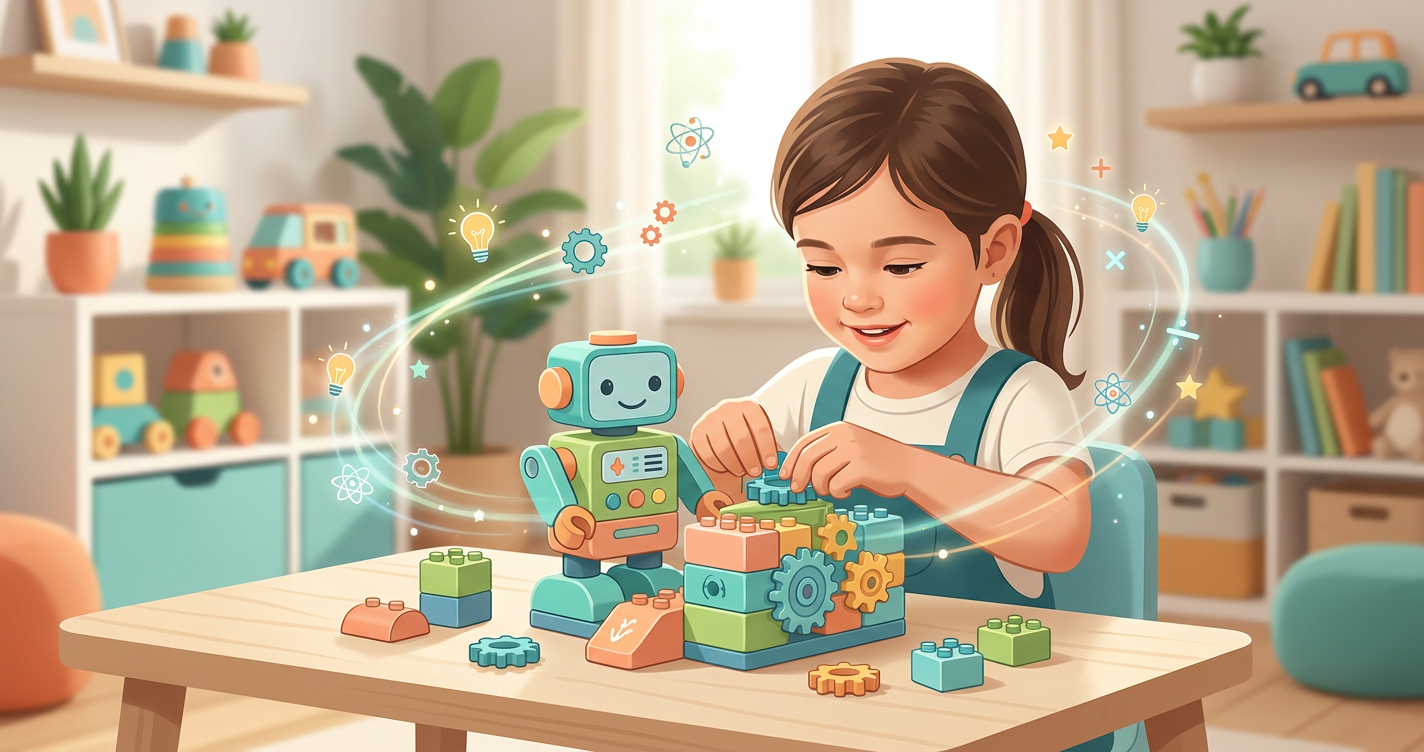
As parents, we all want to give our children the best possible start in life. We dream of them growing into curious, confident, and capable individuals ready to tackle the challenges of tomorrow. In today’s rapidly evolving world, one area that’s increasingly recognized as crucial for future success is STEM – Science, Technology, Engineering, and Mathematics. But how do we introduce these complex concepts to our little ones without overwhelming them? The answer, delightfully, often lies in play! Educational toys, specifically those designed with STEM principles in mind, offer a fantastic, fun, and foundational way to spark a lifelong love for learning and discovery.
Forget the intimidating textbooks and complex formulas; early STEM learning is all about hands-on exploration, asking questions, and discovering how the world works. It’s about building, experimenting, and problem-solving through joyful engagement. This post will dive into why STEM toys are more than just a passing trend, exploring the profound, evidence-backed benefits they offer in shaping your child’s developing mind and how you can integrate them effectively into their play. this excellent toy product
What Exactly Are STEM Toys? Beyond the Buzzword
Before we delve into the 'why,' let's clarify 'what.' STEM toys are designed to introduce children to the core principles of Science, Technology, Engineering, and Mathematics through interactive and engaging play. They aren't necessarily complicated gadgets; often, they are deceptively simple tools that encourage children to experiment, observe, build, and problem-solve. Think beyond robots and coding kits – while those are fantastic for older kids, early STEM toys can be as fundamental as building blocks, shape sorters, or simple magnifying glasses.
The beauty of STEM toys for early childhood lies in their ability to make learning tangible and fun. They transform abstract concepts into concrete experiences. A child stacking blocks is unknowingly exploring engineering principles like balance and stability. A child playing with a magnet is discovering physics. A child sorting colored beads is grasping early mathematical classification. These toys provide opportunities for children to actively engage with the world around them, fostering a natural curiosity and a desire to understand 'how' and 'why.'
The Scientific Benefits: Why STEM Toys Matter for Little Ones
The impact of early STEM exposure extends far beyond just academic readiness. Research consistently highlights the critical role of play in brain development, and STEM toys supercharge this process. Here's how they benefit your child:
Fostering Curiosity and Exploration
- Igniting 'Why?': STEM toys are inherently open-ended, encouraging children to ask questions, test hypotheses, and explore different outcomes. Why did the tower fall? What happens if I use a different block? This 'why' mindset is the bedrock of scientific inquiry.
- Sensory Engagement: Many STEM toys engage multiple senses, making learning a rich and memorable experience. The feel of different textures, the sound of gears turning, or the visual spectacle of a chemical reaction (even a safe, simple one!) all contribute to deeper understanding.
Building Problem-Solving Skills
- Trial and Error: Whether it’s fitting a puzzle piece or making a circuit work, STEM toys often require children to try different approaches, learn from mistakes, and persevere. This iterative process is fundamental to problem-solving.
- Critical Thinking: Children learn to analyze situations, identify challenges, and devise strategies to overcome them. This isn't about finding the 'right' answer, but about developing the 'right' approach to finding solutions.
Enhancing Critical Thinking and Logic
- Pattern Recognition: Many STEM toys, from pattern blocks to simple coding games, help children identify, create, and understand patterns – a vital skill for both mathematics and logical reasoning.
- Cause and Effect: Children learn that their actions have consequences. If I push this button, what happens? If I add more weight, what changes? This understanding forms the basis of scientific thinking.
Sparking Creativity and Innovation
- Open-Ended Play: Unlike toys with a single purpose, many STEM toys encourage children to invent, design, and build whatever they can imagine. Magnetic tiles can be a castle one day and a rocket ship the next.
- Imagination at Work: By combining different elements and experimenting with new ideas, children develop their imaginative capacities, a key ingredient for innovation in any field.
Developing Fine Motor Skills and Hand-Eye Coordination
- Hands-On Manipulation: Stacking, building, connecting, and manipulating small parts are common activities with STEM toys. These actions are excellent for refining fine motor skills, crucial for writing and other daily tasks.
- Precision and Dexterity: Activities requiring precision, like threading beads or using child-safe tools, enhance hand-eye coordination and spatial awareness.
Promoting Early Math and Literacy Concepts
- Numeracy Naturally: Counting blocks, sorting by size or color, comparing quantities – these activities lay the groundwork for mathematical understanding without formal instruction.
- Language Development: As children play, they often narrate their actions, describe their creations, and ask questions, enriching their vocabulary and communication skills. Parents can further this by asking open-ended questions during play.
Choosing the Right STEM Toys for Different Age Groups
The key to successful STEM play is choosing age-appropriate toys that match your child's developmental stage. Here’s a general guide:
Infants & Toddlers (0-2 years): Sensory & Exploration
- Focus: Sensory exploration, cause & effect, basic manipulation.
- Examples: Soft blocks, stackable rings, shape sorters, sturdy board books with textures, simple musical instruments, activity cubes, water play items.
- Why: These toys help them understand object permanence, develop fine motor skills, and explore different textures and sounds.
Preschoolers (3-5 years): Hands-On & Imaginative
- Focus: Building, designing, early problem-solving, imaginative play.
- Examples: Larger building blocks (LEGO Duplo, wooden blocks), magnetic tiles, simple magnifying glasses, basic gears sets, play-doh, simple science experiment kits (e.g., color mixing), beginner coding robots (screen-free).
- Why: They encourage open-ended construction, spatial reasoning, and the ability to follow simple instructions while still fostering creativity.
Early Elementary (6-8 years): Complex & Collaborative
- Focus: Advanced building, simple circuits, more complex experiments, early coding concepts, teamwork.
- Examples: More intricate building sets (LEGO Classic, K'nex), snap circuits, chemistry kits for kids, crystal growing kits, telescopes/microscopes, robotics kits that introduce coding logic.
- Why: These toys challenge children to think more critically, follow multi-step instructions, and often involve collaborative play, fostering social skills alongside STEM learning.
More Than Just Toys: Creating a STEM-Rich Play Environment
Remember, a toy is just a tool. The real magic happens when children interact with it, and even more so when they have supportive adults alongside them. Here’s how you can maximize the benefits of STEM toys:
- Engage with Them: Don't just hand over a toy; sit down and play with your child. Ask open-ended questions like, "What do you think will happen if...?" or "How could we make this stronger?"
- Encourage Experimentation: Let them try different approaches, even if they seem wrong. Emphasize that mistakes are opportunities to learn.
- Connect to the Real World: Point out how the concepts they're exploring with their toys apply to everyday life. "Look, the bridge we built is like the one we drove over!" or "The way the water flows is like our water table game!"
- Provide Variety: Offer a range of STEM toys that touch upon different areas of science, technology, engineering, and math to keep their interest piqued.
- Embrace Mess: Some of the best STEM explorations involve a little mess – water, sand, paint, or even dirt. Embrace it as part of the learning process!
Common Myths About STEM Toys Debunked
Let’s address a few misconceptions that might prevent parents from embracing STEM play:
- Myth: STEM toys are too complex for young children.
Reality: Not at all! Early STEM is about foundational concepts presented in an age-appropriate, playful way. Simple blocks are STEM toys. The complexity grows with the child. - Myth: STEM toys are only for 'smart' kids.
Reality: Every child benefits from STEM exposure. These toys are designed to build skills, not just test existing ones. They foster curiosity and resilience in all learners. - Myth: STEM toys are expensive.
Reality: While some advanced kits can be pricey, many excellent STEM toys are affordable. Often, everyday items like cardboard boxes, measuring cups, or natural materials can be transformed into fantastic STEM learning tools. - Myth: They replace imaginative play.
Reality: Many STEM toys enhance imaginative play! Building a spaceship with magnetic tiles or creating a pulley system for their stuffed animals combines scientific principles with creative storytelling.
Conclusion: Investing in Future Thinkers Through Play
Introducing STEM toys in early childhood isn't about pushing your child into a specific career path; it's about nurturing essential life skills. It’s about cultivating curiosity, critical thinking, problem-solving, and a resilient mindset that will serve them well in any endeavor they choose. By making STEM learning a joyful, hands-on part of their early years, you’re not just buying a toy; you're investing in their future potential, empowering them to become innovative thinkers and confident explorers of their world.
So, go ahead, embrace the wonder of STEM play! Watch as your little one builds, experiments, and discovers, laying a strong foundation for a lifetime of learning and success. The future is bright, and it starts with a curious mind and a playful heart.