
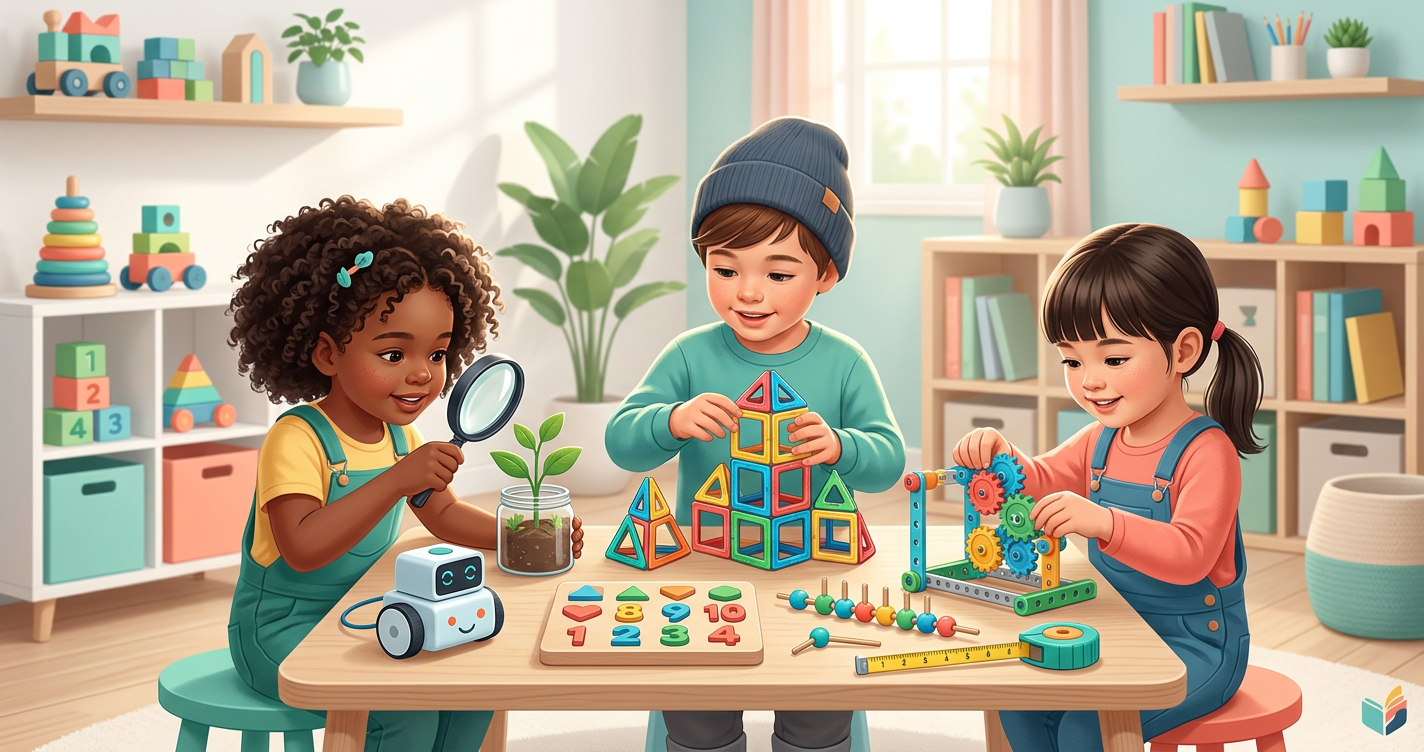
As parents and educators, we all want to give children the best possible start in life. In a rapidly evolving world, equipping our little ones with skills that foster critical thinking, creativity, and problem-solving is more crucial than ever. This is where STEM toys come into play – a powerful, yet often underestimated, tool in nurturing early childhood development. Far beyond simple entertainment, these toys are designed to spark curiosity and lay foundational skills across science, technology, engineering, and mathematics.
But what exactly makes a toy a “STEM toy,” and how do they truly impact a child’s formative years? Join us as we explore the profound benefits of integrating STEM play into early childhood, backed by insights and a friendly, encouraging approach to help you empower your child’s learning journey. this excellent toy product
What Exactly Are STEM Toys?
The acronym STEM stands for Science, Technology, Engineering, and Mathematics. So, a STEM toy isn't just any educational toy; it's specifically designed to engage children in these four interconnected disciplines. Unlike traditional toys that might focus on rote learning or passive entertainment, STEM toys encourage active exploration, experimentation, and discovery.
Think beyond just lab coats and calculators. STEM toys can be as simple as building blocks that teach engineering principles, puzzles that introduce logic and spatial reasoning, or even basic coding games that demystify technology. They are characterized by their ability to:
- Promote hands-on learning: Children learn by doing, touching, and manipulating.
- Encourage problem-solving: They present challenges that require critical thinking to overcome.
- Foster curiosity: They invite questions like “How does this work?” and “What if I try this?”
- Support open-ended play: Many STEM toys don't have a single 'right' way to play, allowing for endless possibilities and creativity.
Ultimately, STEM toys are about making learning an exciting, engaging, and integrated part of play, preparing children for a future where these skills are paramount.
The Science of Play: Boosting Cognitive Development
At the heart of early childhood development lies cognitive growth – the process by which children learn to think, reason, and understand the world around them. STEM toys are exceptional catalysts for this development, transforming playtime into a powerful brain-building exercise.
Nurturing Problem-Solving and Critical Thinking
From the moment a child tries to fit a block into a specific shape or figures out how to make a marble run work, they are engaging in problem-solving. Research consistently shows that play-based learning, especially with materials that offer challenges, significantly enhances children's ability to analyze situations, devise strategies, and overcome obstacles. Toys like pattern blocks, intricate puzzles, or simple circuit kits demand that children think critically: What's going wrong? How can I fix it? What's the next step? This iterative process of trial and error is fundamental to developing robust critical thinking skills that extend far beyond the playroom.
Enhancing Spatial Reasoning
Spatial reasoning is the ability to understand and remember the relationships between objects in space. It's a crucial skill for everything from reading maps to understanding geometry, and even for tasks like packing a suitcase efficiently! STEM toys, particularly construction sets like LEGOs, magnetic tiles, or even simple shape sorters, are fantastic for developing this. As children manipulate these objects, rotate them in their minds, and build structures, they are actively developing their spatial awareness and visual-motor integration. Studies suggest that children who engage with construction toys tend to perform better on spatial reasoning tests, laying a strong foundation for future mathematical and scientific understanding.
Engineering Imagination: Fostering Creativity and Innovation
While often associated with logic and facts, STEM is also a powerful driver of creativity and innovation. STEM toys provide the perfect sandbox for children to unleash their imaginations, experiment with new ideas, and understand that solutions aren't always found in a textbook.
Designing and Building Worlds
Give a child a set of building materials – be it wooden blocks, interlocking bricks, or magnetic construction pieces – and watch their imagination soar. They aren't just stacking; they're designing houses for their dolls, elaborate bridges for their cars, or fantastical creatures from their minds. This open-ended play encourages children to conceptualize, plan, and execute their ideas, much like real-world engineers. They learn about balance, stability, and structure through playful experimentation. The freedom to create without rigid rules empowers them to think innovatively and express their unique visions.
Embracing Trial and Error
Innovation rarely happens on the first try. STEM toys naturally introduce children to the concept of iteration – trying, failing, learning, and trying again. When a tower collapses or a robot doesn't move as intended, children are encouraged to analyze what went wrong, adjust their approach, and persist. This process isn't about getting it right immediately; it's about learning from mistakes and understanding that failure is a stepping stone to success. This resilience and 'growth mindset' are invaluable life skills fostered through STEM play, teaching children that effort and perseverance lead to mastery.
Mastering Math and More: Laying Foundational Skills Early
Mathematics can often feel daunting, but STEM toys make it accessible, tangible, and fun for young children, integrating core concepts seamlessly into their play experiences.
Counting, Sorting, and Pattern Recognition
Many STEM toys naturally incorporate basic mathematical concepts. Sorting toys help children categorize by color, size, or shape, introducing early classification skills. Building blocks or counting bears can be used to teach one-to-one correspondence, addition, and subtraction in a concrete way. Pattern blocks encourage children to recognize and create sequences, a fundamental skill for understanding algebra and data analysis later on. These hands-on experiences make abstract mathematical ideas concrete and relatable, building a positive relationship with numbers from a young age.
Introducing Basic Logic and Sequencing
Logic and sequencing are the backbone of both mathematics and computer science. Toys like simple maze puzzles, domino sets, or early coding games (often screen-free) teach children about cause and effect and the order of operations. When a child plans a route for a small robot or arranges a sequence of actions, they are developing computational thinking skills – breaking down complex problems into smaller, manageable steps. This early exposure to logical thinking is incredibly beneficial for future academic success and problem-solving in everyday life.
The Technology Touch: Preparing for a Digital Future
In our increasingly digital world, understanding technology is no longer an option but a necessity. STEM toys offer a safe, engaging, and age-appropriate way to introduce children to technological concepts without relying solely on screens.
Demystifying Technology
Technology isn't just about screens; it's about understanding how things work, from simple machines to complex systems. STEM toys can introduce concepts like gears, levers, pulleys, and circuits in a tangible way. Children learn about cause and effect: pressing a button makes a light turn on, or turning a crank moves a mechanism. This hands-on exploration helps demystify technology, making it less intimidating and more understandable. It fosters a sense of agency, showing children they can interact with and even create technology.
Early Coding Concepts
Coding is often seen as an advanced skill, but many STEM toys introduce its fundamental concepts in a playful, accessible manner. Screen-free coding robots, sequence-building games, or even simple board games that require planning a series of moves, teach children about algorithms, debugging, and logical sequencing. They learn to give instructions, predict outcomes, and troubleshoot when things don't go as planned. This early exposure to computational thinking helps develop problem-solving skills and prepares them for a future where digital literacy is paramount, without requiring them to stare at a screen for hours.
Beyond Academics: Social and Emotional Growth Through STEM Play
While the academic benefits are clear, STEM toys also play a significant role in nurturing a child’s social and emotional development, fostering crucial life skills.
Collaborative Learning
Many STEM activities, especially building projects or scientific experiments, naturally lend themselves to group play. When children work together to construct a complex structure or solve a challenge, they learn invaluable social skills like communication, negotiation, sharing, and teamwork. They learn to articulate their ideas, listen to others, and compromise to achieve a common goal. This collaborative environment fosters empathy and teaches them the power of collective effort.
Building Persistence and Self-Efficacy
STEM challenges can be tough, and not every experiment will yield the expected result. This process, however, is a powerful teacher of persistence. When a child sticks with a difficult puzzle or rebuilds a collapsing tower, they are developing resilience and grit. Successfully overcoming these challenges, even small ones, boosts their self-efficacy – their belief in their own ability to succeed. This sense of accomplishment is incredibly empowering, fostering confidence and a positive attitude towards learning new things, regardless of initial difficulties.
Choosing the Right STEM Toys for Every Age and Stage
With so many options available, selecting the perfect STEM toys can feel overwhelming. Here are some friendly tips to guide your choices:
- Age-Appropriateness: Always check the recommended age range. Toys that are too complex can be frustrating, while those too simple might not be engaging enough. Look for toys that 'grow' with your child, offering different levels of challenge.
- Open-Ended Play: Prioritize toys that allow for multiple ways to play and encourage imaginative exploration rather than a single, prescribed outcome. Building blocks, magnetic tiles, and simple science kits are excellent examples.
- Safety and Durability: Ensure toys are made from safe, non-toxic materials and are sturdy enough to withstand enthusiastic play. Check for small parts that could be choking hazards for younger children.
- Child's Interests: Observe what your child naturally gravitates towards. Do they love building? Are they fascinated by how things move? Tailoring STEM toys to their existing interests will maximize engagement and learning.
- Balance is Key: Remember that STEM toys are one part of a well-rounded play diet. Ensure your child also has opportunities for creative play (art, music), physical activity, and social interaction.
The best STEM toys are those that spark joy, encourage curiosity, and invite children to explore the world around them actively.
Unleash Their Inner Innovator!
The journey of early childhood is a magical time of discovery, and STEM toys are incredible companions on this adventure. By integrating these thoughtful tools into your child's playtime, you're not just providing entertainment; you're actively nurturing their cognitive, creative, social, and emotional development. You're helping them build essential skills in problem-solving, critical thinking, and innovation – skills that will serve them well in school, in their future careers, and throughout life.
So, go ahead, explore the wonderful world of STEM toys. Watch as your child's eyes light up with curiosity, and empower them to build, experiment, and discover the incredible innovator within. Happy playing, and happy learning!


