
Building Bright Futures: Why STEM Toys Are Essential for Early Childhood Development
In the vibrant tapestry of childhood, every moment is an opportunity for discovery. As parents, we constantly seek ways to nurture our children's innate curiosity and equip them with skills for a future that's ever-evolving. While playtime often seems like pure fun (and it should be!), it's also a powerful engine for learning and development. Enter STEM toys – a category of educational tools that are revolutionizing how our youngest learners engage with the world.
STEM, an acronym for Science, Technology, Engineering, and Mathematics, might sound like a subject for high schoolers, but its foundational concepts are accessible and incredibly beneficial from the earliest years. Far from being intimidating, STEM toys are simply designed to encourage exploration, problem-solving, and creative thinking through hands-on play. This isn't just about academics; it's about fostering critical life skills that will serve your child long into adulthood. Ready to unlock the potential of play? Let's dive into why STEM toys are not just trendy, but truly essential for early childhood development. this excellent toy product
What Exactly Are STEM Toys, Anyway?
At its heart, a STEM toy is any plaything that encourages children to explore concepts related to Science, Technology, Engineering, or Mathematics in an interactive, engaging way. Unlike passive entertainment, these toys prompt children to experiment, build, design, and analyze. They're often open-ended, meaning there isn't just one 'right' way to play, fostering creativity and independent thought.
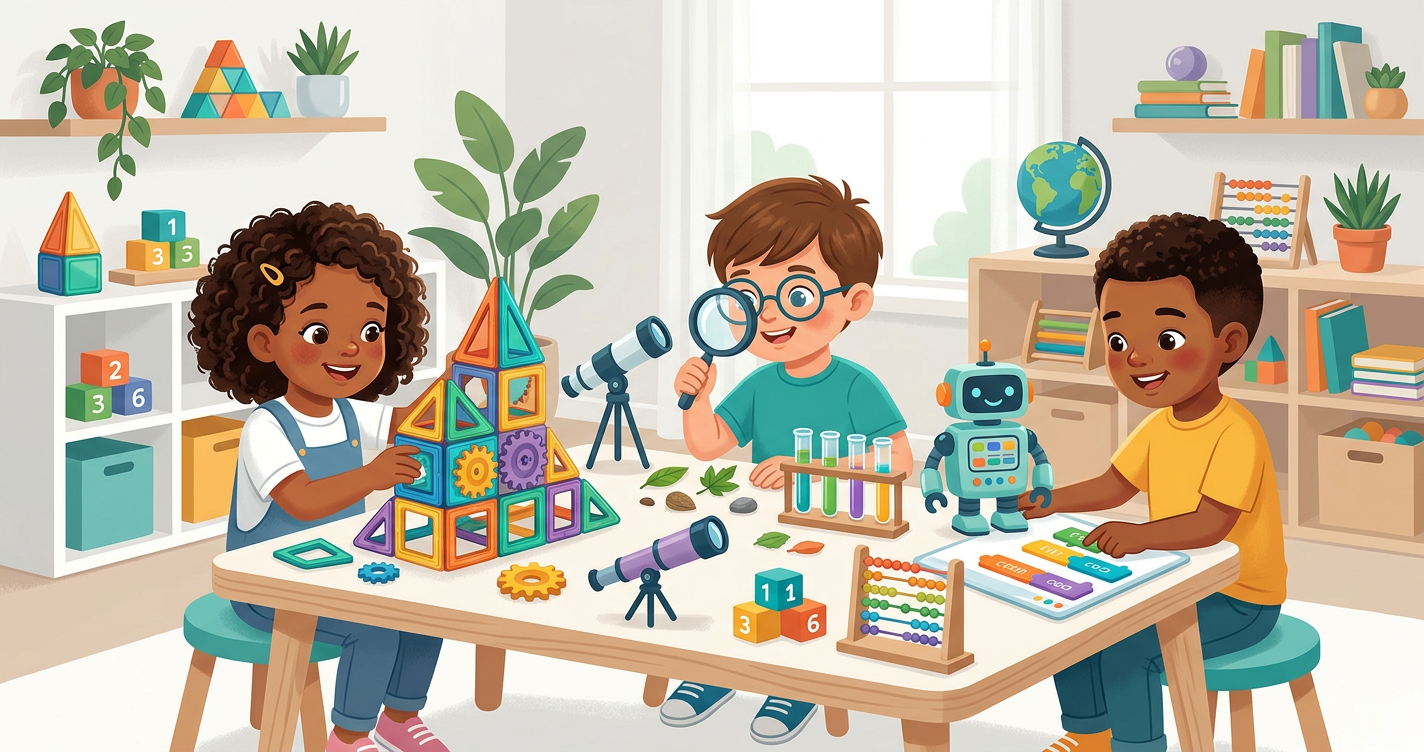
Think beyond just lab coats and calculators! STEM toys for early childhood include a vast array of items:
- Science: Magnifying glasses, simple microscopes, nature exploration kits, sensory bins, color mixing sets.
- Technology: Beginner coding robots (screen-free), light-up circuits, interactive electronic boards.
- Engineering: Building blocks (LEGO Duplo, Magna-Tiles, wooden blocks), gear sets, construction kits, interlocking puzzles.
- Mathematics: Shape sorters, counting bears, pattern blocks, abacuses, balance scales, measurement tools.
The beauty of these toys lies in their ability to make complex ideas tangible and fun. They transform abstract concepts into concrete experiences, allowing children to learn through doing, touching, and seeing immediate results.
The Brain Boost: How STEM Play Ignites Cognitive Growth
The early years are a period of explosive brain development, with billions of neural connections forming daily. STEM toys act as powerful catalysts in this process, stimulating crucial cognitive functions:
- Problem-Solving Skills: Whether it's figuring out why a tower keeps toppling or how to make a robot move, children are constantly engaged in identifying problems and devising solutions. This iterative process builds resilience and strategic thinking.
- Spatial Reasoning: Manipulating blocks, puzzles, and construction sets helps children understand shapes, sizes, and how objects fit together in space. This skill is vital not just for future math and engineering, but for everyday tasks like packing a bag or navigating a room.
- Logical Thinking & Cause-and-Effect: STEM toys inherently teach that actions have consequences. If you push this button, the light turns on. If you connect these gears, they'll spin. This foundational understanding is key to scientific inquiry and critical thinking.
- Fine Motor Skills: Many STEM toys require precise hand movements, strengthening the small muscles in fingers and hands. This dexterity is essential for writing, drawing, and countless other tasks.
Research consistently shows that early engagement with hands-on, exploratory play leads to improved academic performance later on, particularly in math and science. It's not about rote memorization; it's about building a solid foundation for understanding how the world works.
Beyond Academics: Cultivating Essential Life Skills
While the cognitive benefits are profound, STEM toys offer much more than just a head start in school subjects. They are powerful tools for developing a range of invaluable life skills:
- Creativity and Innovation: With open-ended toys, there's no single 'right' answer. Children are encouraged to experiment, imagine, and invent, fostering a mindset of innovation and out-of-the-box thinking.
- Critical Thinking: Instead of being told answers, children learn to ask questions, observe, hypothesize, and test their ideas. This process cultivates a critical approach to information and challenges.
- Resilience and Perseverance: Building a complex structure or solving a puzzle often involves trial and error, and sometimes, failure. STEM play teaches children to try again, learn from mistakes, and persist until they achieve their goal. This grit is a cornerstone of success in all areas of life.
- Collaboration and Communication: Many STEM activities are fantastic for group play. Children learn to share ideas, negotiate, assign roles, and work together towards a common objective, honing their social and communication skills.
These skills aren't just useful for future scientists or engineers; they are fundamental for navigating an increasingly complex world, regardless of career path.
Choosing Wisely: Age-Appropriate STEM Toys for Little Learners
To maximize the benefits, it's crucial to select STEM toys that are appropriate for your child's developmental stage. Here’s a general guide:
Toddlers (1-3 years): Exploration and Sensory Play
- Focus: Sensory exploration, cause-and-effect, basic manipulation, gross motor skills.
- Examples: Large building blocks (soft or wooden), shape sorters, stacking rings, sensory bins with safe materials, simple musical instruments, chunky puzzles, bath toys that demonstrate water flow.
- Key features: Durable, safe (no small parts), easy to grasp, bright colors, varied textures.
Preschoolers (3-5 years): Building, Creating, and Simple Problem-Solving
- Focus: Fine motor skills, spatial reasoning, early sequencing, imaginative play, basic engineering concepts.
- Examples: Magnetic tiles, LEGO Duplo, simple gear sets, beginner coding robots (screen-free), basic science experiment kits (e.g., color mixing, growing crystals), pattern blocks, counting games.
- Key features: Encourage open-ended construction, introduce simple mechanisms, allow for collaborative play, spark curiosity about the natural world.
Always check age recommendations on packaging and prioritize safety. Look for toys made from non-toxic materials with no sharp edges or choking hazards.
Maximizing the Magic: Tips for Parents to Encourage STEM Play
Buying the right toys is just the first step. Here's how you can create an environment that truly fosters a love for STEM:
- Join in the Fun (Sometimes!): Show interest in what your child is doing. Ask questions like, "What are you building?" or "What do you think will happen if...?" But also, allow for independent exploration without constant intervention.
- Ask Open-Ended Questions: Instead of telling them what to do, encourage critical thinking. "How could we make this tower taller?" "Why do you think this car goes faster?" "What else could we use?"
- Provide a Supportive Environment: Dedicate a space for play where toys are accessible. Allow for a bit of mess – experimentation can be untidy!
- Connect Play to the Real World: Point out how STEM concepts are everywhere. "Look, the bridge builder used strong shapes just like your blocks!" "That's gravity pulling the ball down!"
- Rotate Toys: Keep the excitement fresh by rotating toys in and out of storage. When a toy reappears, it often feels new and exciting again.
- Embrace "Failure": Frame challenges and mistakes as learning opportunities. "That didn't work this time, what can we try differently?" This teaches resilience and problem-solving.
Addressing the Digital Dilemma: Balancing Screens with Hands-On Learning
In today's digital age, it's easy for screens to dominate playtime. While some educational apps can be beneficial, nothing can fully replicate the multi-sensory, hands-on experience of physical STEM toys. These toys engage all senses, demand physical manipulation, and foster critical fine motor skills that touchscreens simply can't. They encourage children to interact with the 3D world, understand spatial relationships, and develop a real-world sense of cause and effect.
The goal isn't to eliminate screens entirely, but to ensure a healthy balance. Prioritizing hands-on STEM play ensures children develop a robust foundation of skills that digital interactions alone cannot provide. It’s about building tangible understanding and sparking imaginative, undirected play.
Investing in Tomorrow: The Long-Term Impact of Early STEM Engagement
The benefits of early STEM engagement extend far beyond childhood. By fostering curiosity, critical thinking, and problem-solving skills from a young age, you're not just buying toys; you're investing in your child's future adaptability and success. Children who engage with STEM concepts early tend to develop a stronger foundation for formal schooling, a greater likelihood of pursuing STEM fields, and perhaps most importantly, a lifelong love for learning and discovery.
In a world that demands innovation and adaptability, equipping children with a STEM mindset is one of the most powerful gifts we can give them. It prepares them not just for specific careers, but for navigating an ever-changing landscape with confidence, creativity, and a perpetual sense of wonder.
Conclusion: Embrace the Power of Playful Discovery!
STEM toys are more than just playthings; they are gateways to understanding, innovation, and essential life skills. From simple blocks that teach balance and geometry to beginner robots that introduce coding logic, these tools empower children to be active participants in their own learning journey. They transform complex concepts into joyful discoveries, nurturing curiosity and building a robust foundation for future success.
So, as you consider your child's next toy, think STEM. Embrace the power of playful exploration, encourage their innate curiosity, and watch as they build not just towers and circuits, but also confidence, resilience, and a bright future. The world of STEM is waiting, and it's more fun than you can imagine!


