
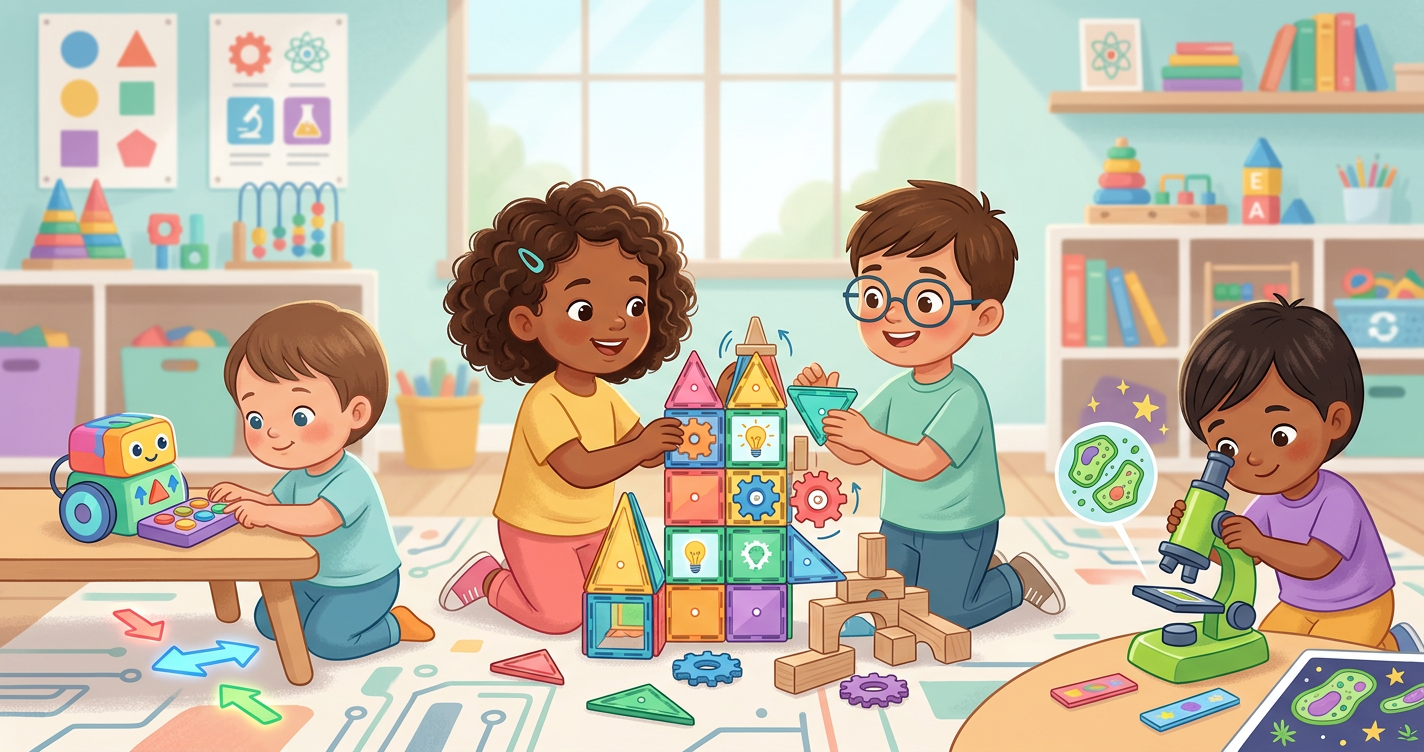
Parents, educators, and caregivers often seek the best ways to foster a child's growth and prepare them for a future that's constantly evolving. In this quest, one category of playthings stands out for its profound impact: STEM toys. STEM, an acronym for Science, Technology, Engineering, and Mathematics, represents a crucial area of learning that goes far beyond textbooks. It’s about cultivating curiosity, encouraging exploration, and equipping children with the essential skills they’ll need to thrive in the 21st century. But how do these seemingly complex concepts translate into engaging, age-appropriate play for our youngest learners?
This blog post will delve into the incredible world of STEM toys, exploring their definition, the compelling science behind their benefits, and practical advice on how to integrate them into your child's early developmental journey. Get ready to discover how simple blocks, gears, and coding games can lay the foundation for critical thinking, problem-solving, and a lifelong love of learning. You're not just buying a toy; you're investing in their future, one playful discovery at a time! this excellent toy product
What Exactly Are STEM Toys? Beyond the Buzzword
Before we explore the 'why,' let's clarify the 'what.' STEM toys are more than just gadgets; they are specifically designed to introduce children to concepts in Science, Technology, Engineering, and Mathematics through hands-on, interactive play. They encourage experimentation, construction, logical reasoning, and creative problem-solving, often without children even realizing they're learning complex ideas.
Science: Fostering Curiosity About the World
Science toys spark a child's natural curiosity about how the world works. Think magnifying glasses for exploring nature, simple chemistry sets (age-appropriate, of course!), or kits that teach about weather patterns. These toys encourage observation, prediction, and understanding cause and effect.
Technology: Introducing Digital Literacy Foundations
Technology toys aren't just about screens. They can include simple robots that teach basic coding logic, circuit kits that demonstrate how electricity flows, or interactive learning tablets that introduce computational thinking without overwhelming complexity. The goal is to demystify technology and build comfort with its principles.
Engineering: The Art of Building and Designing
Engineering toys are perhaps the most recognizable. Building blocks, LEGOs, magnetic tiles, K'nex, and even simple fort-building kits fall into this category. They challenge children to design, construct, test, and refine their creations, teaching them about structure, stability, and spatial reasoning.
Mathematics: Making Numbers and Logic Fun
Math toys help children grasp fundamental mathematical concepts in a playful way. This includes counting toys, shape sorters, pattern blocks, puzzles that require logical sequencing, and games that involve measurement or estimation. They transform abstract numbers into tangible experiences.
The Science Behind Play: Why STEM Matters Early On
The human brain undergoes its most rapid development during early childhood, forming over a million new neural connections every second! This period, from birth to age five, is a critical window for learning and skill acquisition. Research consistently shows that engaging children in stimulating activities during these formative years can have a profound impact on their cognitive, social, and emotional development.
STEM toys tap directly into this developmental sweet spot. They provide concrete experiences that help children build foundational knowledge and skills in a way that abstract teaching cannot. When a child builds a tower that collapses, they learn about gravity and structural integrity. When they experiment with mixing colors, they observe chemical reactions. These hands-on interactions create stronger neural pathways, enhancing memory, attention span, and the ability to process complex information.
Moreover, early exposure to STEM concepts can significantly boost a child's confidence and foster a 'growth mindset' – the belief that abilities can be developed through dedication and hard work. When children successfully solve a puzzle or build a structure, they experience the joy of accomplishment, which encourages them to tackle more challenging tasks in the future.
Unpacking the Core Benefits: A Closer Look
The advantages of integrating STEM toys into early childhood play are multifaceted and far-reaching. Let's break down some of the most significant benefits:
Cultivating Critical Thinking and Problem-Solving Skills
Every STEM toy, from a simple shape sorter to a complex circuit board, presents a challenge that requires thinking things through. Children learn to analyze situations, identify problems, brainstorm solutions, and evaluate outcomes. This iterative process of trial and error is fundamental to developing strong critical thinking and problem-solving abilities that will serve them well throughout life.
Sparking Creativity and Innovation
While often associated with logic, STEM also nurtures immense creativity. Engineering toys, for instance, allow children to imagine and construct anything they can dream up. Science experiments encourage children to think outside the box and devise new ways to test hypotheses. This freedom to create and innovate is crucial for developing imaginative and resourceful individuals.
Enhancing Fine Motor Skills and Hand-Eye Coordination
Many STEM toys involve manipulating small parts, fitting pieces together, or drawing precise lines. These activities are excellent for developing fine motor skills – the coordination of small muscles in the hands and fingers – and improving hand-eye coordination. These skills are vital for tasks like writing, drawing, and even using utensils.
Fostering Collaboration and Communication
While solo play is valuable, many STEM toys lend themselves beautifully to collaborative play. Building a large structure with friends, working together on a simple coding project, or conducting a science experiment as a team teaches children valuable lessons in communication, negotiation, sharing, and compromise. They learn to articulate their ideas and listen to others, essential social skills.
Building Resilience and Perseverance
Not every experiment works on the first try, and not every tower stands tall immediately. STEM play inherently involves moments of frustration and failure. Through these experiences, children learn resilience – the ability to bounce back from setbacks – and perseverance – the dedication to keep trying despite challenges. They discover that mistakes are opportunities for learning, not reasons to give up.
Laying the Foundation for Digital Literacy
In our increasingly digital world, early exposure to the principles of technology is invaluable. Simple coding games or circuit kits introduce children to computational thinking, logic sequences, and the basics of how technology works, demystifying it and building a comfortable foundation for future learning.
Choosing the Right STEM Toys for Different Ages
Selecting age-appropriate STEM toys is key to maximizing their benefits and ensuring engagement. Here's a quick guide:
- Toddlers (1-3 years): Focus on sensory exploration, cause and effect. Think large building blocks, shape sorters, simple stacking toys, water play items, and basic puzzles.
- Preschoolers (3-5 years): Introduce more complex building sets (LEGO Duplo, magnetic tiles), early coding robots (screen-free options), simple science experiment kits (e.g., growing crystals, making slime), and counting/pattern games.
- Early School Age (5-8 years): More intricate LEGO sets, advanced robotics kits, circuit building sets, microscopes, geology kits, and board games that involve strategic thinking and math.
Always consider your child's individual interests and developmental stage. The best toy is one they will actually play with and enjoy!
Integrating STEM Play into Daily Life (Beyond the Toy Box)
While dedicated STEM toys are fantastic, you don't always need a fancy kit to encourage STEM thinking. Here are some simple ways to weave STEM into everyday life:
- Ask Open-Ended Questions: Instead of just observing, ask 'What do you think will happen if...?' or 'How could we make this stronger?'
- Involve Them in Everyday Tasks: Cooking (measurement, chemical reactions), gardening (plant growth, ecosystems), or even fixing something around the house (problem-solving, tools) are real-world STEM opportunities.
- Explore Nature: Go on nature walks, observe insects, collect leaves, and discuss weather patterns.
- Read STEM-Themed Books: Many children's books introduce scientific concepts, engineering marvels, and mathematical ideas in an engaging way.
- Join in the Fun: Your enthusiasm is contagious! Play alongside your child, model curiosity, and demonstrate a willingness to experiment and learn.
Investing in Their Future, One Playtime at a Time
The journey of early childhood is a remarkable period of rapid learning and discovery. By embracing STEM toys and integrating STEM principles into daily interactions, we're not just providing entertainment; we're actively nurturing the skills and mindset our children will need to navigate a complex, ever-changing world. From critical thinking and creativity to resilience and a foundational understanding of technology, the benefits are profound.
So, the next time you're considering a gift or looking for a new activity, remember the power of STEM. Encourage exploration, celebrate curiosity, and watch as your child builds not just incredible structures, but also a brilliant foundation for their future. It's an investment that pays dividends for a lifetime, one delightful, educational play session at a time!


