
As parents, we all share a common goal: to see our children thrive, grow, and reach their full potential. In an increasingly complex and technologically driven world, preparing our little ones for future success can feel like a daunting task. We’re often looking for that 'magic bullet' – a way to spark their curiosity, build critical skills, and foster a lifelong love for learning, all while they’re just enjoying being kids.
Enter STEM toys. Far from being just another fad, these engaging tools are revolutionizing early childhood education by making learning an adventure. STEM, an acronym for Science, Technology, Engineering, and Mathematics, represents the foundational disciplines that drive innovation and progress in our society. But what does this mean for a toddler or a preschooler? It means providing them with playful experiences that subtly introduce these crucial concepts, laying a robust groundwork for future academic and life success. this excellent toy product
This isn't about pushing advanced calculus on a three-year-old. It's about nurturing innate curiosity, encouraging exploration, and developing essential problem-solving skills through hands-on, imaginative play. Research consistently shows that the early years are a critical window for brain development, making this the perfect time to introduce the wonders of STEM. Join us as we explore how STEM toys can be a powerful ally in unlocking your child's inherent brilliance and setting them on a path of discovery.
What Exactly Are STEM Toys, and Why Do They Matter So Early On?
At its heart, a STEM toy is any plaything designed to educate children in one or more of the STEM disciplines. This can range from simple building blocks that teach basic engineering principles to complex coding robots that introduce computational thinking. The beauty of these toys lies in their ability to make abstract concepts tangible and accessible to young minds.
Why is this emphasis on 'early' so crucial? Experts in child development highlight that the brain undergoes rapid growth during the first five years of life, forming billions of neural connections. During this period, children are naturally curious explorers, constantly observing, experimenting, and trying to make sense of the world around them. STEM toys tap into this innate drive, offering structured yet flexible avenues for exploration. They help children develop cognitive skills, fine motor control, spatial awareness, and logical reasoning long before they ever step into a formal classroom.
- Science: Encourages observation, experimentation, and understanding the natural world (e.g., magnifying glasses, simple chemistry sets, nature exploration kits).
- Technology: Introduces basic digital literacy, understanding how things work, and problem-solving with tools (e.g., simple robots, circuit boards, interactive learning tablets).
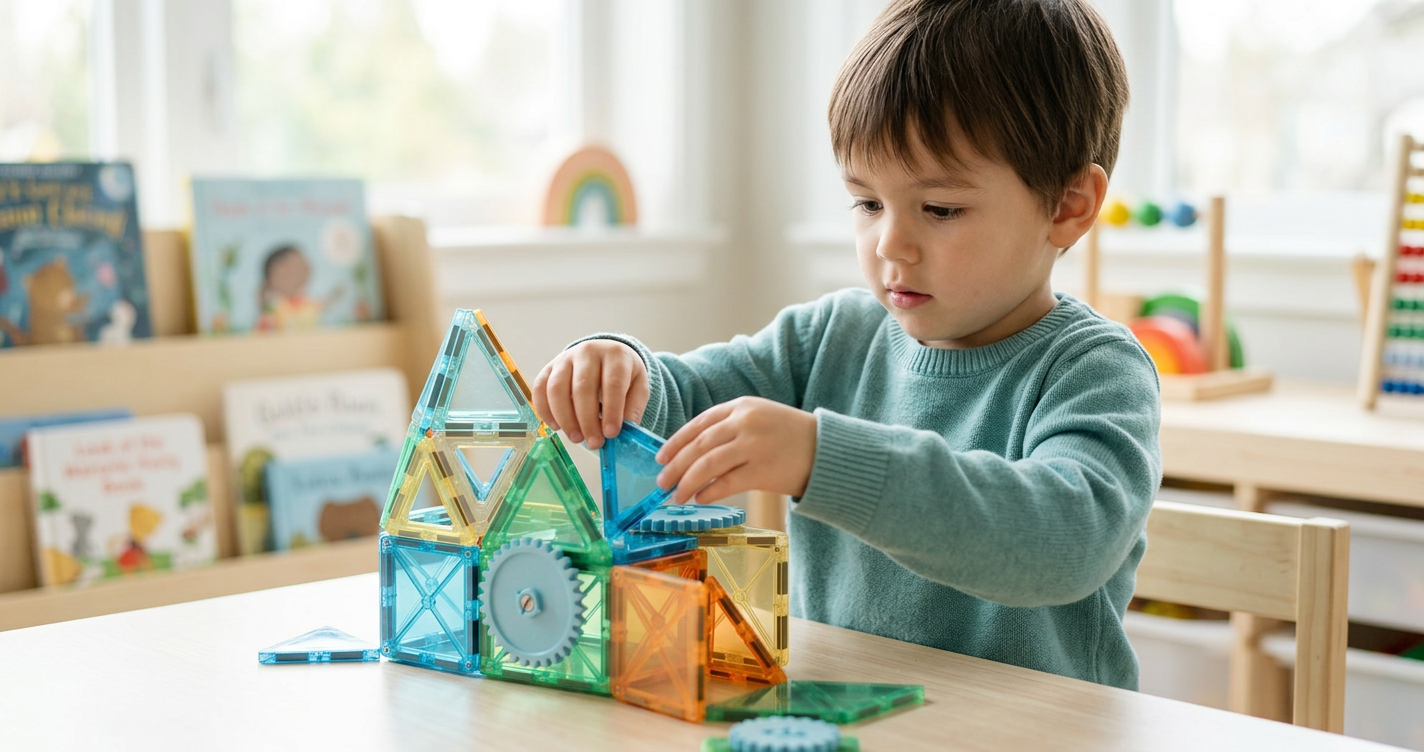
- Engineering: Fosters design thinking, construction, and understanding structures (e.g., building blocks, magnetic tiles, construction sets).
- Mathematics: Develops number sense, patterns, measurement, and spatial reasoning (e.g., counting games, shape sorters, puzzles, balance scales).
By integrating these areas into play, children learn that these subjects are interconnected and exciting, rather than isolated, intimidating academic disciplines.
The Core Benefits: More Than Just Playtime
When your child is engrossed in a STEM toy, they're not just passing the time; they're actively building a foundation for future success. The benefits extend far beyond academic readiness, impacting their holistic development in profound ways.
Cognitive Development & Problem-Solving
STEM toys inherently challenge children to think critically. Whether it's figuring out how to make a tower stand taller, how to guide a robot through a maze, or how different gears interact, these activities require analysis, trial-and-error, and strategic thinking. This iterative process of identifying a problem, formulating a hypothesis, testing it, and evaluating the results mirrors the scientific method, fostering invaluable problem-solving skills that are applicable in all areas of life.
Boosting Creativity & Innovation
Many STEM toys are open-ended, meaning there's no single 'right' way to play. Building blocks can become a castle, a car, or an abstract sculpture. Magnetic tiles can form flat patterns or intricate 3D structures. This freedom encourages imaginative thinking, allowing children to experiment with new ideas, express themselves, and innovate. They learn that mistakes are opportunities for learning, not failures, which is crucial for developing a resilient and creative mindset.
Enhancing Fine Motor Skills & Hand-Eye Coordination
From snapping together small pieces of a circuit board to manipulating gears or carefully placing blocks, STEM toys often require precise hand movements. These activities are excellent for developing fine motor skills, which are essential for tasks like writing, drawing, and self-care. The coordination between what the eyes see and what the hands do is also significantly strengthened, improving dexterity and control.
Fostering a Love for Learning
When learning is disguised as play, children are naturally more engaged and enthusiastic. STEM toys make complex concepts approachable and fun, sparking a genuine curiosity about how the world works. This positive association with learning from an early age can cultivate a lifelong passion for discovery and intellectual growth, making future academic challenges less daunting and more exciting.
Developing Resilience & Critical Thinking
STEM challenges often involve obstacles and moments when things don't go as planned. A tower might tumble, a robot might get stuck, or an experiment might not yield the expected results. These moments are invaluable for teaching resilience. Children learn to persevere, adjust their approach, and think critically about what went wrong and how to fix it. This ability to adapt and problem-solve under pressure is a cornerstone of success in any field.
Age-Appropriate STEM Fun: What to Look For
Choosing the right STEM toy depends heavily on your child's developmental stage. What excites a toddler might frustrate a preschooler, and vice-versa. Here’s a general guide to help you pick wisely:
Infants & Toddlers (0-3 years)
Focus on sensory exploration, cause-and-effect, and basic manipulation. Look for toys that allow for stacking, sorting, nesting, and simple construction. Examples include large, easy-to-grasp building blocks (wooden or soft plastic), shape sorters, stacking rings, activity cubes with buttons and levers, and simple musical instruments. These introduce early concepts of size, shape, balance, and how actions lead to reactions.
Preschoolers (3-5 years)
At this age, children are ready for more complex problem-solving and early engineering. They can begin to follow simple instructions and enjoy imaginative play. Great choices include magnetic tiles, gears and cogs sets, simple coding robots (often screen-free, using buttons or physical sequences), beginner science kits (e.g., exploring magnets, water, or light), and construction sets with larger, interlocking pieces. These toys foster creativity, spatial reasoning, and an understanding of how parts combine to form a whole.
Early School Age (5-8 years)
Children in this age group can handle more abstract concepts and enjoy structured experiments. They are developing stronger fine motor skills and a longer attention span. Consider more advanced robotics kits, circuit building sets, elaborate construction systems, chemistry sets with adult supervision, and educational games that involve logic, strategy, and mathematical concepts. These toys prepare them for more formal STEM learning in school.
Beyond the Toy Box: Maximizing STEM Play
Simply buying a STEM toy isn't enough; how you engage with your child during play makes all the difference. Here are some tips to maximize the learning potential:
- Encourage Open-Ended Play: Resist the urge to dictate how a toy should be used. Let your child lead, explore, and come up with their own ideas. There’s no 'wrong' way to build a tower or conduct an experiment.
- Ask Guiding Questions: Instead of giving answers, ask questions like, “What do you think will happen if...?” “How could we make this stronger?” “Why do you think it fell?” This promotes critical thinking and encourages them to verbalize their thought process.
- Connect to the Real World: Point out how STEM concepts apply to everyday life. “Look, that bridge is like the one you built with your blocks!” “The way this car moves is a bit like your robot!”
- Be a Play Partner: Get down on the floor and play with them. Your enthusiasm is contagious and shows them that learning is an enjoyable, shared experience.
- Embrace Mistakes: When a structure collapses or an experiment doesn't work, don't rush to fix it. Instead, frame it as a learning opportunity. “Oops! What do you think we could change next time to make it work?”
- Create a Supportive Environment: Dedicate a space where your child can freely experiment and leave projects in progress without feeling pressured to clean up immediately.
Common Concerns & How to Address Them
It's natural to have questions or reservations about introducing STEM toys. Let's address a few common ones:
- "Are they too complex for my child?" Not if you choose age-appropriate toys! Start with simpler, more intuitive options and gradually introduce complexity as your child grows and shows interest. Many STEM toys are designed with different skill levels in mind.
- "Are they too expensive?" While some high-tech STEM toys can be an investment, there are countless affordable options. Basic building blocks, simple science kits, and even repurposed household items (like cardboard boxes for engineering projects) can provide excellent STEM learning opportunities without breaking the bank. Focus on quality and engagement over flashy features.
- "My child isn't interested in 'academic' toys." The key is to present them as fun, engaging play, not as academic tasks. If your child isn't immediately drawn to a particular toy, try introducing it in a different context, or integrating it with their existing interests. Perhaps they'll enjoy building a house for their favorite stuffed animal with magnetic tiles, or creating a 'rocket ship' from blocks. Follow their lead and make it about their imagination.
Empowering Future Innovators, One Playtime at a Time
Investing in STEM toys for early childhood development isn't just about giving your child a head start in science or math; it's about nurturing a curious mind, fostering resilience, and equipping them with the critical thinking and problem-solving skills they'll need to navigate an ever-changing world. You're not just buying a toy; you're investing in their future potential, their creativity, and their lifelong love for discovery.
So, the next time you're considering a new toy, think beyond the conventional. Choose a STEM toy that sparks their imagination, challenges their thinking, and encourages them to explore the incredible world around them. With every block stacked, every circuit connected, and every question asked, you're helping to build not just a bright future for your child, but for the world they will inherit. Happy exploring!


