Unlock Potential: The Essential Guide to STEM Toys for Early Childhood Development
As parents, we all dream of providing our children with the best possible start in life. We want them to be curious, capable, and confident. In today's rapidly evolving world, one of the most powerful tools we have for nurturing these qualities from a young age is STEM education. But don't let the serious acronym fool you – for toddlers and preschoolers, STEM isn't about complex equations or advanced robotics. It's about play, exploration, and discovery, often facilitated by incredible educational toys.
This comprehensive guide will demystify STEM toys for early childhood, showing you why they're not just a trend but a fundamental building block for your child's future. We’ll delve into what makes a toy truly 'STEM,' explore age-appropriate options, and provide practical tips for integrating these powerful learning experiences into your daily life. Get ready to empower your little one with the skills they need to thrive! this excellent toy product
What Exactly Are STEM Toys, and Why Do They Matter So Early?
STEM stands for Science, Technology, Engineering, and Mathematics. While these fields might sound intimidating for tiny tots, the core concepts they represent are incredibly accessible and naturally align with how young children learn. A STEM toy isn't necessarily a high-tech gadget; often, it’s a simple, open-ended item that encourages children to:
- Experiment: What happens if I push this? How does this fit?
- Problem-solve: How can I make this tower taller without it falling?
- Build and design: Creating structures, models, or even imaginary worlds.
- Observe and analyze: Noticing patterns, differences, and cause-and-effect.
Why start so early? Research consistently shows that the foundations for critical thinking, creativity, and problem-solving are laid in the earliest years of life. Children are natural scientists and engineers, constantly exploring their environment and trying to understand how things work. Introducing STEM concepts through play taps into this innate curiosity, fostering a lifelong love of learning and equipping them with essential cognitive skills long before they step into a formal classroom.
The Four Pillars of Early STEM Learning: Beyond Just Play
Let's break down how each component of STEM comes alive in early childhood through the right kind of play:
Science: Cultivating Curious Minds
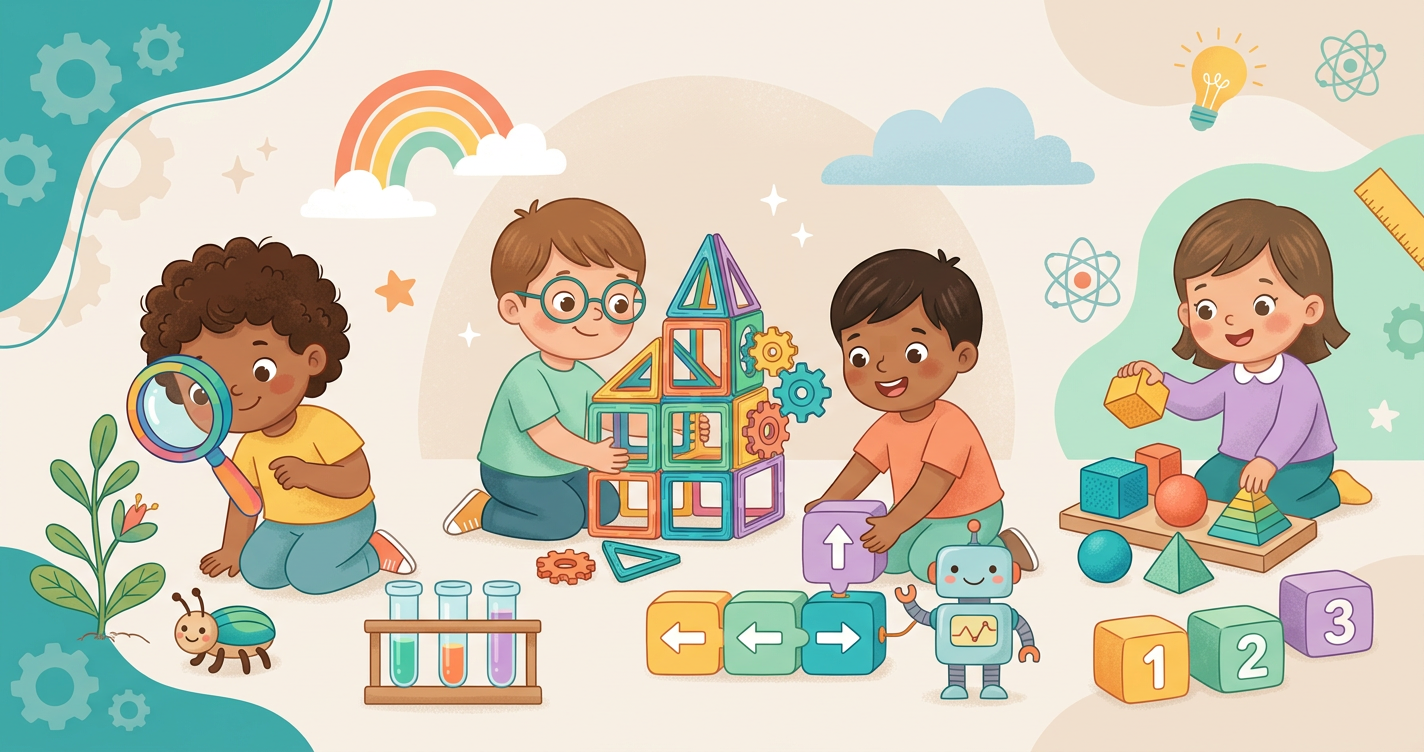
Early science is all about observation and exploration. It’s helping your child understand the world around them. Think about:
- Cause and Effect: A ramp where balls roll down, toys that light up when a button is pressed.
- Nature Exploration: Magnifying glasses to look at leaves, simple gardening tools, sensory bins with natural elements.
- Physical Properties: Water tables, sand play, exploring different textures.
These activities encourage children to ask "why?" and "how?", sparking their natural scientific inquiry.
Technology: Understanding Tools and Innovation
For young children, "technology" isn't just about screens. It’s about understanding tools and how things work to solve problems. This can include:
- Simple Machines: Pulleys, levers (think seesaws or simple construction toys).
- Basic Circuits: Toys that require matching parts to complete a circuit for a light or sound.
- Everyday Tools: Child-safe screwdrivers and nuts/bolts, simple remote controls for toy cars.
It’s about demystifying the world of gadgets and understanding their function, rather than just passively consuming them.
Engineering: The Joy of Building and Designing
Engineering is perhaps the most visible aspect of STEM in early childhood. It's about designing, building, and understanding structures. This includes:
- Construction Sets: Building blocks (wooden, magnetic, interlocking), LEGO DUPLO, fort-building kits.
- Problem-Solving Puzzles: Jigsaw puzzles, shape sorters, gears that fit together.
- Creative Construction: Using recycled materials to build imaginative structures.
These activities develop spatial reasoning, fine motor skills, and an understanding of balance and stability.
Mathematics: Discovering Patterns and Numbers
Early math isn't about memorizing times tables. It's about developing number sense, understanding patterns, shapes, and measurement. Consider:
- Counting and Sorting: Stacking rings by size, sorting blocks by color or shape.
- Pattern Recognition: Stringing beads in a sequence, creating patterns with blocks.
- Shapes and Spatial Awareness: Shape sorters, puzzles, building with geometric blocks.
- Basic Measurement: Using measuring cups in a sensory bin or during pretend play.
These foundational math skills are crucial for logical thinking and problem-solving.
Age-Appropriate STEM Fun: What to Look For
Choosing the right STEM toys means understanding your child's developmental stage. Here’s a quick guide:
Infants (0-12 Months): Sensory Exploration and Cause-and-Effect
- Focus: Sensory stimulation, grasping, pushing, pulling, observing reactions.
- Examples: Rattles, soft blocks, sensory balls, activity gyms with dangling toys that respond to touch, simple stackers, board books with textures.
Toddlers (1-3 Years): Early Problem-Solving and Building
- Focus: Stacking, sorting, basic building, shape recognition, simple puzzles.
- Examples: Large interlocking blocks (e.g., DUPLO), shape sorters, nesting cups, simple wooden puzzles, chunky vehicle sets, water play tables with scoops and pouring toys.
Preschoolers (3-5 Years): Complex Building, Introduction to Coding, Science Exploration
- Focus: More intricate building, early coding concepts, simple experiments, pattern creation, imaginative play.
- Examples: Magnetic tiles, advanced building blocks, introductory coding robots (screen-free), simple science kits (magnets, color mixing), gears and cogs sets, craft supplies for engineering projects.
Always prioritize safety, durability, and open-ended play that encourages imagination over prescriptive instructions.
The Long-Term Ripple Effect: Why Early STEM Matters
The benefits of introducing STEM concepts early extend far beyond just academic readiness. These foundational experiences help cultivate a range of vital life skills:
- Critical Thinking and Problem-Solving: Children learn to analyze situations, identify challenges, and devise solutions.
- Creativity and Innovation: STEM encourages 'out-of-the-box' thinking and designing new ways to approach tasks.
- Resilience and Persistence: When a tower falls, children learn to try again, fostering grit and a growth mindset.
- Collaboration and Communication: Many STEM activities can be done with others, encouraging sharing ideas and teamwork.
- Confidence: Successfully building something or figuring out a puzzle boosts self-esteem and a sense of accomplishment.
These are the very skills that employers value most in the 21st century, making early STEM engagement an investment in your child's future success and well-being.
Choosing the Best STEM Toys: A Parent's Guide
With so many options, how do you pick the "best" STEM toys? Here are key considerations:
- Open-Ended Play: Look for toys that can be used in multiple ways, encouraging creativity rather than following strict instructions. Blocks, magnetic tiles, and simple construction sets are excellent examples.
- Durability and Safety: Ensure toys are made from non-toxic materials, are age-appropriate, and can withstand enthusiastic play.
- Engagement Factor: Does the toy genuinely capture your child’s interest? A toy gathering dust isn't fostering development.
- Grows with Your Child: Some toys, like elaborate building sets, offer simpler play for younger kids and more complex challenges as they grow.
- Promotes Active Learning: The best STEM toys require hands-on interaction, not passive observation.
- Avoid Gender Stereotypes: STEM is for everyone! Ensure your toy choices reflect this inclusivity.
Remember, the most expensive toy isn't always the best. Sometimes, a collection of simple, versatile items can offer more developmental benefits.
Integrating STEM into Daily Life: Beyond the Toy Box
While dedicated STEM toys are fantastic, you don't need fancy gadgets to foster a STEM mindset. Everyday activities offer countless opportunities:
- Kitchen Adventures: Cooking and baking involve measuring (math), observing changes (science), and following sequences (engineering).
- Nature Walks: Point out different plants and animals (biology), discuss weather patterns (meteorology), or observe how water flows (physics).
- Building Forts: This is pure engineering! Children learn about structure, stability, and spatial reasoning.
- Household Chores: Sorting laundry by color or size (math), understanding how a vacuum works (technology/engineering).
- Reading Books: Many children's books feature STEM themes, from space exploration to how machines work.
The key is to engage with your child, ask open-ended questions, and encourage their natural curiosity in every scenario. Be a facilitator, not just a provider of toys.
Empowering Future Innovators: Start Their STEM Journey Today!
Investing in STEM toys and experiences for early childhood isn't just about preparing your child for a specific career; it's about nurturing well-rounded individuals who are curious, resilient, and equipped with the critical thinking skills to navigate any challenge. By embracing play-based learning and integrating STEM into everyday moments, you're giving your child a powerful head start, fostering a lifelong love of discovery, and empowering them to become the innovators and problem-solvers of tomorrow. So, open that toy box, step outside, and start exploring the wonderful world of STEM with your little one today!