As parents and educators, we all want to give children the best possible start in life. In today's rapidly evolving world, that often means equipping them with skills that go beyond traditional rote learning. Enter STEM toys – an exciting and increasingly popular category of educational playthings designed to introduce children to Science, Technology, Engineering, and Mathematics from a young age. But are they just a trend, or do they genuinely hold the key to unlocking a child's full potential? The evidence suggests the latter, revealing a fascinating synergy between purposeful play and profound developmental growth.
For years, play was often seen as separate from learning, a mere pastime. However, modern child development research unequivocally shows that play is, in fact, the primary vehicle through which young children learn about themselves and the world around them. When we introduce well-designed STEM toys, we're not just offering entertainment; we're providing powerful tools that foster curiosity, critical thinking, and problem-solving skills, laying a robust foundation for future academic success and life-long learning. Let's dive into the magic of STEM toys and explore how they can transform early childhood development. this excellent toy product
What Exactly Are STEM Toys and Why Do They Matter So Early On?
STEM is an acronym for Science, Technology, Engineering, and Mathematics. STEM toys are specifically designed to introduce children to concepts and skills related to these fields through hands-on, engaging activities. Unlike passive toys, STEM toys encourage active participation, experimentation, and discovery. Think building blocks that teach balance and structure, simple circuit kits that illuminate the basics of electricity, or coding games that introduce logical sequences.
Why is early exposure so crucial? The formative years, from birth to age eight, are a period of incredible brain development. During this time, neural connections are rapidly forming, shaping a child's cognitive abilities, emotional intelligence, and physical skills. Introducing STEM concepts during these years capitalizes on a child's natural curiosity and innate desire to explore. It's not about turning toddlers into rocket scientists overnight, but rather about nurturing an inquisitive mind, fostering a love for discovery, and developing foundational skills that will serve them well in every aspect of life.
Nurturing Natural Curiosity
Children are born scientists. They constantly observe, ask ‘why,’ and experiment with their environment. STEM toys provide a structured yet playful outlet for this inherent curiosity. When a child stacks blocks and watches them tumble, they're conducting a physics experiment. When they sort colored beads, they're engaging in early mathematical classification. These experiences, though seemingly simple, build a framework for understanding complex ideas later on.
The Science of Play: How STEM Toys Boost Cognitive Skills
The benefits of STEM toys extend far beyond memorizing facts. They are powerful catalysts for developing a range of cognitive and executive function skills vital for success in school and beyond.
Problem-Solving and Critical Thinking
From figuring out how to make a marble run work to assembling a complex puzzle, STEM toys inherently present challenges that require children to think critically and devise solutions. This isn't about finding the 'right' answer from a textbook; it's about trial and error, adapting strategies, and learning from mistakes. This iterative process strengthens neural pathways associated with problem-solving, making children more resilient and resourceful when faced with real-world challenges.
Fostering Creativity and Innovation
Many STEM toys, particularly those in the engineering and technology categories, are open-ended, allowing for endless possibilities. Construction sets, magnetic tiles, or even simple art supplies with a scientific twist (like color mixing experiments) encourage children to imagine, design, and build unique creations. This process isn't just about following instructions; it's about pushing boundaries, expressing ideas, and developing an innovative mindset.
Developing Fine Motor Skills and Hand-Eye Coordination
Manipulating small parts, connecting circuits, drawing precise lines, or carefully placing building blocks all contribute to the development of fine motor skills. These are crucial for tasks like writing, drawing, and even self-care. Hand-eye coordination also improves significantly as children learn to direct their movements with precision, an essential skill for sports, art, and countless daily activities.
Early Mathematical and Scientific Literacy
STEM toys introduce fundamental concepts in an accessible, tangible way. Children learn about numbers, shapes, patterns, spatial reasoning, cause-and-effect relationships, and basic physics principles without even realizing they are 'learning.' This playful introduction builds a positive association with these subjects, making them less intimidating as children progress through their education.
Beyond Academics: Life Skills Fostered by STEM Play
The impact of STEM toys reaches beyond academic readiness, cultivating crucial life skills that contribute to a child's overall well-being and social development.
Cultivating Resilience and Persistence
When a tower tumbles or a coding sequence doesn't work, children learn invaluable lessons in persistence. They learn that failure isn't an end, but an opportunity to try a different approach. This resilience, developed through repeated attempts and eventual success, is a cornerstone of a growth mindset – the belief that abilities can be developed through dedication and hard work.
Enhancing Communication and Collaboration
Many STEM activities are naturally collaborative. When children work together to build a fort, solve a puzzle, or conduct a simple science experiment, they learn to communicate their ideas, listen to others, negotiate, and share responsibilities. These social interactions are vital for developing empathy, teamwork, and effective communication skills.
Choosing the Right STEM Toys for Different Age Groups
The key to maximizing the benefits of STEM toys is selecting age-appropriate items that align with your child's developmental stage and interests. Remember, the goal is engagement, not frustration.
- Infants (0-12 months): Focus on sensory exploration and simple cause-and-effect. Soft blocks, sensory balls, stackable rings, and activity cubes introduce basic concepts like balance, texture, and object permanence.
- Toddlers (1-3 years): Introduce more complex manipulation. Shape sorters, simple puzzles, large building blocks (like Duplo), and basic musical instruments encourage problem-solving, fine motor skills, and an understanding of patterns.
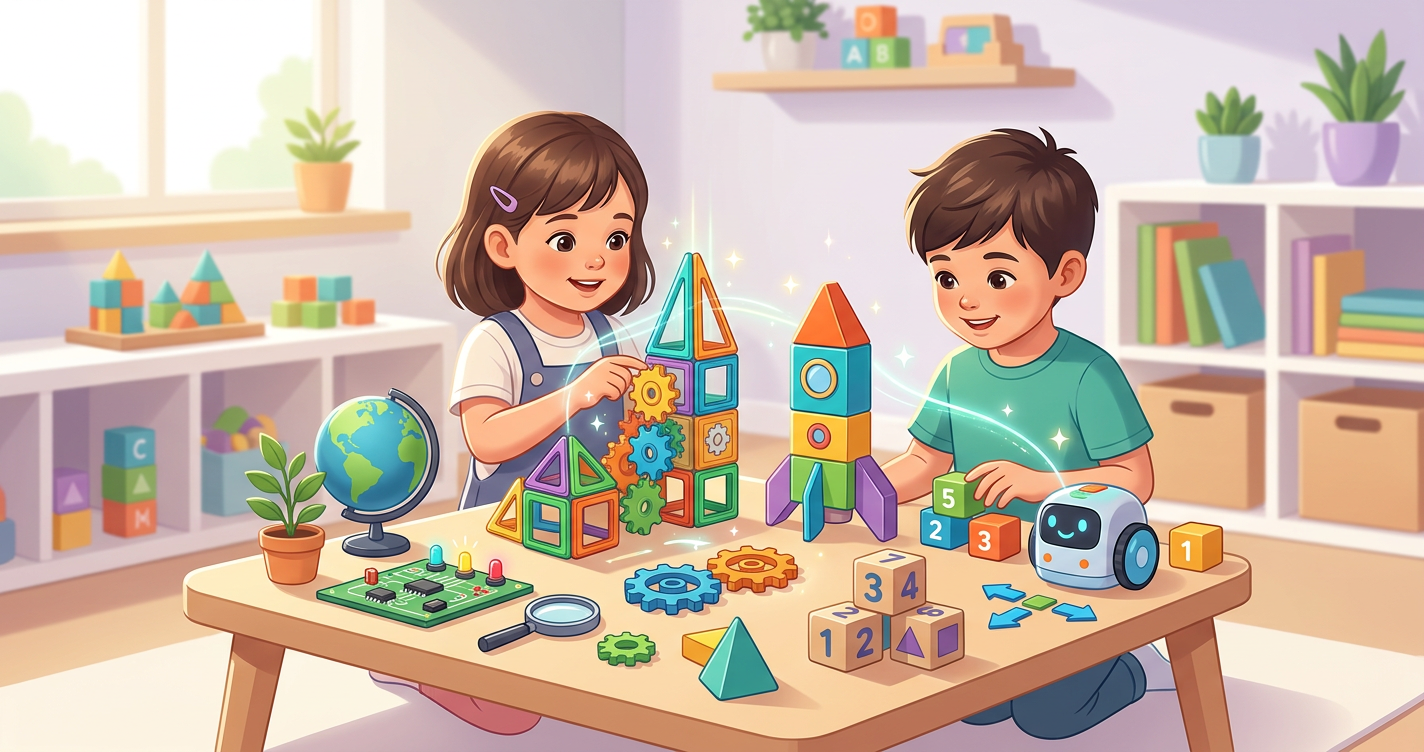
- Preschoolers (3-5 years): This is an exciting age for STEM! Magnetic tiles, gear sets, beginner coding robots, simple science experiment kits (e.g., growing crystals, making slime), and construction toys like LEGOs can ignite a passion for discovery. Look for toys that encourage open-ended play and imaginative building.
- Early Elementary (5-8 years): More advanced robotics kits, circuit boards, engineering challenges (e.g., K’nex, advanced LEGO sets), chemistry sets, and astronomy kits can deepen their understanding and challenge their problem-solving abilities.
Always prioritize safety and durability. Opt for non-toxic materials and ensure small parts are not a choking hazard for younger children.
Integrating STEM Play into Daily Life: Tips for Parents
Bringing STEM into your child's world doesn't require a dedicated science lab or extensive training. It's about fostering an environment of curiosity and discovery.
- Join in the Fun: Play alongside your child! Your enthusiasm is contagious. Ask open-ended questions like, “What do you think will happen if…?” or “How could we make this stronger?”
- Don't Force It: If your child isn't interested in a particular toy today, that's perfectly fine. Put it away and reintroduce it later. Play should always be enjoyable, not a chore.
- Connect to Real Life: Point out STEM concepts in everyday activities. “Look how the ramp helps the car go faster!” “How many apples do we need for everyone?”
- Create a 'Discovery Zone': Designate a small area where STEM toys and materials are easily accessible. This encourages independent exploration.
- Embrace Mess: Some of the best STEM learning involves a bit of mess – water play, sand play, simple kitchen experiments.
- Rotate Toys: Keep a selection of toys available and rotate them periodically to maintain novelty and interest.
Conclusion: Empowering Future Innovators Through Play
Investing in STEM toys for early childhood development isn't just about buying another plaything; it's about investing in your child's future. By integrating these thoughtful tools into their play, we empower them to become creative thinkers, persistent problem-solvers, and confident explorers. We're not just preparing them for school; we're preparing them for a world that increasingly values innovation, adaptability, and a strong foundation in scientific and mathematical literacy.
So, embrace the power of play. Watch your child's eyes light up with discovery, celebrate their small victories, and nurture their innate curiosity. The magic of STEM toys lies in their ability to transform playtime into a profound learning journey, laying the groundwork for a lifetime of brilliance and endless possibilities.