Beyond the Screen: Igniting Curiosity with STEM Toys
In an increasingly digital world, it's easy for children to get lost in the passive consumption of screens. But what if there was a way to channel that innate childhood curiosity into active, hands-on learning that prepares them for the future? Enter STEM toys. For elementary school children, these aren't just playthings; they are powerful tools that unlock potential, foster critical thinking, and build a foundational love for discovery. As parents and educators, we have a unique opportunity to cultivate these vital skills during these formative years. Let's explore how engaging with science, technology, engineering, and mathematics through play can transform your child's learning journey.
What Exactly Are STEM Toys, Anyway?
STEM is an acronym for Science, Technology, Engineering, and Mathematics. STEM toys are specifically designed to introduce children to these core concepts in an engaging, interactive, and often challenging way. Unlike traditional toys that might focus solely on imaginative play or motor skills, STEM toys encourage children to experiment, build, solve problems, and think analytically. this excellent toy product
Think beyond simple building blocks (though they have their place!). STEM toys encompass a vast array of products, from chemistry kits and robotics sets to circuit boards and elaborate construction systems. The unifying factor is their ability to prompt children to ask 'why' and 'how,' developing skills that are crucial not just for academic success but for navigating the complexities of the modern world.
Why STEM Toys Are Essential for Elementary Minds
The elementary years (roughly ages 5-10) are a critical period for cognitive development. Children are naturally curious, and their brains are rapidly forming connections. Introducing STEM concepts during this time offers a multitude of benefits:
- Fosters Critical Thinking and Problem-Solving: STEM toys often present challenges that require children to think logically, test hypotheses, and find solutions. Whether it's figuring out why a robot isn't moving or how to stabilize a structure, these experiences build robust problem-solving skills.
- Boosts Creativity and Innovation: While often associated with logic, STEM also heavily relies on creative thinking. Engineering challenges, for instance, demand innovative solutions. Children learn to think outside the box, experiment with different approaches, and design their own creations.
- Develops Resilience and Perseverance: Not every experiment works on the first try, and not every building stands perfectly. STEM play teaches children that 'failure' is a stepping stone to success. It encourages them to try again, adjust their methods, and learn from mistakes – invaluable life lessons.
- Introduces Foundational Concepts: Without realizing it, children are learning about gravity, simple machines, coding logic, spatial reasoning, and mathematical patterns. These hands-on experiences make abstract concepts tangible and easier to grasp later in formal education.
- Makes Learning Fun and Engaging: When learning feels like play, children are more motivated to engage. STEM toys transform potentially daunting subjects into exciting adventures, sparking a genuine love for discovery and inquiry.
- Prepares for Future Careers: The global economy increasingly relies on STEM skills. Introducing these concepts early doesn't just prepare children for school; it lays the groundwork for future opportunities in a wide range of fields, from software development to environmental science.
Exploring the World of STEM: Types of Engaging Toys
The variety of STEM toys available today is incredible, catering to diverse interests and age groups within elementary school. Here are a few popular categories:
Science Kits: Unleashing the Inner Scientist
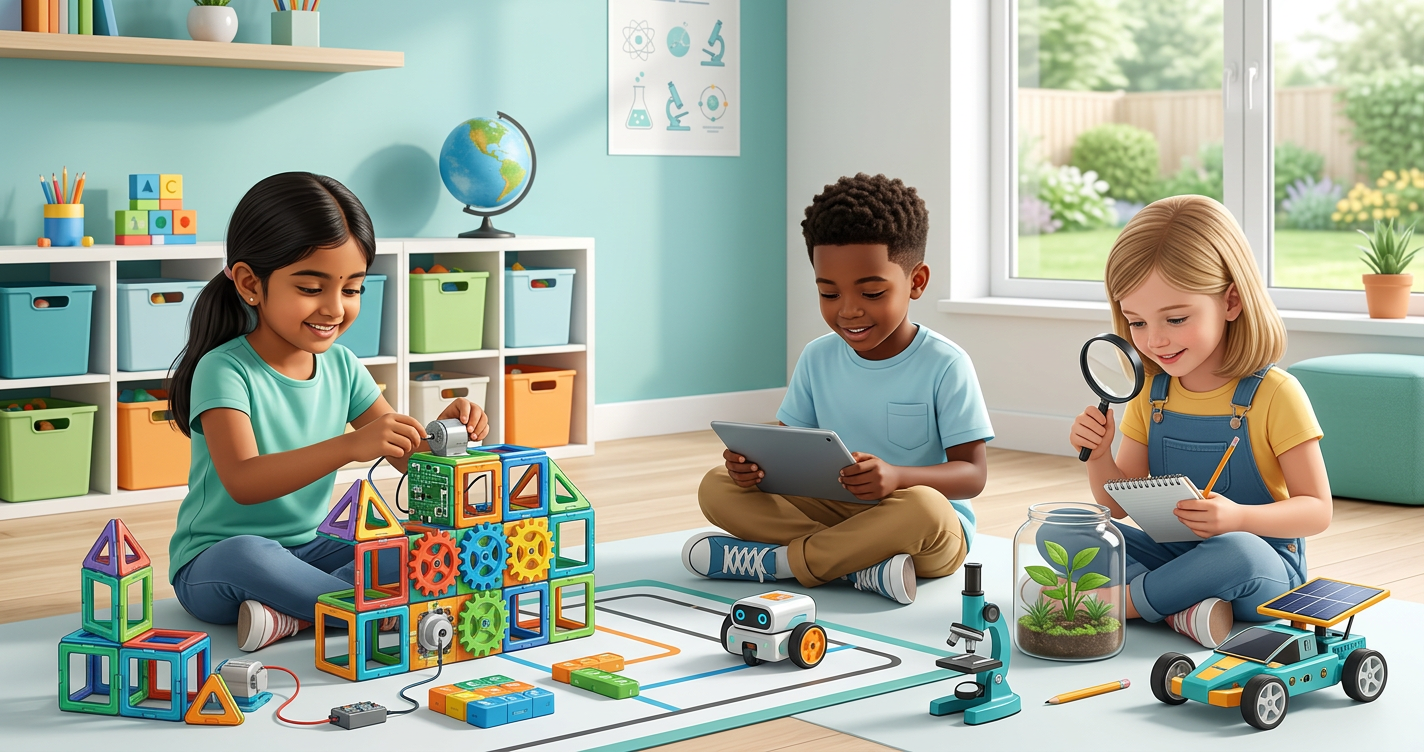
From bubbling chemistry experiments to exploring the wonders of biology, science kits allow children to conduct safe, hands-on investigations. Look for kits that explain scientific principles clearly and encourage independent experimentation. Think microscopes, crystal growing kits, or even simple circuits that light up bulbs.
Robotics & Coding Kits: Building the Future, One Line at a Time
These toys introduce children to the basics of programming and engineering. Many kits feature user-friendly, block-based coding interfaces that allow kids to program robots to perform tasks, navigate mazes, or even draw pictures. This teaches computational thinking and logical sequencing in a highly interactive way.
Engineering & Building Sets: Architects and Inventors in Training
Beyond basic blocks, advanced building sets like LEGO Technic, K'nex, magnetic tiles, or even simple circuitry kits challenge children to design, construct, and understand structural integrity. They learn about balance, levers, gears, and how different components work together to create a functional whole.
Math Games & Logic Puzzles: Making Numbers Fun
These toys go beyond rote memorization, focusing on mathematical reasoning, spatial awareness, and problem-solving. From geometry sets that explore shapes and angles to logic puzzles that require strategic thinking, these games make math an enjoyable challenge rather than a chore.
Nature & Exploration Tools: Connecting with the World
Sometimes, the best STEM toys are those that encourage exploration of the natural world. Binoculars, child-friendly telescopes, magnifying glasses, and bug catchers foster observational skills, curiosity about ecosystems, and an early appreciation for biology and astronomy.
Choosing the Right STEM Toy: A Parent's Guide
With so many options, selecting the perfect STEM toy can feel overwhelming. Here are some tips to help you make informed choices:
- Consider Your Child's Interests: If your child loves animals, a biology kit might be more engaging than a robotics set. Tapping into existing passions will maximize engagement.
- Age Appropriateness: Always check the recommended age range. Toys that are too simple might bore them, while those that are too complex can lead to frustration.
- Open-Ended Play vs. Structured: Some toys offer guided experiments, while others are more open-ended, allowing for endless creative possibilities. A good balance of both can be beneficial.
- Durability and Safety: Ensure the toy is made from high-quality, non-toxic materials and is built to withstand enthusiastic play.
- Educational Value: Does the toy clearly explain the concepts it's teaching? Does it encourage experimentation and critical thinking? Read reviews and product descriptions carefully.
- Involve the Family: Some of the best STEM toys are those that can be enjoyed collaboratively, fostering shared learning experiences and quality family time.
Maximizing the Learning: Beyond the Box
Simply buying a STEM toy isn't enough; the real magic happens through interaction and engagement. Here’s how you can help your child get the most out of their STEM play:
- Play Together: Join in the fun! Your enthusiasm is contagious, and playing alongside your child can provide gentle guidance and encourage deeper exploration.
- Ask Open-Ended Questions: Instead of telling them what to do, ask questions like, "What do you think will happen if...?" "How could we make this stronger?" or "What did you learn from that?" This encourages independent thought.
- Let Them Lead: Resist the urge to take over. Allow your child to experiment, make mistakes, and discover solutions on their own. The learning often happens in the process, not just the outcome.
- Embrace Mistakes: Frame errors as learning opportunities. "That didn't work as planned, what can we change next time?" teaches resilience and problem-solving.
- Connect to the Real World: Point out how the concepts they're learning apply to everyday life. "Look, that bridge uses the same engineering principles as your building set!"
- Provide a Conducive Environment: Designate a space where they can spread out, make a mess (within reason!), and leave projects unfinished to return to later.
Future-Proofing Through Play
Investing in STEM toys for elementary school children is more than just buying a new toy; it's an investment in their future. It's about nurturing their natural curiosity, equipping them with essential 21st-century skills, and fostering a lifelong love of learning and discovery. By choosing engaging, educational play, we empower our children to become the innovators, critical thinkers, and problem-solvers the world needs.
Conclusion: Build a Brighter Future, One Toy at a Time
The journey through elementary school is a crucial period for shaping a child's approach to learning. By thoughtfully integrating STEM toys into their play, we can move beyond traditional learning methods and offer a dynamic, hands-on pathway to understanding the world. These toys don't just entertain; they educate, inspire, and equip our children with the confidence and capabilities to tackle challenges with creativity and resilience. So, let's encourage our young explorers, engineers, scientists, and mathematicians to build, experiment, and discover – one fascinating STEM toy at a time.