
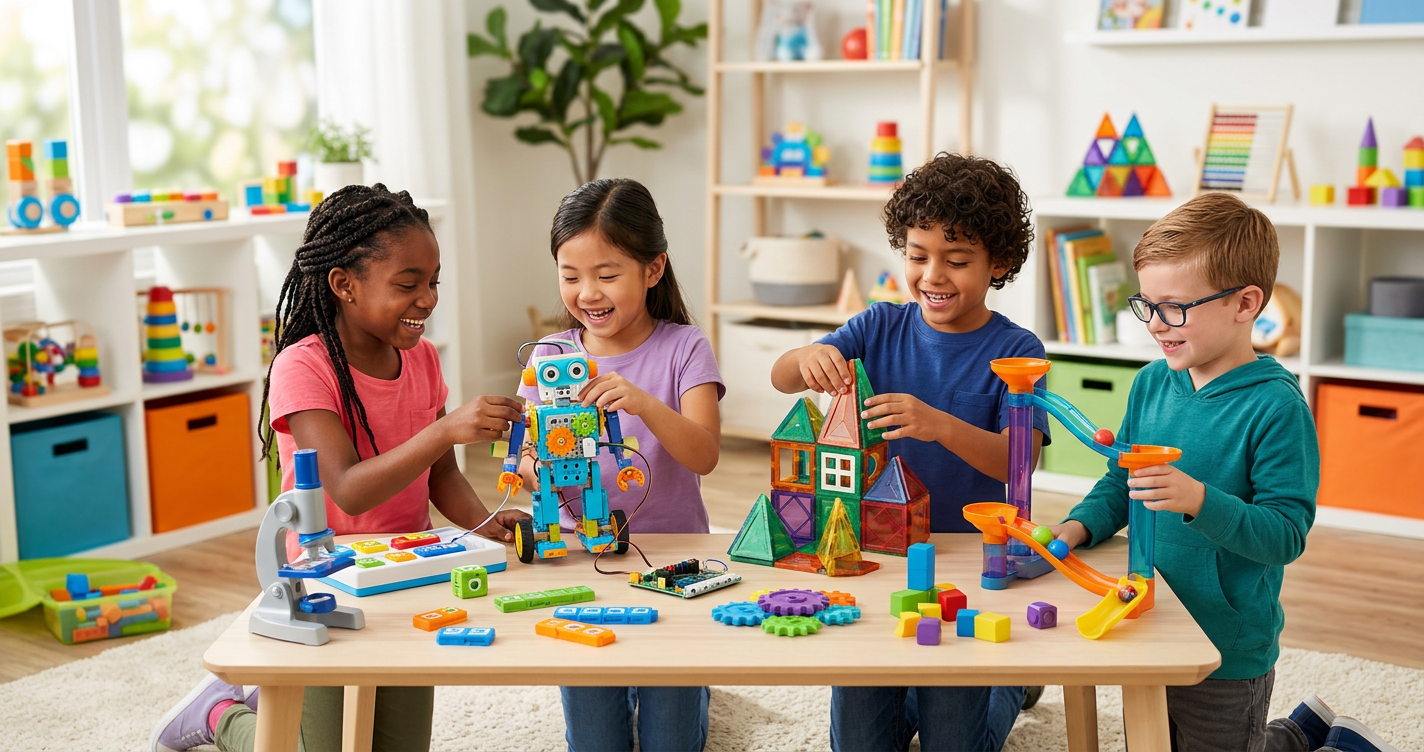
As parents, educators, and guardians, we all share a common goal: to nurture our children into well-rounded, curious, and capable individuals. In today's rapidly evolving world, preparing kids for the future means equipping them with more than just rote knowledge. It means fostering a love for discovery, a knack for problem-solving, and the confidence to innovate. This is where STEM toys shine brightest!
You’ve probably heard the acronym STEM – Science, Technology, Engineering, and Mathematics. Far from being intimidating subjects reserved for older students, STEM concepts are foundational to how our world works. And the most joyful, effective way to introduce these vital areas to children? Through play! this excellent toy product
This post will delve into the incredible world of STEM educational toys, exploring why they are not just fun distractions but powerful tools for development. We’ll look at the tangible benefits, what the research says, and how you can choose the perfect STEM toys to spark curiosity and build essential skills in your child, no matter their age.
What Exactly Are STEM Toys and Why Do They Matter?
At its core, a STEM toy is designed to educate children in one or more of the four disciplines: Science, Technology, Engineering, and Mathematics. But it's more than just a label; it's about an approach to learning. Unlike traditional toys that might focus on a single skill, STEM toys often encourage interdisciplinary thinking, experimentation, and hands-on discovery.
Think beyond lab coats and calculators. STEM toys can be anything from building blocks that teach basic physics and engineering principles, to coding robots that introduce computational thinking, to science kits that explore chemical reactions, or even puzzles that hone mathematical logic. The key is that they encourage children to observe, question, experiment, and analyze – skills crucial for success in virtually every field.
Why do they matter so much? The global economy is increasingly driven by STEM fields. By fostering an early interest, we're not just preparing kids for potential careers; we're cultivating a mindset of innovation and resilience. Children who engage with STEM toys develop:
- Curiosity: They learn to ask "why?" and "how?"
- Problem-Solving: They encounter challenges and figure out solutions.
- Critical Thinking: They analyze situations and make informed decisions.
- Creativity: They design, build, and invent new things.
- Persistence: They learn that failure is part of the process and encourages trying again.
The Brain-Boosting Benefits of STEM Play
The beauty of STEM toys lies in their ability to make complex concepts accessible and exciting. When children play with these toys, they're not just passing time; they're actively building neural pathways and strengthening cognitive abilities. Let's explore some key benefits:
Fostering Problem-Solving and Critical Thinking
Whether it's figuring out how to make a robot move, designing a stable bridge with LEGOs, or conducting a simple chemistry experiment, STEM toys inherently present challenges. Children learn to identify problems, brainstorm solutions, test hypotheses, and evaluate outcomes. This iterative process is the bedrock of critical thinking and effective problem-solving – skills that transcend academics and benefit every aspect of life.
Igniting Creativity and Innovation
Many STEM toys are open-ended, meaning there isn't just one "right" way to play. Building sets, circuit kits, and coding games often invite children to imagine, design, and create their own unique solutions or inventions. This freedom to experiment nurtures imaginative thinking and encourages children to innovate, seeing possibilities where others might only see limitations.
Building Resilience and Persistence
Not every experiment works on the first try, and not every block tower stands tall immediately. STEM play often involves trial and error. This invaluable experience teaches children that setbacks are opportunities for learning, not reasons to give up. They develop patience, resilience, and the grit to keep trying until they succeed, building a growth mindset that is critical for future challenges.
Enhancing Collaboration and Communication
While many STEM toys can be enjoyed individually, many also lend themselves beautifully to collaborative play. Working together on a building project, a coding challenge, or a science experiment teaches children how to share ideas, delegate tasks, negotiate, and communicate effectively. These social skills are just as vital as the academic ones.
Evidence-Based Insights: What the Experts Say
The benefits of hands-on, exploratory learning, like that offered by STEM toys, are well-documented in educational psychology. Pioneers like Jean Piaget emphasized that children learn best by interacting with their environment and constructing their own understanding. Lev Vygotsky highlighted the importance of play in cognitive development, seeing it as a crucial means by which children make sense of the world.
Modern research continues to support this. Studies show that early engagement with STEM concepts through play can significantly improve a child's spatial reasoning, mathematical abilities, and overall academic readiness. For instance, a report by the LEGO Foundation underlines that "playful learning experiences... are crucial for developing the skills needed for success in the 21st century." By engaging multiple senses and allowing for self-directed discovery, STEM toys tap into how children naturally learn, making the process both effective and enjoyable.
Choosing the Right STEM Toys for Every Age
The world of STEM toys is vast and varied, with options suitable for every developmental stage. Here’s a quick guide to help you choose:
Toddlers & Preschoolers (Ages 1-5): The Foundations of Discovery
- Focus: Sensory exploration, cause-and-effect, basic shape/color recognition, simple building.
- Examples: Large interlocking blocks (like DUPLO), magnetic tiles, shape sorters, simple gear sets, water tables, basic doctor kits for imaginative play, chunky puzzles.
- Tip: Look for durable, safe toys that encourage open-ended play and don't have too many small parts.
Elementary Schoolers (Ages 6-10): Experimentation and Exploration
- Focus: Introduction to scientific principles, basic engineering design, simple coding logic, mathematical patterns.
- Examples: Science experiment kits (volcanoes, slime, crystals), introductory robotics kits (e.g., simple build-and-code robots), advanced LEGO sets, circuit building kits, geology kits, astronomy telescopes, logic puzzles.
- Tip: Choose toys that offer clear instructions but also room for experimentation and customization.
Pre-Teens (Ages 11-13+): Advanced Challenges and Specialization
- Focus: Complex problem-solving, advanced coding, detailed engineering projects, in-depth scientific inquiry.
- Examples: More sophisticated robotics platforms (Arduino, Raspberry Pi kits), advanced chemistry sets, drone building kits, intricate model building, advanced coding games, electronics kits that require soldering.
- Tip: Encourage them to pursue areas of genuine interest. These toys can be gateways to hobbies and even future careers.
Integrating STEM Play into Everyday Life
You don't need a dedicated "STEM room" or a specific curriculum. Integrating STEM play can be as simple as:
- Asking "What if?": Encourage questions about how things work. "What if we try building it this way?"
- Making it Accessible: Have a designated spot for STEM toys that's easy for kids to access.
- Playing Together: Join in the fun! Your enthusiasm is contagious and provides valuable interaction.
- Connecting to the Real World: Point out how STEM concepts are used in daily life – from bridges to baking, from smartphones to weather patterns.
- Embracing Messes: Science experiments can get messy, and that's okay! Focus on the learning.
Addressing Common Concerns: Are STEM Toys Just for 'Smart' Kids?
Absolutely not! This is a common misconception that can deter parents and children. STEM toys are for all children, regardless of their current academic standing or perceived "intelligence." The goal isn't to create child prodigies, but to foster curiosity, resilience, and a love for learning. Every child possesses an innate curiosity, and STEM toys are simply tools to tap into and develop that natural inclination.
Focus on the process of discovery and enjoyment, not just the outcome. Celebrate effort, experimentation, and the joy of figuring things out, rather than just "getting the right answer." When approached with an open mind and a playful spirit, STEM toys can unlock hidden talents and interests in any child.
Conclusion: Empowering Future Innovators Through Play
Investing in STEM educational toys is more than just buying another plaything; it's an investment in your child's future. It's about empowering them to think critically, solve problems creatively, and approach challenges with confidence and persistence. These are the skills that will serve them well, not just in school or future careers, but in navigating an increasingly complex world.
So, take a leap into the exciting world of STEM play! Observe your child's interests, choose age-appropriate toys, and most importantly, join them in the adventure of discovery. You'll be amazed at how quickly they ignite their inner innovator and build a lifelong passion for learning and exploration. Happy playing!


