As parents, we all want to give our children the best possible start in life. In today's rapidly evolving world, that often means equipping them with skills that go beyond traditional ABCs and 123s. This is where the magic of STEM — Science, Technology, Engineering, and Mathematics — comes into play, even for our littlest learners!
You might think STEM sounds like a concept best suited for older kids in labs, but the truth is, the foundational principles of STEM are incredibly accessible and beneficial for preschoolers. Through playful exploration with the right educational toys, we can spark curiosity, foster critical thinking, and lay a robust groundwork for future success. This post will dive deep into why STEM toys are essential for your preschooler's development, how to choose them wisely, and how to maximize their impact at home. this excellent toy product
Why STEM Matters for Our Littlest Learners (The Evidence!)
The benefits of early STEM exposure are far-reaching and backed by developmental psychology research. Preschoolers are natural scientists, engineers, and mathematicians; they constantly observe, experiment, build, and count. STEM toys simply channel this innate curiosity into structured, yet playful, learning experiences.
- Cultivating Critical Thinking & Problem-Solving: When a child tries to build a tower that keeps falling, they're engaging in engineering and physics. They're learning to identify problems, hypothesize solutions, and test them out. This iterative process is the core of critical thinking.
- Boosting Creativity & Innovation: STEM isn't just about rigid rules; it's about imagining new possibilities. Open-ended STEM toys encourage children to invent, design, and express their unique ideas, fostering a spirit of innovation from a young age.
- Enhancing Fine Motor Skills & Spatial Reasoning: Manipulating blocks, connecting gears, or fitting puzzle pieces all contribute to developing fine motor control and hand-eye coordination. These activities also improve spatial reasoning – the ability to understand and reason about shapes and space, crucial for math and engineering.
- Developing Early Literacy & Language Skills: As children play with STEM toys, they're often talking through their actions, describing what they see, and asking questions. This verbalization strengthens their vocabulary and narrative skills, connecting play to language development.
- Building Resilience & Perseverance: Not every experiment works on the first try! STEM play teaches children to embrace mistakes as learning opportunities, encouraging them to keep trying, adjust their approach, and celebrate small victories.
Early exposure to STEM concepts doesn't just make kids smarter; it makes them more resilient, creative, and curious individuals, ready to tackle the challenges of the 21st century.
Decoding STEM: What Does it Look Like in a Toy?
Understanding what each letter in STEM represents helps us identify truly beneficial toys. It's not about complicated gadgets, but about toys that encourage certain types of thinking and interaction.
Science (S) for Curious Minds
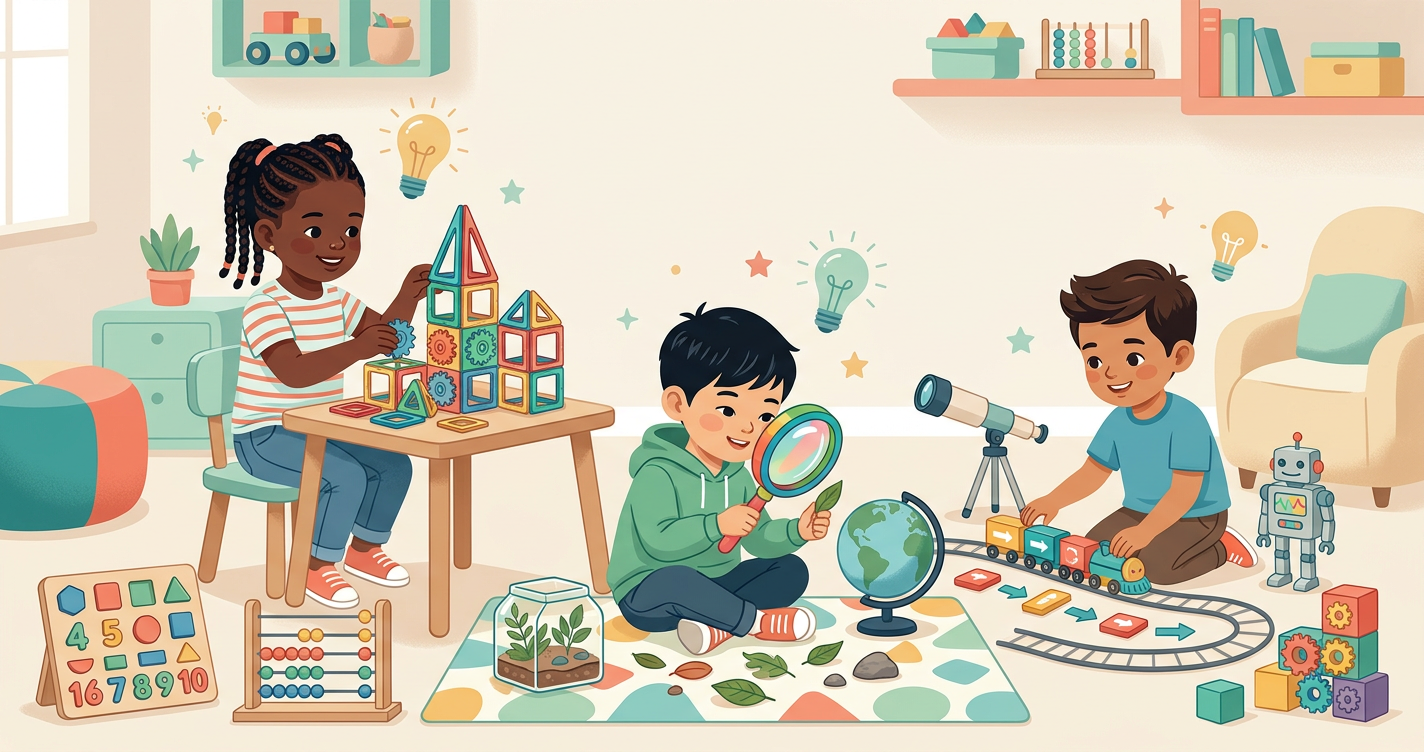
Science toys encourage observation, exploration, and understanding the natural world. Think about cause and effect, properties of materials, and living things.
- Examples: Magnifying glasses, bug viewers, simple nature exploration kits, sensory bins with natural elements (water, sand, leaves), color mixing sets, simple balance scales.
- How they help: They spark questions like 'What happens if...?', 'Why does this float?', and 'How does this work?', fostering early scientific inquiry.
Technology (T) for Early Innovators
For preschoolers, 'technology' isn't about screens, but about understanding how things work and simple machines. It's about problem-solving through tools and systems.
- Examples: Simple gear sets, basic circuit kits (safe, large pieces), early coding robots (like Bee-Bot or Code & Go Robot Mouse) that introduce sequencing, cause-and-effect toys, light tables.
- How they help: Introduce concepts of input/output, sequencing, and how different parts work together to achieve a goal.
Engineering (E) for Budding Builders
Engineering toys are all about design, construction, and problem-solving through building. They encourage children to plan, build, test, and refine.
- Examples: Building blocks (wooden, magnetic tiles, LEGO Duplo), interlocking construction sets, fort-building kits, ramps and marble runs.
- How they help: Develop spatial awareness, understanding of stability and structure, and the iterative process of design and refinement.
Mathematics (M) for Little Logicians
Math for preschoolers isn't just counting. It involves recognizing patterns, understanding shapes, sorting, comparing, and developing early logical reasoning.
- Examples: Puzzles (shape sorters, jigsaw puzzles), pattern blocks, counting bears or counters, measuring cups/spoons for water play, sorting games, simple abacus.
- How they help: Foster number sense, geometric understanding, pattern recognition, and logical deduction.
Choosing the Right STEM Toys: A Parent's Guide
With so many options available, how do you pick the best STEM toys for your child? Here are some key considerations:
- Age-Appropriateness: Always check the recommended age range. Toys that are too complex will frustrate, while those too simple might bore.
- Open-Ended Play: Look for toys that can be used in multiple ways, encouraging imagination and sustained engagement. Blocks, magnetic tiles, and art supplies are perfect examples.
- Durability and Safety: Preschoolers are tough on toys! Choose well-made, non-toxic materials. Ensure there are no small parts that could be a choking hazard.
- Engagement Factor: Does the toy genuinely capture your child's interest? The best educational toy is one your child *wants* to play with.
- Promotes Active Learning: The toy should encourage hands-on interaction and exploration, not just passive observation.
- Aligns with Interests: If your child loves dinosaurs, look for dinosaur-themed science kits or building sets. Tapping into their passions makes learning more enjoyable.
Top STEM Toy Categories for Preschoolers (with examples)
To help you get started, here are some popular and highly effective STEM toy categories for preschoolers:
- Building Blocks & Construction Sets: From classic wooden blocks to magnetic tiles (like Magna-Tiles or PicassoTiles) and LEGO Duplo, these are engineering powerhouses. They teach balance, symmetry, spatial reasoning, and creative design.
- Puzzles & Logic Games: Chunky wooden puzzles, shape sorters, and pattern blocks are fantastic for developing problem-solving skills, shape recognition, and fine motor coordination.
- Early Science & Nature Exploration Kits: Simple microscopes (kid-friendly), magnifying glasses, bug viewers, and gardening tools inspire curiosity about the natural world.
- Simple Engineering & Robotics: Gear sets allow children to see cause and effect in action. Beginner coding robots introduce basic programming concepts in a fun, screen-free way.
- Sensory & Manipulative Toys: Playdough, kinetic sand, and water tables offer endless opportunities for scientific exploration (texture, volume, states of matter) and creative construction.
Beyond the Toy: Maximizing STEM Play at Home
A STEM toy is only as good as the interaction it inspires. Here’s how you can supercharge your child’s learning:
- Be a Play Partner: Sit with your child, observe what they're doing, and ask open-ended questions like, “What do you think will happen if...?” or “Tell me about your invention!”
- Embrace Mess & Experimentation: Sometimes the best learning comes from trial and error, or even a bit of a mess. Encourage them to try new things, even if it doesn't work out perfectly.
- Connect Play to the Real World: Point out real-life examples of STEM. “Look, that bridge is an amazing piece of engineering!” or “How many apples do we have? Let’s count them!”
- Provide a Stimulating Environment: Offer a variety of materials and a dedicated space where your child feels free to explore, build, and create without constant supervision or fear of making a mess.
- Rotate Toys: Keep a selection of toys available and rotate them periodically to maintain novelty and interest.
Common Pitfalls to Avoid When Buying STEM Toys
While the intention behind buying educational toys is always good, there are a few traps parents can fall into:
- Over-focusing on the 'Educational' Label: Not all toys marketed as 'educational' are truly effective. Prioritize engagement and open-ended play over flashy packaging.
- Buying Too Many Toys: A few high-quality, versatile STEM toys are far more beneficial than a mountain of single-purpose gadgets. Less can often be more, allowing for deeper engagement.
- Ignoring Your Child's Interests: Forcing a child to play with a STEM toy they have no interest in will likely backfire. Observe their natural curiosities and choose toys that align.
- Prioritizing Screens Over Hands-On: While some apps can be educational, nothing replaces the tactile, multi-sensory experience of hands-on STEM play for preschoolers.
Conclusion: Spark Their STEM Journey Today!
Investing in STEM toys for your preschooler is more than just buying another plaything; it's an investment in their cognitive development, problem-solving abilities, and future readiness. By choosing thoughtfully and engaging actively in their play, you can ignite a lifelong love for learning, exploration, and innovation. So go ahead, embrace the power of play, and watch your little one unlock their incredible potential!