
Introduction: The Power of Play in Early Learning
Imagine your preschooler stacking blocks, meticulously arranging pieces of a puzzle, or excitedly pointing out a ladybug in the garden. What might look like simple play is often much more profound. These moments are ripe with opportunities for learning, especially in the crucial areas of Science, Technology, Engineering, and Mathematics – collectively known as STEM. While STEM might sound like a high-level concept reserved for older students, its foundations are laid much earlier, right in the heart of your child’s playful explorations.
In today's rapidly evolving world, equipping our children with strong problem-solving skills, critical thinking, and a curious mindset is more important than ever. And the beautiful truth is, you don't need a lab coat or complex textbooks to start. Educational toys, particularly those designed with STEM principles in mind, offer a fun, intuitive gateway to these essential skills. This post will explore why STEM toys are not just 'nice-to-haves' but truly transformative tools for your preschooler's development, helping them build a robust foundation for future success and a lifelong love of learning. this excellent toy product
What Exactly Are STEM Toys for Preschoolers?
Before we dive into the benefits, let's clarify what we mean by STEM toys for this age group. Forget complex coding robots or advanced chemistry sets – for preschoolers (ages 3-5), STEM is all about hands-on exploration and understanding the world around them through play.
- Science: Encourages observation, experimentation, and understanding cause and effect. Think magnifying glasses, sensory bins, or simple experiments like mixing colors.
- Technology: At this age, 'technology' isn't about screens, but rather simple tools and understanding how things work. Examples include simple levers, gears, or even basic building tools.
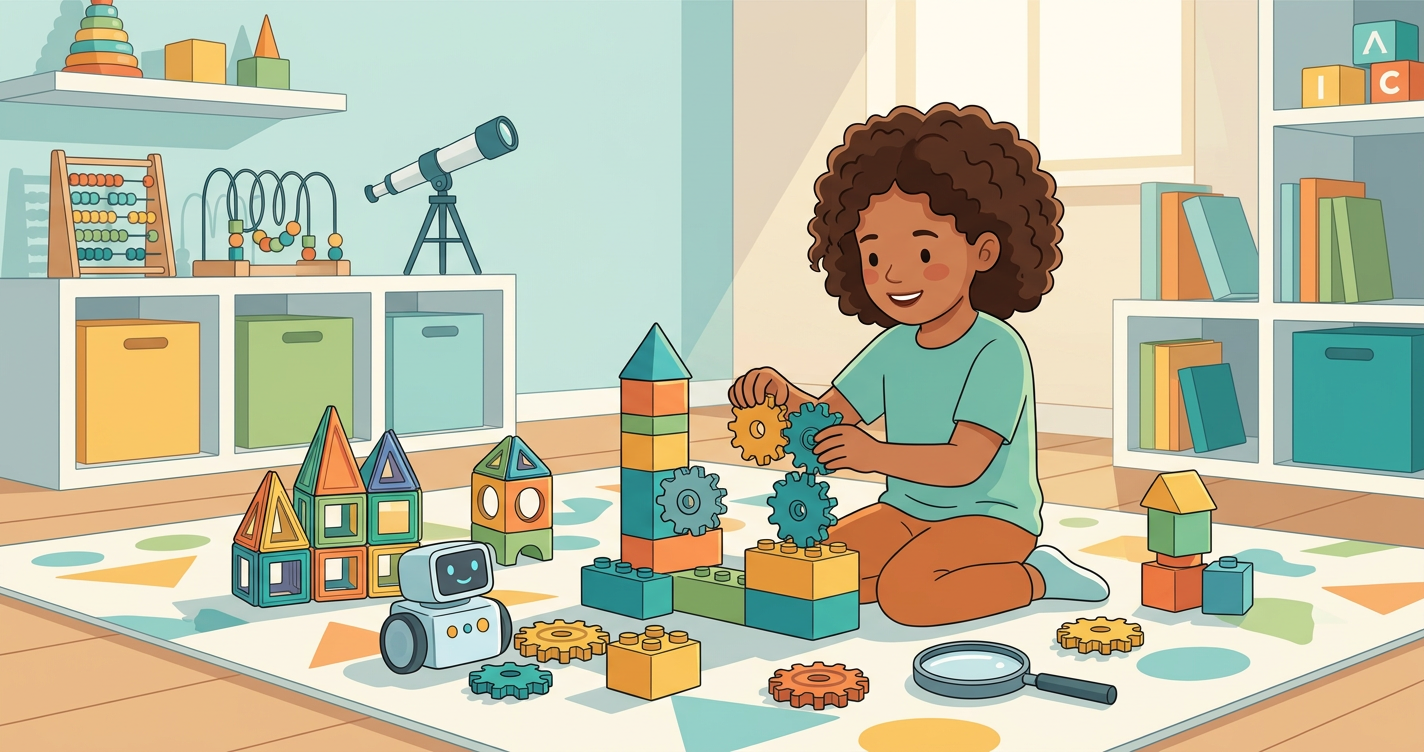
- Engineering: Fosters problem-solving, design, and construction. Building blocks, magnetic tiles, and construction sets are perfect examples.
- Mathematics: Develops early concepts like counting, sorting, patterning, and spatial awareness. Puzzles, shape sorters, and counting games fall into this category.
Essentially, a STEM toy for a preschooler is anything that encourages them to ask 'why,' 'how,' or 'what if,' and then provides them with the means to discover the answers themselves through playful interaction.
The Brain-Boosting Benefits: Why Early STEM Matters So Much
The impact of engaging with STEM toys during the preschool years extends far beyond just learning about science or math. It nurtures a holistic development that benefits children in countless ways, backed by extensive research in early childhood education.
Fostering Critical Thinking and Problem-Solving
When a child tries to fit puzzle pieces together or figures out how to make a tower stand tall, they're engaging in critical thinking. They hypothesize, test, and adapt. STEM toys naturally present small challenges that encourage children to think through solutions, learn from 'mistakes,' and persist until they succeed. This iterative process builds resilience and a 'growth mindset' crucial for lifelong learning.
Sparking Creativity and Innovation
Many STEM toys are open-ended, meaning there's no single 'right' way to play. Building blocks can become a castle, a car, or an abstract sculpture. This encourages imaginative play and allows children to express their unique ideas, fostering innovation from a young age. They learn that there are multiple paths to a solution and that their own ideas have value.
Developing Fine Motor Skills and Hand-Eye Coordination
Manipulating small parts, fitting pieces, stacking, and balancing all contribute significantly to the development of fine motor skills. These skills are essential for everyday tasks like writing, drawing, and self-care, and they are intricately linked to cognitive development.
Enhancing Language and Communication Skills
As children play with STEM toys, they often narrate their actions, describe their observations, and interact with others. This rich environment encourages vocabulary expansion (e.g., 'magnify,' 'balance,' 'structure'), helps them articulate their thoughts, and fosters collaborative communication if they're playing with peers or adults.
Laying the Foundation for Future Academic Success
Exposure to basic STEM concepts like patterns, symmetry, cause-and-effect, and simple measurement through play establishes a strong cognitive framework. Children who engage in early STEM activities are better prepared for formal schooling, showing improved readiness in subjects like math and science, but also in literacy, as the underlying cognitive processes are strengthened.
Beyond the Buzzwords: Practical Examples of Engaging STEM Play
You might already have some of these 'STEM toys' in your home without even realizing it! Here are some fantastic examples that truly shine for preschoolers:
- Building Blocks & Construction Sets: Wooden blocks, LEGO DUPLO, magnetic tiles (e.g., Magna-Tiles, Connetix). These are engineering powerhouses, teaching balance, stability, geometry, and spatial reasoning.
- Puzzles & Shape Sorters: Excellent for developing spatial awareness, problem-solving, and recognizing patterns and shapes – key early math skills.
- Sensory Bins & Water/Sand Tables: Fill a bin with rice, beans, water, or sand, and add scoops, cups, funnels, and small toys. This is a science lab in disguise, exploring volume, texture, cause-and-effect (pouring, sinking/floating), and measurement.
- Simple Science Kits/Tools: A magnifying glass for exploring nature, a prism for seeing rainbows, or even just household items like baking soda and vinegar for a fizzy reaction (with supervision!). These ignite curiosity and observation skills.
- Gears & Linking Toys: Toys with interlocking gears or linking pieces help children understand mechanical principles, sequences, and cause-and-effect.
- Nature Exploration: A simple walk in the park can be a STEM adventure. Collect leaves, observe insects, talk about seasons. It’s hands-on biology and environmental science!
Choosing the Right STEM Toys for Your Little Learner: A Parent's Guide
With so many options, how do you pick the best STEM toys for your preschooler? Here are some friendly tips:
- Prioritize Open-Ended Play: Look for toys that can be used in multiple ways, encouraging imagination rather than prescribing a single outcome. The less a toy 'does' on its own, the more your child's brain has to do!
- Consider Age-Appropriateness: Ensure the toy isn't too challenging (leading to frustration) or too simple (leading to boredom). Packaging often provides age recommendations, but observe your child's interests and abilities.
- Focus on Durability & Safety: Preschoolers are tough on toys! Choose sturdy, non-toxic materials. Large pieces are generally safer and easier for small hands to manipulate.
- Observe Their Interests: Is your child fascinated by animals? Look for nature-themed science kits. Do they love taking things apart? A simple take-apart vehicle might be perfect for understanding basic mechanics.
- It Doesn't Have to Be Expensive: Many everyday items – pots and pans, measuring cups, cardboard boxes, natural materials – are fantastic, free STEM tools.
Making STEM Play a Daily Adventure (Without Even Trying!)
You don't need dedicated 'STEM time' to integrate these valuable experiences into your child's day. Many opportunities arise naturally!
- In the Kitchen: Let your child help measure ingredients (math), observe changes when baking (science), and understand sequences (engineering a recipe).
- During Bathtime: Explore concepts of floating, sinking, and water displacement with various toys (science).
- On Walks: Point out different types of plants, leaves, or rocks (science), count steps (math), or observe how a bridge is built (engineering).
- Ask Open-Ended Questions: Instead of telling them the answer, ask, 'What do you think will happen if...?', 'How could we make this work?', or 'Why do you think that happened?' This encourages prediction and critical thinking.
- Embrace the Mess: True exploration often involves some mess. A little dirt, spilled water, or scattered blocks are often signs of active learning.
Remember, your enthusiasm and participation are the most powerful tools. When you show genuine curiosity, your child will mirror that excitement for discovery.
Common Myths Debunked: Why Early STEM Is For Every Child
Despite the clear benefits, some parents might have misconceptions about early STEM education.
Myth 1: My child is too young for STEM.
Reality: Children are natural scientists and engineers from birth! They constantly observe, experiment, and try to understand how the world works. STEM toys simply provide structured (but still playful) ways to channel this innate curiosity.
Myth 2: STEM is only for 'science-y' or 'math-y' kids.
Reality: STEM skills are universal. Problem-solving, creativity, and critical thinking benefit every child, regardless of their future career path. Early exposure simply builds a stronger foundation for all learning.
Myth 3: STEM toys are expensive and complicated.
Reality: As discussed, many everyday items are fantastic STEM tools. High-quality STEM toys can be an investment, but there are countless affordable and even free ways to introduce STEM concepts.
Myth 4: I need to be an expert to teach my child STEM.
Reality: You don't need a degree in engineering! Your role is to facilitate, ask questions, and explore alongside your child. It's about nurturing their curiosity, not delivering lectures.
Conclusion: Nurturing a Lifetime of Curiosity and Discovery
Investing in STEM toys and activities for your preschooler is truly an investment in their future. It's not about turning every child into a scientist or an engineer; it's about nurturing their innate curiosity, building essential cognitive skills, and fostering a confident, resilient approach to learning and problem-solving.
By providing opportunities for hands-on exploration, encouraging open-ended play, and simply engaging with them as they discover the wonders of their world, you are giving your child a powerful head start. So, go ahead – embrace the blocks, the puzzles, the nature walks, and the messy experiments. You're not just playing; you're building the foundation for a brilliant future, one curious moment at a time!


