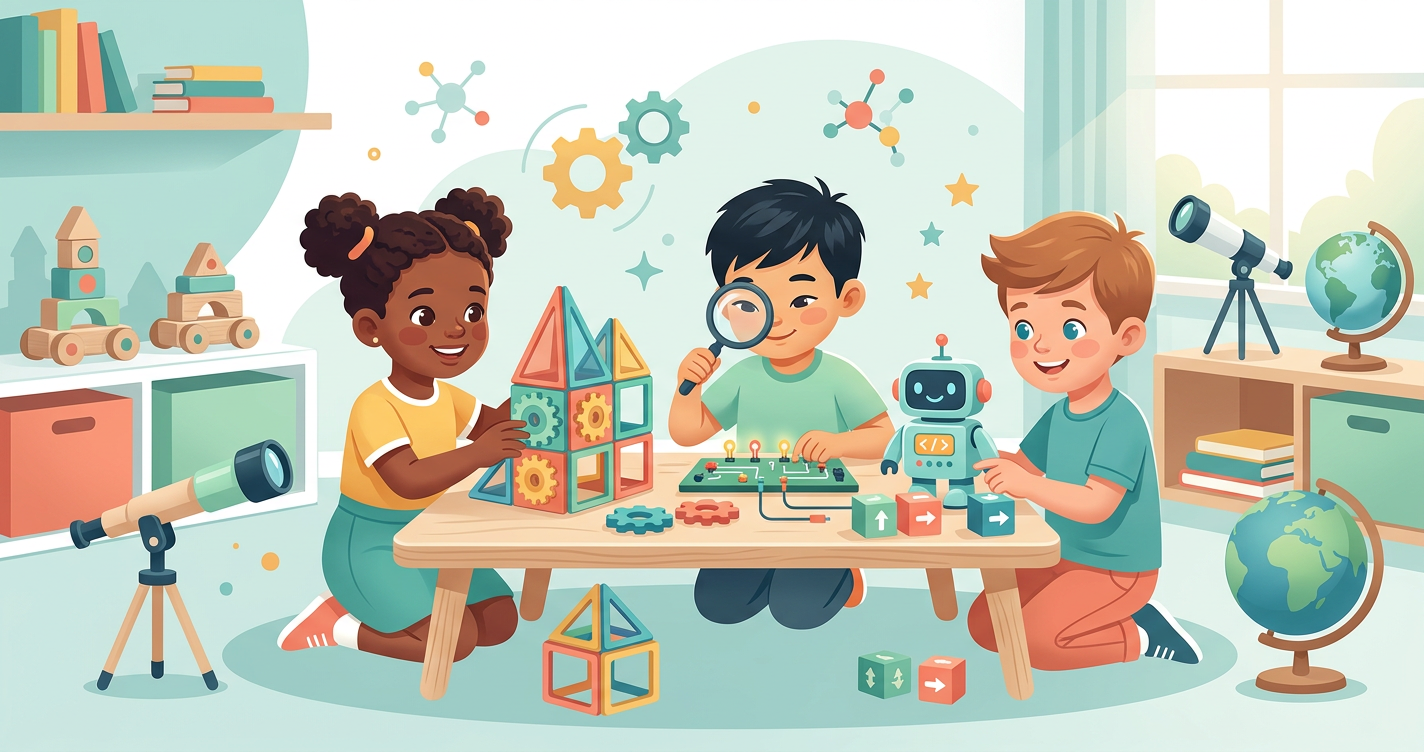
Remember that incredible spark in a child's eyes when they discover something new? That moment of pure wonder as they figure out how something works, or successfully build a tower that reaches the sky? For preschoolers, every single interaction is a learning opportunity, a chance to explore the world around them. And what better way to nurture this innate curiosity than with STEM toys?
STEM, an acronym for Science, Technology, Engineering, and Mathematics, might sound like a concept reserved for high school labs or university lecture halls. But the truth is, the foundational skills for these critical disciplines begin developing much earlier, right in the sandbox, with building blocks, and during playful exploration. Introducing STEM concepts through engaging, age-appropriate toys can set your little one on a path of lifelong learning, critical thinking, and innovation. this excellent toy product
What Exactly Are STEM Toys (and Why Preschoolers)?
At its heart, a STEM toy is designed to engage children in hands-on experiences that encourage exploration, problem-solving, and understanding how things work. It's not just about memorizing facts; it's about fostering a scientific mindset, an engineering approach to challenges, a technological understanding, and a mathematical way of thinking.
So, why focus on preschoolers (ages 3-5)? This developmental stage is a golden window for learning. Their brains are rapidly forming connections, curiosity is at an all-time high, and they are naturally inclined to experiment and ask “why?” and “how?” During these formative years, children develop:
- Gross and Fine Motor Skills: Manipulating objects, building, stacking.
- Cognitive Abilities: Cause and effect, problem-solving, spatial reasoning.
- Language and Social Skills: Describing observations, collaborating on projects.
- Emotional Development: Persistence, resilience, satisfaction from accomplishment.
STEM toys tap into these natural inclinations, transforming playtime into powerful learning experiences that are both fun and incredibly beneficial for their developing minds.
The Brain-Boosting Benefits of Early STEM Play
The impact of early exposure to STEM concepts through play extends far beyond the playroom. It lays a crucial groundwork for a child's overall development.
Fostering Problem-Solving and Critical Thinking
When a child tries to build a bridge for their toy cars and it keeps collapsing, they're engaging in an engineering challenge. They'll try different shapes, materials, or support structures. This trial-and-error process is the essence of problem-solving and critical thinking – skills vital for success in all areas of life.
Igniting Curiosity and a Love for Learning
STEM toys often present open-ended challenges, sparking a child's natural curiosity. “What happens if I add more water?” “Can I make this car go faster?” These questions are the beginning of scientific inquiry. By encouraging exploration and discovery, we nurture a lifelong love for learning.
Enhancing Creativity and Innovation
Many STEM toys, especially building sets, encourage imaginative play. There's no single “right” way to play, allowing children to invent their own solutions, designs, and stories. This freedom fosters creativity and innovative thinking, crucial for adapting to a rapidly changing world.
Developing Fine Motor Skills and Hand-Eye Coordination
From snapping together magnetic tiles to carefully placing gears, STEM toys often require precise movements. This helps preschoolers refine their fine motor skills, which are essential for tasks like writing, drawing, and self-care. Hand-eye coordination also gets a significant boost as they learn to manipulate objects to achieve a desired outcome.
Building Foundational Math and Science Concepts
Without even realizing it, preschoolers playing with STEM toys are learning about gravity, balance, measurement, patterns, shapes, and sequences. These hands-on experiences make abstract concepts tangible and understandable, forming a solid base for more complex learning later on.
Choosing the Right STEM Toys for Your Little Learner
With so many options available, selecting the perfect STEM toy can feel overwhelming. Here are some key considerations to guide your choices:
- Age-Appropriateness: Always check the recommended age range. Toys too complex can lead to frustration, while those too simple might not hold their interest. Safety is also paramount, ensuring no small parts pose a choking hazard.
- Open-Ended Play: Look for toys that can be used in multiple ways, rather than just one. Building blocks, magnetic tiles, and simple science kits offer endless possibilities, encouraging creativity and sustained engagement.
- Durability and Safety: Preschoolers can be tough on toys! Choose well-made, sturdy toys from reputable brands. Ensure materials are non-toxic and free from sharp edges.
- Engagement Factor: Does the toy genuinely capture your child's interest? The best STEM toy is one they love to play with repeatedly, exploring new aspects each time.
- Hands-On Exploration: Opt for toys that require active participation – building, experimenting, manipulating – rather than passive observation.
Top STEM Toy Categories for Preschoolers
Let's dive into some specific categories and examples that are fantastic for cultivating early STEM skills:
Building & Construction Toys
These are the quintessential STEM toys. They teach spatial reasoning, balance, geometry, and basic engineering principles.
- DUPLO Blocks: Large, easy-to-handle blocks perfect for little hands to create towers, houses, and vehicles. They introduce concepts of stacking, balance, and simple structures.
- Magnetic Tiles: Magna-Tiles or PicassoTiles are fantastic for building 2D and 3D shapes. They teach geometry, magnetism, and allow for incredible creative freedom.
- Wooden Blocks: Simple, timeless, and incredibly versatile. They encourage open-ended play, problem-solving, and understanding of weight and stability.
- Gear Sets: Toys like Learning Resources Gears! Gears! Gears! introduce cause and effect, simple mechanics, and sequencing as children connect gears to make them all turn.
Science Exploration Kits (Simple)
These toys encourage observation, prediction, and understanding of the natural world.
- Magnifying Glasses: A simple tool that opens up a world of tiny wonders, from inspecting leaves and insects to examining fabrics.
- Nature Collection Kits: Buckets, scoops, and bug viewers encourage outdoor exploration and classification of natural objects.
- Color Mixing Labs: Simple pipettes and colored water or paints allow preschoolers to experiment with primary and secondary colors, introducing basic chemistry.
- Floating & Sinking Toys: A tub of water and various objects (sponges, rocks, leaves) can lead to fascinating discussions about density and buoyancy.
Early Math & Logic Toys
These help develop number sense, patterns, sorting, and logical thinking.
- Counting Bears & Sorting Toys: Great for learning colors, counting, patterns, and classification.
- Pattern Blocks: Geometric shapes that can be arranged to create intricate patterns, teaching geometry and spatial reasoning.
- Stacking Cups/Rings: Help with size differentiation, sequencing, and counting.
- Shape Sorters: Classic toys that teach shape recognition and problem-solving.
Basic Engineering & Technology Toys
These introduce concepts of cause and effect, simple mechanics, and computational thinking.
- Simple Circuit Boards (Age-Appropriate): Kits with large, easy-to-connect pieces that light up or make sounds, introducing basic electricity without complex wiring.
- Screen-Free Coding Toys: Toys like the Code & Go Robot Mouse allow children to program a sequence of movements, introducing basic coding concepts like algorithms and sequencing in a tangible way.
- Ramps & Balls: Building simple ramps for balls to roll down teaches about gravity, momentum, and incline.
Making STEM Play a Family Affair
The toys are just the beginning! Your involvement can amplify the learning experience exponentially.
- Join in the Play: Sit down with your child and explore the toy together. Model curiosity and enthusiasm.
- Ask Open-Ended Questions: Instead of “What color is this?” try “What do you think will happen if we add another block here?” or “How could we make this stronger?”
- Don't “Fix” It For Them: When they encounter a challenge, resist the urge to jump in and solve it. Instead, offer guiding questions or suggestions: “What else could you try?” “Is there another way to do it?”
- Celebrate Effort, Not Just Outcome: Acknowledge their persistence and creative attempts, even if the final result isn't perfect. “You worked so hard on that!” or “That was a really clever idea to try the square block there.”
Beyond the Toy Box: Integrating STEM into Everyday Life
STEM learning isn't confined to specific toys. You can weave STEM concepts into your daily routines:
- Cooking Together: Measuring ingredients (math), observing changes when baking (chemistry).
- Gardening: Planting seeds, watching them grow (biology), understanding sunlight and water needs.
- Nature Walks: Identifying different leaves, counting birds, observing weather patterns (science, math).
- Building Forts: Engineering structures, understanding balance and support.
- Simple Experiments: A baking soda volcano, seeing what floats or sinks in the bath, or observing shadows.
Conclusion: Nurturing a Future of Innovators
Providing your preschooler with STEM toys isn't about creating a child genius or forcing them into a particular career path. It's about nurturing their innate curiosity, building foundational skills in problem-solving, critical thinking, creativity, and resilience. It's about empowering them to ask questions, explore possibilities, and understand the world around them.
By embracing the power of STEM play in these crucial early years, you're not just giving them toys; you're giving them tools for a lifetime of discovery, learning, and success. So go ahead, unlock their inner genius, and watch them build, discover, and thrive!