Imagine a world where learning feels like an exciting adventure, where curiosity is celebrated, and every playtime moment builds a foundation for future success. For our youngest learners, this isn't a fantasy – it's the reality brought to life by STEM toys for preschoolers. As parents and educators, we instinctively want to give children the best start, and in today's rapidly evolving world, that increasingly means nurturing skills in Science, Technology, Engineering, and Mathematics (STEM).
You might think STEM concepts are too advanced for a three or four-year-old, but the truth is, children are natural scientists and engineers! They constantly experiment, observe, and build their understanding of how the world works. Educational toys designed with STEM principles in mind simply harness this innate drive, transforming play into powerful learning experiences that are both fun and incredibly beneficial. Let's dive into why introducing STEM toys early is one of the best investments you can make in your child's development, fostering not just academic readiness but also a lifelong love for exploration and problem-solving. this excellent toy product
What Exactly Are STEM Toys for Preschoolers?
Before we explore the 'why,' let's clarify the 'what.' STEM stands for Science, Technology, Engineering, and Mathematics. When we talk about STEM toys for preschoolers, we're referring to playthings that subtly introduce these complex concepts in an age-appropriate, hands-on, and engaging way. These aren't textbooks or complicated gadgets; they are often simple, open-ended items that encourage natural exploration.
For a preschooler, 'Science' might mean observing how water flows through tubes or mixing colors. 'Technology' could be as simple as understanding cause and effect with a button that makes a light turn on or a gear spin. 'Engineering' comes alive when they stack blocks to build a tower that doesn't fall over or design a ramp for a toy car. 'Mathematics' is woven into counting, sorting shapes, recognizing patterns, and understanding size comparisons. Unlike passive toys, STEM toys actively invite children to experiment, hypothesize, and discover principles through their own actions, making learning tangible and exciting.
The Astonishing Benefits of Early STEM Engagement
The impact of engaging with STEM toys during the preschool years extends far beyond just academic preparation. These experiences are fundamental to holistic child development, nurturing a wide array of cognitive, motor, and social-emotional skills.
Fostering Critical Thinking and Problem-Solving
When a child tries to build a bridge for their toy cars and it collapses, they don't just give up. They observe, they think, and they try a different approach. This trial-and-error process is the bedrock of critical thinking and problem-solving. STEM toys challenge children to identify issues, brainstorm solutions, and evaluate outcomes, skills that are invaluable in all areas of life.
Sparking Curiosity and a Love for Learning
STEM toys are inherently about discovery. What happens if I push this button? How high can I stack these blocks before they tumble? Why does this magnet stick? By providing tools for exploration, these toys naturally ignite a child's innate curiosity. This early exposure to the joy of discovery lays the groundwork for a lifelong passion for learning and asking 'why?'
Developing Fine Motor Skills and Hand-Eye Coordination
Many STEM toys, from connecting building pieces to manipulating small gears or using child-safe tools, require precise hand movements. This hands-on interaction is excellent for developing fine motor skills, improving dexterity, and enhancing hand-eye coordination – essential prerequisites for tasks like writing, drawing, and even self-care.
Building Foundational Math and Science Concepts
Without realizing it, preschoolers are internalizing fundamental concepts. They learn about gravity when things fall, balance when stacking, cause-and-effect with simple machines, and patterns with interlocking blocks. They grasp early math concepts like counting, sorting, sequencing, and spatial awareness through play, making abstract ideas concrete and understandable.
Encouraging Creativity and Innovation
The best STEM toys are open-ended, meaning there isn't just one 'right' way to play. Children are encouraged to invent, design, and create their own solutions and structures. This freedom to innovate fosters imagination and teaches them that there are often multiple paths to a successful outcome.
Boosting Social-Emotional Skills (Collaborative Play)
While often seen as individual activities, many STEM toys lend themselves beautifully to collaborative play. Building a giant fort with a friend, working together to solve a puzzle, or sharing observation tools can teach children valuable social skills like communication, negotiation, sharing, and teamwork. These interactions build empathy and an understanding of different perspectives.
Choosing the Right STEM Toys for Your Preschooler
With so many options available, selecting the perfect STEM toys might feel overwhelming. Here’s what to look for to ensure you're making the best choices for your little learner:
- Age Appropriateness: Always check the recommended age range. Toys should be challenging enough to engage but not so complex as to frustrate. Safety is paramount, especially regarding small parts.
- Open-Ended Play: Prioritize toys that can be used in multiple ways and encourage imaginative, self-directed play. The more possibilities a toy offers, the longer it will hold your child's interest and foster creativity.
- Durability and Safety: Preschoolers are active! Look for sturdy, well-made toys that can withstand enthusiastic play. Ensure they are made from non-toxic materials and meet safety standards.
- Engagement Factor: Does the toy naturally invite interaction and exploration? The best STEM toys captivate a child's attention and inspire them to experiment and discover.
- Versatility: Can the toy grow with your child? Many high-quality STEM toys offer different levels of play, providing new challenges as children develop.
Top Picks: Essential STEM Toy Categories for Preschoolers
Ready to start building your child's STEM toolkit? Here are some fantastic categories to consider:
Building Blocks & Construction Sets (Engineering)
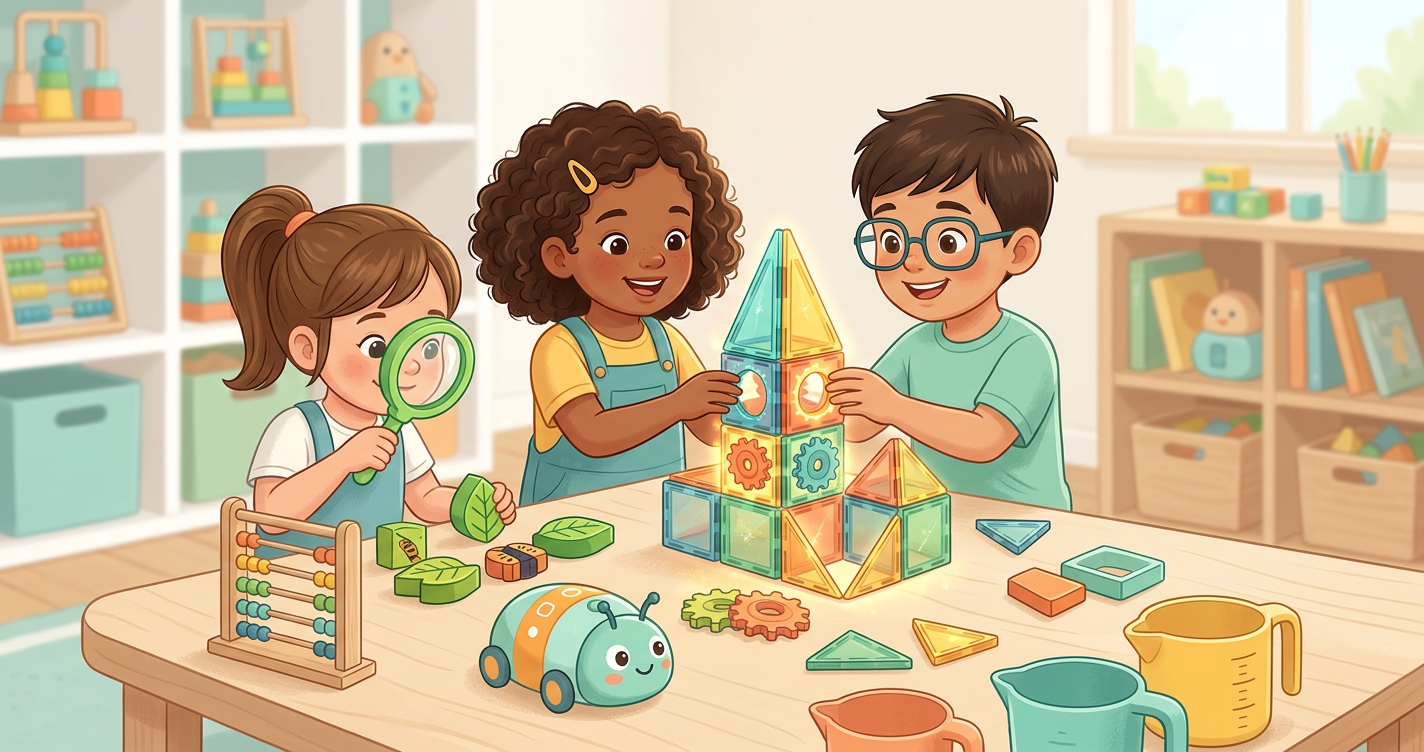
From classic wooden blocks to LEGO DUPLO, Magna-Tiles, and magnetic building sets, these toys are engineering powerhouses. They teach concepts of balance, stability, spatial reasoning, and design. Children learn about shapes, sizes, and how different components fit together to create a larger structure. The satisfaction of building something from scratch is immense!
Simple Science Kits & Exploration Tools (Science)
Think magnifying glasses, child-friendly microscopes, nature exploration kits (nets, bug viewers), and simple experiment sets. These tools encourage observation and investigation of the natural world. Children can explore textures, colors, and the properties of different materials, fostering a scientific mindset from a young age.
Early Coding & Robotics (Technology)
Don't let the terms scare you! For preschoolers, 'coding' means understanding sequencing and cause-and-effect. Toys like Code & Go Robot Mouse Activity Set, Botley the Coding Robot (simpler versions), or even simple path-planning games introduce foundational programming logic without screens. They teach children how to give commands and predict outcomes.
Manipulatives & Puzzles (Math)
Pattern blocks, counting bears, shape sorters, geoboards, and interlocking cubes are excellent for developing early math skills. They help children understand numbers, shapes, patterns, sorting, and measurement. These hands-on tools make abstract mathematical concepts tangible and fun.
Sensory Bins & Discovery Tables (All STEM)
While not traditional 'toys,' sensory bins (filled with rice, beans, water beads, sand, or natural materials) combined with scoops, funnels, and small containers offer endless STEM opportunities. Water tables and sand tables allow for exploration of physics (flow, displacement), measurement, and sensory play, touching on all aspects of STEM in a wonderfully tactile way.
Maximizing the STEM Play Experience
It's not just about the toys you provide; it's also about how you engage with them. Your involvement can significantly amplify the learning and enjoyment your child gains from STEM play.
- Play Together: Join in the fun! Your enthusiasm is contagious. Build a tower with them, explore a leaf under the magnifying glass, or try to figure out a puzzle together.
- Don't Direct, Facilitate: Resist the urge to show them the 'right' way. Instead, ask open-ended questions: "What do you think will happen if...?" "How could we make this stronger?" "Tell me about your invention!" Let them lead the discovery.
- Embrace Mistakes: Learning from trial and error is a core part of STEM. When something doesn't work, encourage them to try again, or think about why it didn't. Frame 'failures' as 'learning opportunities.'
- Connect to Real Life: Point out STEM concepts in your everyday world. "Look at how the engineer designed that bridge to be so strong!" "Let's count how many apples we have." "Why do you think the ice melts in the sun?" This helps children see the relevance of STEM all around them.
- Create a STEM-Friendly Environment: Make STEM toys easily accessible in your play space. Provide a dedicated area for building, experimenting, or exploring, fostering an atmosphere where curiosity is encouraged and celebrated.
Investing in STEM toys for preschoolers is more than just buying another plaything; it's an investment in your child's future. By harnessing their natural curiosity and providing opportunities for hands-on exploration, you're helping them develop crucial skills in critical thinking, problem-solving, creativity, and a genuine love for learning. So, go ahead, embrace the magic of STEM play, and watch your little one build a bright, inquisitive, and capable future, one block, one experiment, and one joyful discovery at a time!