Unlock Their Potential: The Power of STEM Toys for Preschoolers
As parents, we dream of a bright future for our children, filled with curiosity, innovation, and critical thinking. It might surprise you to learn that the seeds for these essential skills can be sown as early as preschool, right in their playroom! We’re talking about STEM toys – those incredible tools that transform playtime into a powerful learning experience. Far from being just a passing fad, engaging preschoolers with Science, Technology, Engineering, and Math (STEM) through play is a proven pathway to fostering a lifelong love for learning and problem-solving.
In a world increasingly driven by technological advancements and complex challenges, giving our youngest learners a head start in STEM isn't just beneficial; it's a game-changer. This isn't about turning your three-year-old into a rocket scientist overnight, but rather about nurturing their innate curiosity, encouraging exploration, and building foundational skills that will serve them well in school and beyond. Let's dive into how these simple yet profound toys can ignite your preschooler's mind and set them on a path to brilliance. this excellent wellness product
What Exactly Are STEM Toys and Why Start So Young?
Before we explore the magic, let's clarify what STEM truly means. STEM is an acronym for Science, Technology, Engineering, and Mathematics. When applied to toys, it refers to playthings specifically designed to introduce children to these concepts in an age-appropriate, hands-on, and engaging manner. Think beyond traditional blocks; imagine toys that encourage experimentation, building, and logical thinking.
But why focus on STEM during the preschool years (ages 3-5)? The answer lies in early brain development. Research consistently shows that a child's brain is incredibly malleable during these formative years, forming millions of neural connections every second. Introducing STEM concepts early helps to:
- Stimulate Curiosity: Preschoolers are naturally inquisitive. STEM toys capitalize on their "why?" questions and encourage them to explore how things work.
- Develop Critical Thinking: They learn to observe, predict, test, and analyze – fundamental scientific processes.
- Build Foundational Skills: From counting and sorting (Math) to understanding cause and effect (Science) and designing structures (Engineering), these toys lay crucial groundwork.
- Foster Problem-Solving: When a tower tumbles or a gear doesn't mesh, children learn to identify problems and strategize solutions.
- Encourage Persistence: Trying, failing, and trying again is a vital part of the learning process, building resilience.
Neuroscience confirms that rich, stimulating experiences in early childhood literally shape the architecture of the developing brain, making early STEM engagement a powerful investment in your child's cognitive future.
The Magnificent Benefits of Early STEM Engagement
The impact of STEM toys stretches far beyond just understanding numbers or shapes. They cultivate a holistic set of skills that are invaluable for all aspects of life:
Science: Nurturing Little Scientists
Science toys encourage observation, prediction, and simple experimentation. A magnifying glass can turn a backyard into a microscopic wonderland, while a simple water table teaches principles of buoyancy and flow. Children learn to ask questions like, "What will happen if...?" and develop an understanding of the natural world around them.
Technology: Understanding Their World
For preschoolers, "technology" isn't about screen time. It's about understanding how simple machines work, exploring cause and effect, and manipulating tools. Think about gears that turn, simple circuits that light up, or even construction toys with moving parts. These toys help children grasp the basic mechanics of how things function.
Engineering: Budding Builders and Designers
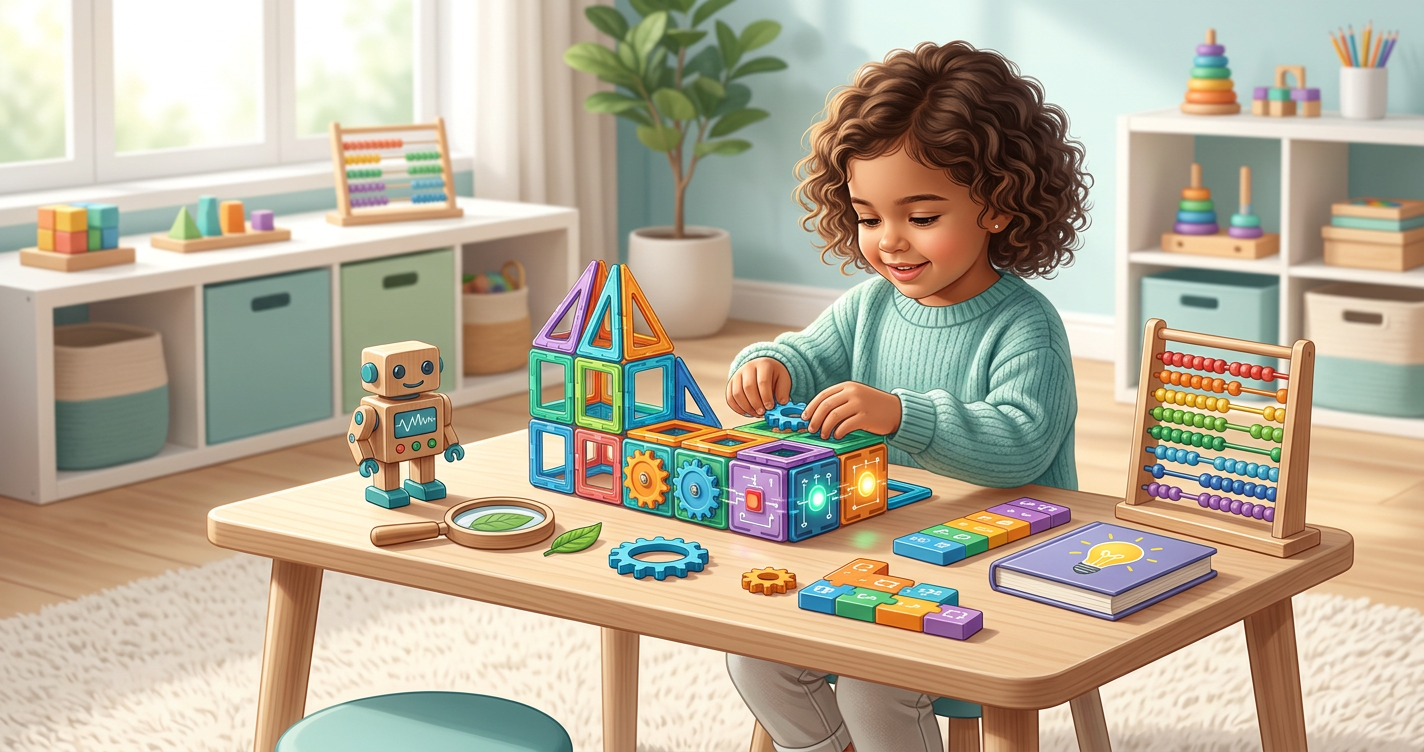
This is where creativity truly flourishes! Building blocks, magnetic tiles, interlocking gears, and construction sets are engineering powerhouses. Children learn about balance, stability, spatial reasoning, and design as they plan and construct their creations. They learn to visualize, problem-solve when structures collapse, and refine their designs.
Mathematics: Making Math Fun and Tangible
Math skills are woven into almost every STEM toy. Counting blocks, sorting shapes, recognizing patterns in a puzzle, measuring water in different containers – these activities make abstract mathematical concepts concrete and enjoyable. They build a strong numerical foundation without feeling like a chore.
Beyond the core STEM disciplines, these toys also significantly boost:
- Creativity and Imagination: Open-ended STEM toys allow children to invent their own designs and scenarios.
- Fine Motor Skills: Manipulating small pieces, connecting parts, and building intricate structures hones dexterity and hand-eye coordination.
- Language and Communication: Describing their creations, asking questions, and explaining their processes enhances vocabulary and communication skills.
- Collaboration and Social Skills: Many STEM activities are perfect for group play, teaching sharing, negotiation, and teamwork.
Choosing the Right STEM Toys for Your Preschooler (Age 3-5)
With so many options available, selecting the best STEM toys can feel overwhelming. Here are some key considerations to guide your choices:
- Age-Appropriateness: Always check the manufacturer's recommended age. Toys should be challenging enough to engage but not so complex that they cause frustration.
- Safety First: Ensure toys are made from non-toxic materials, have no small parts that could be choking hazards for younger preschoolers, and are durable.
- Open-Ended Play: Look for toys that can be used in multiple ways, encouraging creativity and different outcomes each time. Building blocks, magnetic tiles, and open-ended construction sets are excellent examples.
- Durability: Preschoolers can be tough on toys! Choose items that are well-made and can withstand enthusiastic play.
- Engagement Factor: Does the toy spark curiosity? Does it invite interaction and exploration?
Excellent Examples of Preschool STEM Toys:
- Building Blocks (wooden, LEGO DUPLO, Magna-Tiles): Perfect for engineering, spatial reasoning, and creative design.
- Gear Sets: Teach cause and effect, simple mechanics, and problem-solving.
- Simple Puzzles & Shape Sorters: Enhance spatial awareness, problem-solving, and pattern recognition.
- Science Kits for Kids (e.g., bug viewers, magnifying glasses, simple plant growing kits): Foster observation and a love for nature.
- Play-Doh with tools: Great for fine motor skills, understanding volume, and creative sculpting.
- Water Tables & Sand Play: Introduce physics concepts like buoyancy, volume, and flow in a fun, sensory way.
- Counting & Sorting Toys: Essential for early math skills.
Bringing STEM Play to Life: Tips for Parents
Having the right toys is just one part of the equation; how you engage with your child during play is equally important. Remember, you're a facilitator, not a director!
- Be Present and Observe: Watch what your child is doing. What are they trying to achieve? What challenges are they facing?
- Ask Open-Ended Questions: Instead of telling them what to do, ask questions like, "What do you think will happen if...?", "How could we make that stronger?", "Why do you think it fell?" This encourages critical thinking.
- Encourage Experimentation (and Failure): Let them try different approaches. It's okay if a tower falls or an experiment doesn't work as expected. These are valuable learning moments. "Oops, it fell! What did we learn? How can we try it differently next time?"
- Connect Play to the Real World: Point out how the concepts they're exploring in play relate to everyday life. "Look, just like our blocks, that building has a strong base!" or "The water goes down the drain, just like our water table!"
- Create a Dedicated Play Space: A clutter-free, accessible area encourages independent exploration.
- Join in the Fun: Play alongside them! Your enthusiasm is contagious and models a love for learning.
- Praise Effort, Not Just Outcome: Acknowledge their persistence, creativity, and problem-solving attempts, even if the final outcome isn't perfect.
Beyond Toys: Integrating STEM into Everyday Life
STEM learning isn't confined to the playroom. You can weave it into your daily routines:
- Cooking Together: Measuring ingredients (Math), observing changes (Science), and following recipes (sequencing, problem-solving).
- Gardening: Planting seeds, observing growth (Science), counting plants (Math).
- Nature Walks: Identifying plants and animals (Science), counting steps, finding patterns in leaves (Math).
- Simple Home Repairs: Observing tools, understanding how things fit together (Engineering).
- Counting and Sorting: Asking your child to count out plates for dinner or sort laundry by color.
Everyday moments are rich with opportunities to explore STEM concepts, making learning a natural and continuous part of their world.
Building a Foundation for Future Innovators
Investing in STEM toys and integrating STEM principles into your preschooler's life is one of the most powerful ways to nurture their natural curiosity and prepare them for a future that demands adaptable, creative, and critical thinkers. It's not about pushing them into a specific career path, but about fostering a mindset of exploration, resilience, and ingenuity.
By transforming playtime into a laboratory of discovery, you're not just buying toys; you're investing in a foundation of skills that will empower your child to confidently navigate challenges, embrace innovation, and ultimately, build their own brilliant future. So, let the building begin, let the experiments flow, and watch your little innovator soar!