
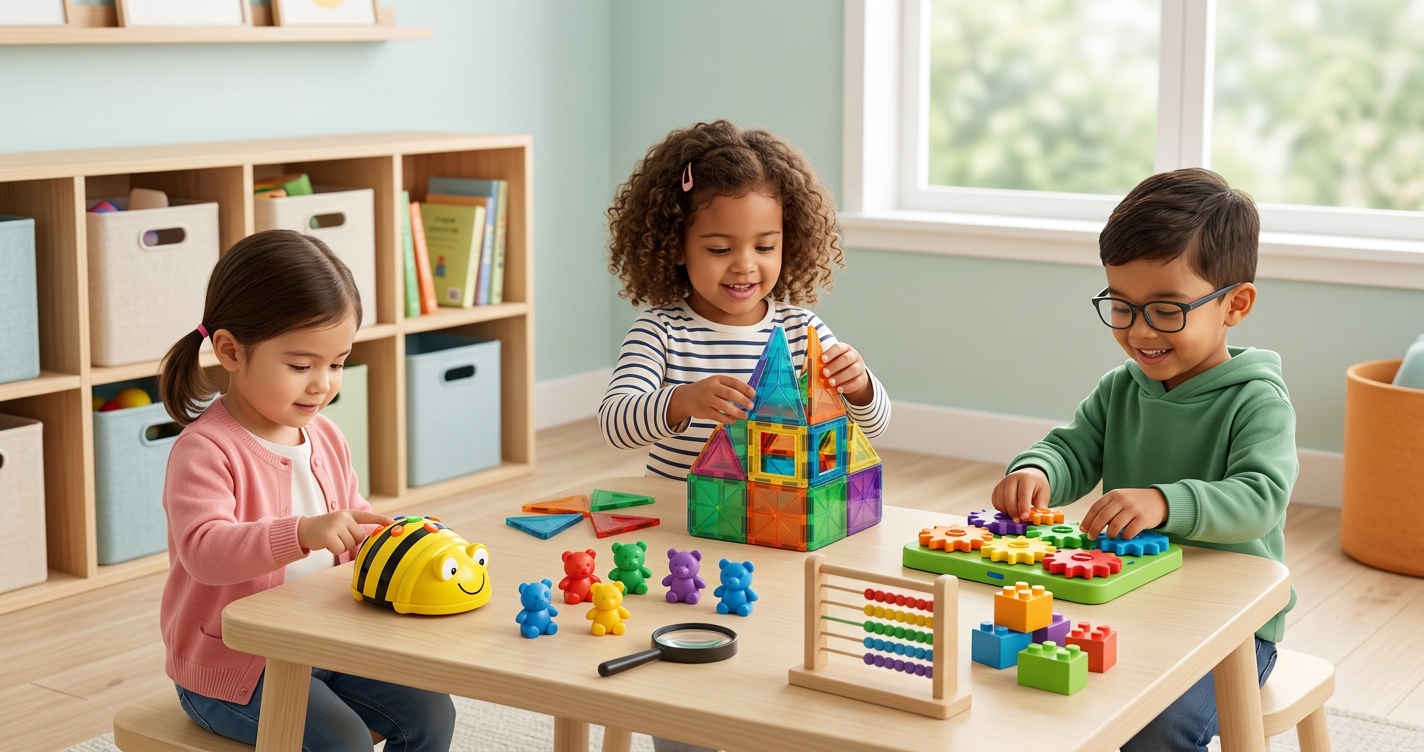
As parents, we all want the best for our children, especially when it comes to their development and future success. In today’s rapidly evolving world, skills in Science, Technology, Engineering, and Math (STEM) are more crucial than ever. But here’s a secret: you don’t have to wait until your child is in school to start fostering these vital abilities! Early exposure to STEM concepts through play can lay a powerful foundation for critical thinking, problem-solving, and a lifelong love of learning. And the best part? It can be incredibly fun!
This guide is your friendly, evidence-based roadmap to understanding and choosing the best STEM toys for your preschooler. We’ll explore why these toys are so important, what to look for, and how you can maximize their learning potential to help nurture your little one into a future innovator. this excellent toy product
Why Early STEM Education Matters More Than You Think
You might hear “STEM” and picture complex equations or advanced robotics, but for preschoolers, STEM is all about hands-on exploration and discovery. Research consistently shows that the early years are a critical window for brain development, where children form the neural connections that underpin future learning. Introducing STEM concepts through play during this period offers profound benefits:
- Boosts Cognitive Development: STEM toys challenge young minds to think, reason, and understand cause and effect.
- Enhances Problem-Solving Skills: Children learn to experiment, try different approaches, and overcome challenges – essential skills for life.
- Fosters Curiosity and Exploration: They encourage children to ask “why?” and “how?” and to investigate the world around them.
- Develops Fine Motor Skills: Manipulating blocks, gears, and other components refines hand-eye coordination and dexterity.
- Builds Confidence: Successfully solving a puzzle or building a structure gives children a sense of accomplishment and encourages persistence.
Experts like Dr. Sandra Calvert, a professor of psychology at Georgetown University, emphasize that play is the primary way young children learn about the world. Integrating STEM into play makes learning natural and engaging, rather tremendously beneficial for long-term academic and personal growth.
What Exactly Are STEM Toys for Preschoolers?
Forget intimidating gadgets! For preschoolers, STEM toys are simply tools that inspire inquiry, experimentation, and construction. They aren't about rote memorization but about encouraging children to think like scientists, engineers, and mathematicians through play.
Good STEM toys for this age group are typically:
- Open-Ended: They can be used in multiple ways, encouraging creativity and imaginative play. Think building blocks, not single-use electronic gadgets.
- Hands-On: They require physical interaction – stacking, sorting, connecting, experimenting.
- Age-Appropriate: Safe, durable, and designed for small hands and developing minds.
- Inspiring Exploration: They prompt questions, encourage hypothesis testing, and allow for trial and error.
- Connective to Real-World Concepts: Even simple toys can introduce ideas like balance, gravity, patterns, and sequences.
They are not necessarily branded as “STEM” but rather possess qualities that naturally align with scientific inquiry, technological understanding, engineering design, and mathematical thinking.
The Core Benefits: How STEM Toys Boost Development
Fostering Curiosity and Exploration
STEM toys transform everyday play into an adventure of discovery. When a child experiments with different materials, observes how they interact, or uses a magnifying glass to examine a leaf, they're engaging in fundamental scientific inquiry. This sparks a natural curiosity about the world and encourages them to ask questions and seek answers, just like a scientist.
Developing Problem-Solving and Critical Thinking
Building a tower that doesn't fall, figuring out how gears connect to make something move, or solving a simple puzzle are all exercises in problem-solving. STEM toys challenge children to identify a goal, strategize, try different solutions, and learn from their mistakes. This iterative process of trial and error is crucial for developing robust critical thinking skills.
Enhancing Fine Motor Skills and Hand-Eye Coordination
Many STEM toys involve manipulating small parts, fitting pieces together, or drawing intricate patterns. Activities like stacking blocks, connecting magnetic tiles, or using simple tools require precision and control, which significantly refines fine motor skills and hand-eye coordination – essential for writing, drawing, and countless other daily tasks.
Building Foundational Math Concepts
From counting and sorting blocks by color or size to recognizing patterns and understanding spatial relationships, STEM toys naturally integrate early mathematical concepts. Children learn about quantity, measurement, geometry, and sequencing without even realizing they’re doing math. For instance, building with blocks teaches about balance, symmetry, and three-dimensional space.
Sparking Creativity and Imagination
While often associated with logic, STEM toys, especially open-ended ones, are powerful vehicles for creativity. When a child builds a unique structure, designs a new path for a toy car, or invents a story around their scientific discovery, they are engaging their imagination. There’s no single “right” way to play, which empowers children to express their unique ideas.
Top Categories of STEM Toys for Little Learners (with examples!)
Here are some fantastic categories of STEM toys perfect for preschoolers, along with examples that inspire genuine learning:
- Building Blocks & Construction Sets: These are the quintessential STEM toys. From classic wooden blocks to LEGO DUPLO, Magna-Tiles, or even simple interlocking bricks, they teach engineering principles, spatial reasoning, balance, and early math concepts through stacking, connecting, and creating. They encourage planning and problem-solving as children design and build.
- Science Exploration Kits: Simple kits that include magnifying glasses, bug viewers, child-safe binoculars, or even a prism can ignite a passion for science. Nature exploration sets encourage observation and understanding of the natural world. These toys foster curiosity and observational skills.
- Early Coding & Robotics: Don't let the names intimidate you! For preschoolers, this means screen-free toys like Code & Go Robot Mouse Activity Set or simple button-press robots that introduce sequencing, logic, and directional commands. They teach children that actions have consequences and how to plan a series of steps to achieve a goal.
- Math & Logic Games: Toys like pattern blocks, sorting activities (by color, shape, size), counting games, or simple puzzles enhance mathematical understanding and logical reasoning. They help children recognize patterns, compare quantities, and develop early number sense.
- Sensory & Manipulative Toys: While not always explicitly labeled STEM, materials like Play-Doh, kinetic sand, or water tables offer incredible opportunities for scientific exploration. Children learn about properties of matter, volume, cause and effect (e.g., mixing colors, pouring water), and fine motor control.
Choosing the Right STEM Toy: A Parent's Guide
With so many options, how do you pick the best STEM toy for your child? It's not about the most expensive or high-tech gadget; it's about engagement and potential for learning. Here are some key considerations:
- Age-Appropriateness: Always check recommended age ranges for safety (choking hazards!) and complexity. A toy too advanced will frustrate, while one too simple will bore.
- Open-Ended Play Potential: Can the toy be used in multiple ways? Does it encourage imagination or dictate a single outcome? Open-ended toys offer more longevity and learning.
- Durability and Safety: Preschoolers are tough on toys! Choose sturdy, non-toxic materials.
- Align with Child's Interests: If your child loves dinosaurs, look for dinosaur-themed building sets or science kits. Their existing interests will naturally draw them in.
- Avoid Over-Stimulation: Sometimes simpler is better. Toys with too many flashing lights, sounds, or pre-programmed actions can limit imaginative play.
- Look for “Grow-With-Me” Toys: Some toys, like high-quality building blocks, can be used in simple ways by toddlers and in increasingly complex ways as children grow.
Remember, the best toy is one your child genuinely enjoys and wants to play with repeatedly, as sustained engagement is key to deeper learning.
Maximizing the Learning: How Parents Can Engage
A STEM toy is a fantastic tool, but your involvement as a parent is the secret ingredient that truly unlocks its potential. You don't need to be a scientist or engineer; just bring your enthusiasm and curiosity!
- Play Alongside Them: Sit down and build with them, or ask if you can join their scientific experiment. Your presence validates their play and provides opportunities for interaction.
- Ask Open-Ended Questions: Instead of just observing, ask questions like, “What do you think will happen if we add this piece?” “How can we make this tower stronger?” “Why do you think the ball rolled faster on this surface?” This encourages critical thinking and prediction.
- Encourage Experimentation (and Failure!): Let them try different approaches, even if you know they won’t work. Learning from mistakes is a crucial part of the scientific process. Celebrate their efforts, not just the outcome.
- Connect Play to the Real World: Point out how the bridge they built is like the one you drive over, or how the patterns they made are similar to those on a rug. This helps them see the relevance of STEM in everyday life.
- Create a Dedicated Play Space: Having a designated area for building, experimenting, or creating can encourage more focused play.
- Don't Force It: If your child isn't interested in a particular toy today, that's okay! Interest can ebb and flow. Follow their lead and introduce toys when they seem receptive.
Your encouragement and interaction transform a simple toy into a powerful learning experience, fostering a growth mindset and a love for discovery.
Conclusion
Investing in STEM toys for your preschooler is more than just buying another plaything; it's investing in their future. By providing opportunities for hands-on exploration, problem-solving, and creative thinking, you're equipping them with skills that will serve them well in school and throughout life. Remember, the goal isn't to create child prodigies, but to nurture curious, confident, and resilient learners who aren't afraid to ask questions, experiment, and innovate.
So go ahead, explore the wonderful world of STEM toys. Watch your child's eyes light up with discovery, celebrate their small victories, and enjoy being a part of their incredible journey as they build, create, and imagine their way to a brighter future!


