
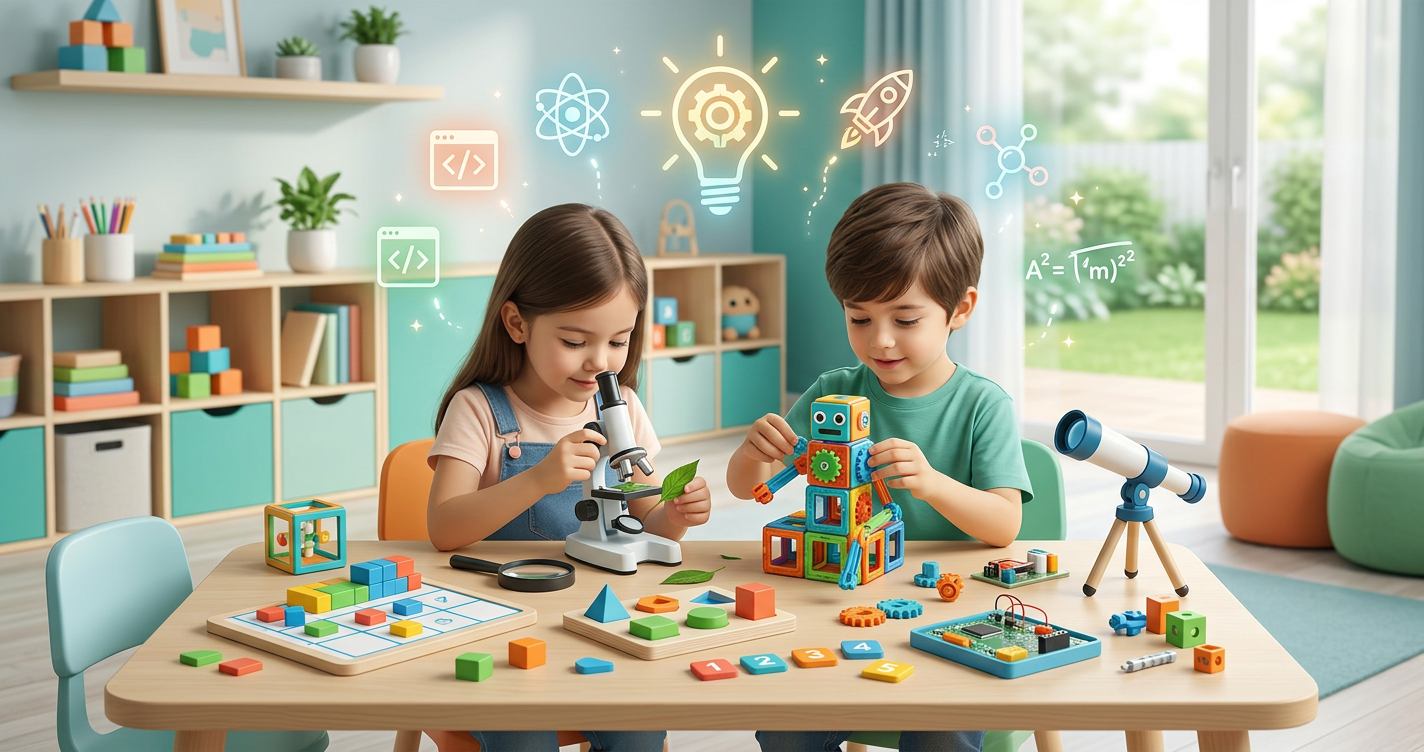
Unlocking Brilliance: How Educational Toys Ignite STEM Skills in Young Minds
In a world that’s constantly evolving with technological advancements, preparing our children for the future means equipping them with more than just basic knowledge. It means fostering a spirit of curiosity, problem-solving, and innovation from a very young age. This is where educational toys, particularly those focused on Science, Technology, Engineering, and Mathematics (STEM), become truly invaluable tools. They’re not just about fun and games; they’re powerful catalysts for developing critical thinking, creativity, and a lifelong love for learning.
As parents, educators, and caregivers, we all want to give our children the best start. The good news is that you don't need a fancy laboratory or complex textbooks to introduce these vital concepts. The secret lies in the magic of play, and how thoughtfully chosen educational toys can transform everyday moments into profound learning experiences. Let's explore how these incredible tools can ignite STEM brilliance in the youngest of minds, setting them on a path to discovery and success. this excellent toy product
What Exactly Are STEM Skills and Why Do They Matter Early On?
Before we dive into the toys, let’s clarify what STEM truly encompasses. It's an acronym for four distinct yet interconnected disciplines:
- Science: Understanding the natural world through observation, experimentation, and critical analysis.
- Technology: Applying scientific knowledge to create practical tools and solutions, from simple machines to complex computers.
- Engineering: Designing, building, and maintaining structures, systems, and processes to solve real-world problems.
- Mathematics: The language of numbers, patterns, and logic, essential for problem-solving in all STEM fields.
Why is early exposure to STEM so crucial? Research consistently shows that a child's brain develops rapidly during the early years, forming foundational connections that impact future learning. Introducing STEM concepts through play taps into a child's natural curiosity, encouraging them to ask "why?" and "how?". This early engagement builds a strong foundation for future academic success, cultivates a growth mindset, and develops essential skills like logical reasoning, perseverance, and creative problem-solving – skills that are invaluable in any career path, not just STEM-related ones. It’s about building thinkers, not just learners.
The Magic of Play: How Educational Toys Build STEM Foundations
Children learn best when they are actively engaged and having fun, and play is their primary mode of exploration. Educational toys harness this innate drive, offering structured yet open-ended opportunities for discovery. Unlike passive entertainment, these toys encourage children to interact, manipulate, experiment, and imagine.
Think about it: when a child stacks blocks and they tumble, they’re learning about gravity and structural integrity (Science and Engineering). When they figure out how to make a toy car move using a simple lever, they're engaging with basic physics (Technology and Science). Each trial, error, and eventual success builds neural pathways and reinforces learning in a way that rote memorization simply cannot. This isn't just about teaching facts; it's about nurturing an investigative mindset, fostering resilience, and showing children that learning is an exciting, hands-on adventure.
Deconstructing STEM: Toys for Each Pillar
Let's look at how specific types of educational toys can support each component of STEM, making abstract concepts tangible and engaging for young children.
Science: Fostering Curiosity and Observation
Science is all about asking questions and exploring the world around us. Toys that encourage observation, experimentation, and understanding cause-and-effect are perfect for budding scientists.
- Magnifying Glasses & Nature Explorer Kits: Encourage children to get up close with leaves, bugs, rocks, and flowers. This promotes keen observation skills and sparks curiosity about the natural world.
- Simple Science Kits: Kits for making slime, growing crystals, or creating a mini volcano introduce basic chemistry and physical reactions in a safe, exciting way.
- Prism Sets & Color Filters: Help children explore light, color, and how they interact, laying groundwork for optics.
- Sensory Bins: Filled with different textures, water, sand, or natural elements, these bins allow for tactile exploration and simple experiments.
These toys teach children to notice details, form hypotheses, and understand that actions have predictable outcomes, all while having a blast.
Technology: Introducing Basic Concepts and Problem-Solving
While we might think of technology as screens and gadgets, for young children, it’s about understanding simple mechanisms, cause-and-effect, and logical sequences.
- Simple Coding Robots: Toys like Code-a-Pillar, Cubetto, or Botley introduce foundational coding concepts through physical play. Children learn to program a sequence of movements, developing logical thinking and problem-solving skills without needing a screen.
- Circuit Kits: Beginner-friendly kits with oversized pieces allow children to build simple circuits that light up, make sounds, or power small motors, teaching basic electrical engineering.
- Interactive Learning Tablets (with curated apps): While screen time should be limited, certain educational apps designed for young children can introduce concepts like patterns, sequencing, and basic problem-solving in an interactive format. Focus on apps that require active engagement rather than passive viewing.
- Walkie-Talkies & Intercom Systems: Introduce basic communication technology and the concept of transmitting and receiving signals.
These toys help demystify technology, showing children that it’s a tool for creation and communication, and that they can be active participants in how it works.
Engineering: Building, Designing, and Innovating
Engineering is all about design, construction, and problem-solving. Toys that allow children to build, create, and adapt are perfect for inspiring future engineers.
- Building Blocks (Wooden, LEGOs, Duplos): The quintessential engineering toy! Children learn about balance, stability, spatial reasoning, and structural integrity as they construct towers, houses, or imaginary worlds.
- Magnetic Tiles: These versatile tiles allow for 2D and 3D construction, introducing geometry, magnetism, and advanced structural design principles.
- K'nex & Gears Sets: More complex construction toys that teach about connections, movement, and mechanical principles. Children can build anything from simple machines to elaborate roller coasters.
- Marble Runs: Designing and assembling a track for marbles to roll down teaches physics, gravity, and problem-solving as children adjust angles and obstacles.
- Cardboard Boxes & Recycled Materials: The ultimate open-ended engineering challenge! Encourage children to transform these materials into rockets, forts, or vehicles, fostering immense creativity and resourcefulness.
Through building, children learn to plan, execute, test, and revise their designs, embracing the engineering design process from an early age.
Mathematics: Making Numbers and Patterns Fun
Mathematics forms the bedrock of all STEM fields. Educational toys can make numbers, shapes, and patterns engaging and intuitive.
- Shape Sorters & Puzzles: These classic toys teach shape recognition, spatial awareness, and problem-solving.
- Counting Bears & Abacus: Hands-on tools for learning number recognition, one-to-one correspondence, addition, and subtraction.
- Pattern Blocks & Geoboards: Excellent for exploring geometric shapes, symmetry, and creating intricate patterns, introducing early algebraic thinking.
- Measuring Cups & Spoons (for play kitchens/sandboxes): Introduce concepts of volume, quantity, and comparison in a playful context.
- Board Games & Card Games: Many games involve counting, strategy, probability, and logical deduction, making math fun and social.
By interacting with these toys, children develop a concrete understanding of mathematical concepts, making the transition to abstract math much smoother later on.
Beyond the Basics: Developing Critical Thinking and Problem-Solving
While breaking down STEM into its individual components is helpful, the true power of these educational toys lies in their holistic impact. They don't just teach discrete skills; they cultivate an overarching approach to learning and life. When a child is engrossed in building a complex structure, they are not only practicing engineering but also developing patience, persistence, and the ability to think critically when something doesn't go as planned. They learn to identify a problem, brainstorm solutions, test them out, and adapt their approach – skills that are universally valuable.
These toys also encourage creativity, as children are often prompted to imagine new uses for materials or design unique solutions. They foster resilience, teaching children that mistakes are part of the learning process and that trying again often leads to success. Ultimately, STEM educational toys are about empowering children to become confident, adaptable, and innovative thinkers who are ready to tackle the challenges of tomorrow.
Choosing the Right STEM Educational Toys for Your Child
With so many options available, how do you pick the best STEM toys for your child? Here are a few friendly tips:
- Consider Age-Appropriateness: Always check the recommended age range. Toys that are too complex can lead to frustration, while those that are too simple might not engage them sufficiently.
- Prioritize Open-Ended Play: Look for toys that can be used in multiple ways and encourage imaginative play, rather than those with a single, predetermined outcome. Open-ended toys foster greater creativity and problem-solving.
- Follow Your Child's Interests: If your child loves animals, look for science kits related to biology or nature. If they enjoy building, invest in different types of construction sets. Their natural curiosity is your best guide.
- Think Durability and Safety: Choose well-made toys from reputable brands that can withstand enthusiastic play and meet safety standards.
- Encourage Interaction: The best STEM toys often provide opportunities for parents or caregivers to join in the fun, asking questions, offering guidance, and celebrating discoveries together.
Integrating STEM Toys into Everyday Play
Bringing STEM into your child's life doesn't require a rigid schedule or formal lessons. It's about seamlessly weaving these learning opportunities into their daily play routine. Here’s how you can make it happen:
- Don't Force It: Let your child lead the play. Introduce the toy and allow them to explore it at their own pace.
- Ask Open-Ended Questions: Instead of telling them what to do, ask questions like, "What do you think will happen if...?" or "How could we make this stronger?" This encourages critical thinking.
- Connect to Real-World Scenarios: Point out how the concepts they're playing with apply to everyday life. "Look, the bridge we're driving over is like the one you built with your blocks!"
- Create a "STEM Play Zone": Designate a small area where STEM toys are easily accessible, inviting spontaneous exploration.
- Embrace Mess and Experimentation: Some of the best STEM learning involves a bit of mess. Embrace it as part of the discovery process!
Remember, the goal isn't to create a child prodigy, but to cultivate a curious mind that enjoys learning and isn't afraid to experiment.
Conclusion
Educational toys are far more than just playthings; they are powerful gateways to a future of innovation and discovery. By thoughtfully incorporating STEM-focused toys into your child's playtime, you're not just providing entertainment – you're nurturing their innate curiosity, building foundational skills in science, technology, engineering, and mathematics, and empowering them to become confident, creative, and resilient problem-solvers. So, go ahead, embrace the power of playful learning, and watch your child's brilliance truly ignite!


