
In a world increasingly shaped by innovation and discovery, equipping our children with the skills to thrive isn't just a goal—it's a necessity. We often hear about STEM (Science, Technology, Engineering, and Mathematics) and its importance for future careers, but how do we introduce these complex concepts to our youngest learners in a way that's engaging, natural, and fun? The answer, surprisingly simple yet profoundly effective, lies in the power of educational toys.
Far from being mere distractions, the right educational toys are powerful tools that transform playtime into a vibrant learning laboratory. They don't just entertain; they ignite curiosity, foster problem-solving, and lay down the foundational building blocks for critical thinking and creativity. This post will explore how these incredible toys nurture vital STEM skills in young children, setting them on a path toward lifelong learning and future success. this excellent toy product
What Exactly Are STEM Skills and Why Do They Matter So Early On?
STEM isn't just a collection of academic subjects; it's a mindset—a way of approaching the world with curiosity, inquiry, and a drive to solve problems. Let's break it down:
- Science: Understanding the natural world through observation, experimentation, and discovery.
- Technology: Using tools and systems to solve problems and achieve goals.
- Engineering: Designing, building, and creating solutions to practical challenges.
- Mathematics: Understanding numbers, patterns, shapes, and logical reasoning.
You might think these are advanced topics, but the fundamental principles of STEM are accessible even to toddlers. Exposing children to STEM early on isn't about teaching them calculus in kindergarten; it's about nurturing their innate curiosity, encouraging them to ask "why" and "how," and developing their abilities to think critically and creatively. Research consistently shows that early exposure to STEM concepts improves cognitive development, enhances problem-solving skills, and can significantly influence a child's interest and proficiency in these fields later in life. It's about building a solid foundation, brick by playful brick, for future learning and innovation.
Science in Play: Exploring the World Around Us
Science is all about asking questions and exploring answers, and children are natural-born scientists! Educational toys provide fantastic avenues for scientific discovery:
- Observation and Inquiry: Simple magnifying glasses or bug viewers encourage children to closely examine leaves, insects, or even their own fingerprints. This fosters keen observation skills and sparks questions about the natural world.
- Cause and Effect: Toys like water tables with various pourers, spinners, and dams teach basic physics principles. What happens when you block the flow? How does water displace objects? These hands-on experiences are invaluable for understanding cause and effect.
- Classification and Sorting: Shape sorters, color-matching games, and animal figurines help children categorize objects based on attributes, a foundational skill for scientific classification.
Through these playful interactions, children aren't just memorizing facts; they're actively experimenting, formulating hypotheses (even if unconsciously), and drawing conclusions. They're learning the scientific method through direct, joyful experience.
Technology & Engineering: Building, Designing, and Innovating
While "technology" might conjure images of screens, in early childhood, it refers to tools and systems designed to solve problems. Engineering is the process of designing and building those solutions. Educational toys excel in these areas:
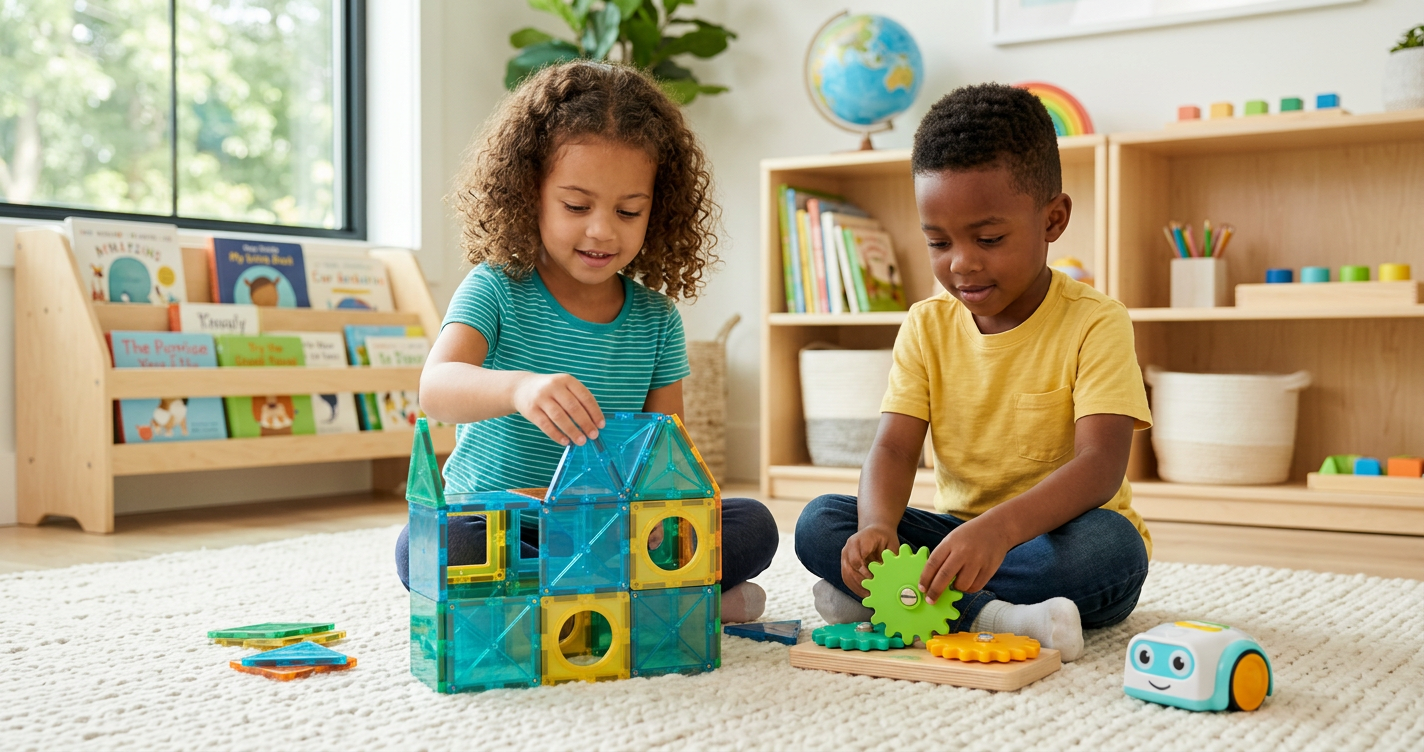
- Construction Sets: Classic building blocks, LEGOs, Magna-Tiles, and K'nex are engineering powerhouses. Children learn about balance, stability, spatial reasoning, and structural integrity as they construct towers, bridges, and fantastical creations. They plan, execute, and troubleshoot when their structures inevitably tumble.
- Simple Machines: Toys featuring gears, levers, pulleys, or ramps introduce the concepts of simple machines, demonstrating how they can make work easier. Think about toy cranes or marble runs.
- Early Robotics & Coding: For slightly older preschoolers and early elementary children, age-appropriate coding robots (like Bee-Bot or Code & Go Robot Mouse) introduce fundamental programming concepts without screens. They learn sequencing, algorithms, and problem-solving as they program their robot to navigate a maze. This demystifies technology and builds logical thinking.
These toys encourage iterative design—trying, failing, adjusting, and trying again—a core principle of engineering and innovation. They empower children to be creators, not just consumers, of technology.
Math Made Fun: Numbers, Shapes, and Logic
Math is woven into the fabric of our world, and educational toys make its introduction seamless and enjoyable:
- Counting and Number Sense: Counting toys, abacuses, and games that involve dice or quantity recognition help children develop early number sense. They learn one-to-one correspondence and the concept of quantity in a tangible way.
- Shapes and Spatial Reasoning: Shape sorters, puzzles, and pattern blocks introduce geometric shapes and spatial relationships. Children learn to identify shapes, understand how they fit together, and develop visual-spatial skills crucial for geometry and problem-solving.
- Patterns and Sequencing: Beading sets, pattern blocks, and musical instruments encourage children to recognize, create, and extend patterns—a fundamental mathematical concept that underpins algebra and logical thinking.
- Measurement and Comparison: Sand and water play, alongside simple rulers or measuring cups, introduces concepts of volume, length, and comparison (e.g., "which tower is taller?").
Through these activities, children aren't just memorizing numbers; they're developing a deep, intuitive understanding of mathematical concepts that will serve them well throughout their academic journey.
Beyond Core STEM: Nurturing Essential Soft Skills
The benefits of educational toys extend beyond the explicit teaching of STEM subjects. They are powerful catalysts for developing crucial soft skills that are vital for success in any field:
- Critical Thinking and Problem-Solving: Every time a child tries to fit a block into a space, build a stable tower, or figure out how a toy works, they are engaging in critical thinking and problem-solving.
- Creativity and Imagination: Open-ended STEM toys, especially construction sets, encourage children to imagine, design, and create, fostering boundless creativity.
- Perseverance and Resilience: When a tower tumbles or a puzzle piece doesn't fit, children learn the importance of trying again, adapting their approach, and not giving up—essential life lessons.
- Collaboration and Communication: Many STEM toys are best enjoyed with others, promoting teamwork, sharing ideas, and communicating effectively.
These skills are not just "nice-to-haves"; they are fundamental to navigating a complex world and thriving in future roles that will demand adaptability and innovative thinking.
Choosing the Right Educational Toys: A Parent's Guide
With so many options, how do you select the best STEM-focused educational toys for your child? Here are some friendly, evidence-based tips:
- Age-Appropriateness: Always check the recommended age range. Toys too simple will bore, while those too complex will frustrate.
- Open-Ended Play: Prioritize toys that can be used in multiple ways and encourage imaginative, self-directed play. Blocks, art supplies, and simple science kits are excellent examples. Avoid toys that do all the "thinking" for the child.
- Durability and Safety: Ensure toys are well-made, non-toxic, and free from small parts that could be choking hazards for young children.
- Engagement Factor: Does the toy genuinely capture your child's interest? The best learning happens when children are intrinsically motivated and having fun.
- Balance: A healthy toy collection includes a mix of STEM, creative, physical, and social play items.
Remember, the goal isn't to turn your playroom into a classroom, but to seamlessly integrate learning opportunities into everyday fun.
Making Play Purposeful: Tips for Parents
Your involvement is key to maximizing the learning potential of educational toys. You don't need to be a STEM expert; just be an enthusiastic playmate and guide:
- Ask Open-Ended Questions: Instead of "What color is this?", try "What do you think will happen if...?" or "How could we make this stronger?"
- Observe and Follow Their Lead: Watch what fascinates your child and offer related toys or activities. If they love building, suggest a challenge like "Can you build a bridge for this car?"
- Encourage Experimentation: Let them try different approaches, even if they don't immediately succeed. Celebrate the effort and the learning process, not just the outcome.
- Provide Opportunities for Repetition: Children learn through repetition. Don't worry if they play with the same toy in similar ways; each interaction solidifies understanding.
- Connect to Real Life: Point out how STEM concepts appear in the real world—the engineering of a bridge, the patterns in nature, or the technology in everyday devices.
Your presence, encouragement, and genuine interest make all the difference, transforming simple playtime into profound learning experiences.
Conclusion: Play Your Way to a Brighter Future
Educational toys are far more than just playthings; they are foundational tools that unlock a child's innate potential for curiosity, innovation, and critical thinking. By embracing the power of play, we can introduce young children to the wonders of Science, Technology, Engineering, and Mathematics in a way that is joyful, intuitive, and deeply impactful. We're not just preparing them for future careers; we're nurturing well-rounded individuals who are confident, creative, and equipped to solve the challenges of tomorrow.
So, let's empower our children to build, explore, question, and discover. Let's make playtime purposeful, and watch as they build not just towers and robots, but the very foundations of their brilliant futures. The journey to becoming tomorrow's innovators begins today, one playful STEM toy at a time.


